

How Heat and Wildfire Smoke Shorten AC Life
How Sierra Foothill Heat and Wildfire Smoke Shorten AC Life Expectancy — What You Need to Know. How sierra foothill heat and wildfire smoke shorten AC life…
How Sierra Foothill Heat and Wildfire Smoke Shorten AC Life Expectancy — What You Need to Know
How sierra foothill heat and wildfire smoke shorten AC life expectancy is a real and urgent concern for homeowners in this region. In short, extreme summer heat forces your AC to work harder and longer, while wildfire smoke coats internal components with corrosive particles and gases — together, these two stressors can cut years off your system's life.
Here's a quick breakdown of the main ways heat and smoke damage your AC:
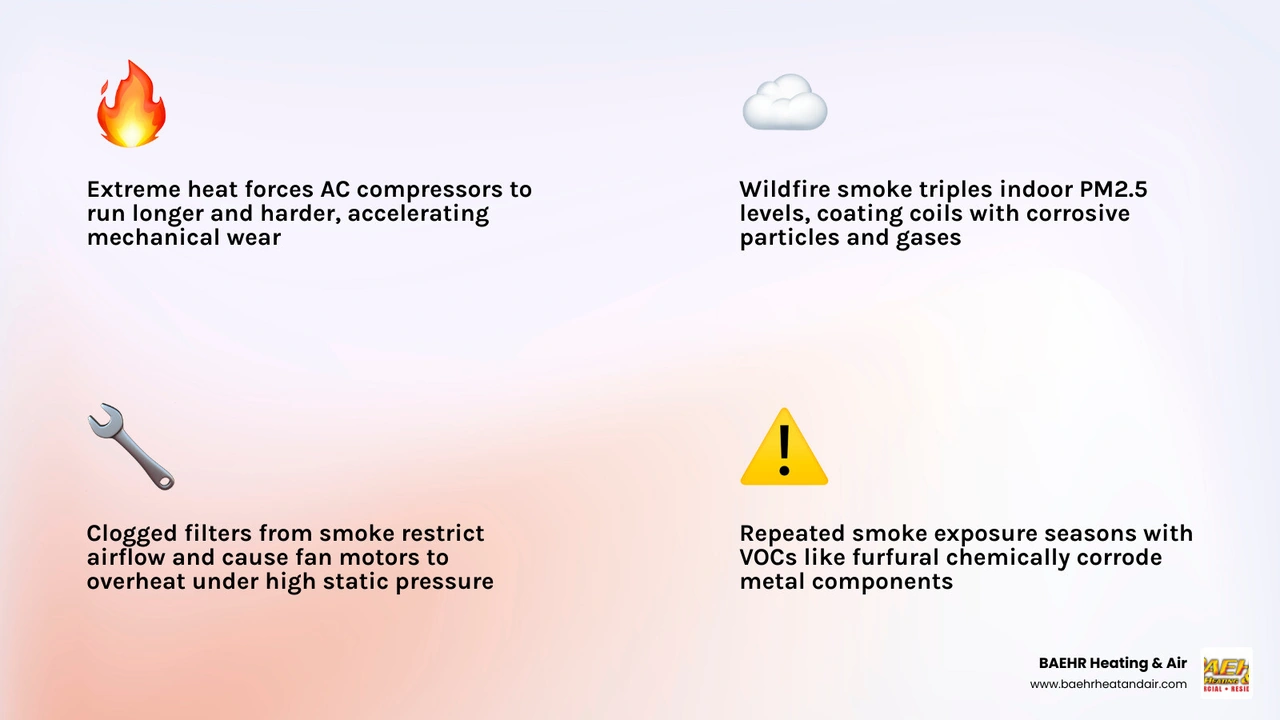
- Compressor overload — High ambient temperatures push compressors to their limits for extended periods, accelerating wear
- Coil contamination — Smoke particles and corrosive gases coat evaporator and condenser coils, reducing heat transfer efficiency
- Filter clogging — Wildfire smoke dramatically increases particulate loading, forcing filters to restrict airflow far sooner than normal
- Fan motor strain — Restricted airflow from clogged filters raises static pressure, stressing blower and condenser fan motors
- Chemical corrosion — VOCs and organic compounds in smoke (like furfural) can corrode metal components over repeated exposure seasons
The Sierra foothills face a particularly harsh combination. Summers regularly push temperatures into triple digits, and wildfire smoke has become a near-annual reality rather than a rare exception. Research shows that even indoors, mean PM2.5 concentrations nearly triple during wildfire events — meaning your AC system is pulling heavily contaminated air through its components for days or even weeks at a time. As wildfires across California grow larger and burn at higher severity, this compounding stress on residential cooling systems is only expected to worsen.
For Sierra foothill homeowners, understanding this dual threat is the first step toward protecting your investment and staying cool when it matters most.
The Science Behind How Sierra Foothill Heat and Wildfire Smoke Shorten AC Life Expectancy
To understand how our local climate impacts your home's cooling system, we have to look at the chemistry and physics of what happens when extreme heat meets heavy particulate pollution. In communities like Grass Valley, Nevada City, and Auburn, summer temperatures frequently soar. At the same time, the surrounding Sierra Nevada mixed conifer forests are highly prone to both wildfires and necessary prescribed burns.
When biomass burns, it doesn't just produce gray ash; it releases a complex chemical cocktail. This mixture includes fine particulate matter (PM2.5), black carbon (BC), organic carbon (OC), and a host of volatile organic compounds (VOCs).
Research from the Blodgett Forest Research Station—located right in our Sierra Nevada backyard—has analyzed these emissions in detail. During forest fires, the combustion process transitions between two phases:
- Flaming combustion: Highly efficient, producing more black carbon (soot) and carbon dioxide.
- Smoldering combustion: Low-temperature, oxygen-starved burning that occurs in the duff and litter layers of the forest floor. This phase produces massive quantities of organic carbon and VOCs.
Among these VOCs, furfural—a dominant chemical compound released during biomass burning—shows incredibly high mixing ratios in smoke samples. When these organic compounds, gases, and fine particulates are drawn into your HVAC system, they create a sticky, acidic film on sensitive metal surfaces. Combined with the thermal stress of operating in 100°F+ weather, this chemical exposure accelerates the physical degradation of your system.
Over time, this continuous chemical and physical assault can severely decrease your system's operational lifespan. To learn more about how long your system should last under normal conditions, check out our guide on Understanding the Lifespan of Your AC.
Particulate Matter and Corrosive Gases: How Sierra Foothill Heat and Wildfire Smoke Shorten AC Life Expectancy at the Component Level
When wildfire smoke blankets areas like Penn Valley, Lake Wildwood, or Lincoln, your air conditioner becomes the primary line of defense for your indoor air quality. However, this defense comes at a steep cost to the individual components of the system:
- Evaporator Coils: Located inside your home, these coils are cold and damp because they extract moisture from the air. When PM2.5 and organic carbon slip past standard filters, they stick to the wet copper and aluminum surfaces of the coil. This creates a grimy insulating barrier that hinders heat transfer and forces the system to run longer cycles.
- Condenser Coils: Located in the outdoor unit, these coils are directly exposed to raw, unfiltered wildfire smoke. As the outdoor fan pulls smoke-laden air through the condenser, heavy ash and soot settle between the delicate aluminum fins. This restricts the unit's ability to release heat into the outdoor air.
- The Compressor: This is the heart of your AC. When both the indoor and outdoor coils are coated in grime, the compressor must work twice as hard to pump refrigerant and cool your home. The combination of high ambient heat and poor heat exchange causes the compressor to run at elevated temperatures, leading to premature mechanical failure.
- Fan Motors (Blower and Condenser Fans): As filters clog and coil fins block airflow, static pressure within the system spikes. The indoor blower motor has to push harder against this resistance, drawing more electrical current and running hot. Outdoor fan motors can also seize up if fine ash penetrates their unsealed bearings.
- Corrosive VOCs: The high levels of furfural and other acidic VOCs carried by smoke react with the moisture on your indoor coils. This chemical reaction can cause formicary corrosion—a specific type of microscopic tunneling in copper tubing that leads to hard-to-find refrigerant leaks.
If you notice your system struggling to keep up, blowing lukewarm air, or making unusual noises, it may already be suffering from component wear. Read about the Recognizing 5 Common Signs That You Need to Replace Your AC Unit to see if smoke damage has taken a permanent toll.
System Stress Analysis: How Sierra Foothill Heat and Wildfire Smoke Shorten AC Life Expectancy During Peak Summer
During a typical clean-air summer day, your AC operates within its designed parameters. But add a wildfire event to a triple-digit heatwave, and the system experiences a compounding stress cycle.
When smoke particles block airflow, the system experiences high static pressure. This means the air is physically restricted from moving smoothly through the ductwork and equipment. The immediate result is a severe loss in thermodynamic efficiency.
| Performance Metric | Normal Summer Day (Clean Air) | Wildfire Smoke Event (Heavy Particulates) |
|---|---|---|
| Airflow Rate | Optimal (350–400 CFM per ton) | Restricted (often drops below 250 CFM) |
| System Static Pressure | Low to Moderate (0.5 in. w.g.) | High (0.8+ in. w.g. due to clogged filters) |
| Compressor Operating Temp | Normal (Within manufacturer limits) | Elevated (Risk of thermal overload) |
| Hourly Run Time | Balanced cycles (30–40 minutes per hour) | Near-continuous (50–60 minutes per hour) |
| Energy Consumption | Standard baseline | Elevated (15% to 30% increase) |
| Refrigerant Line Pressures | Stable and balanced | Elevated head pressure, low suction pressure |
This constant state of high-pressure, high-temperature operation leads directly to thermal overload. Modern AC units have safety switches to shut the system down if it gets too hot, but repeatedly reaching these thermal limits degrades electrical windings, breaks down compressor lubricating oil, and significantly shortens the system's overall life expectancy.
Wildfire Smoke vs. Prescribed Burns: Emission Profiles and HVAC Impact

Many homeowners in Loomis, Rocklin, and Truckee wonder if the smoke from controlled prescribed burns is just as damaging to their AC units as smoke from major wildfires. To answer this, we look at the fuel dynamics and emissions profiles of both.
Prescribed burns are highly managed, planned fires designed to reduce the risk of catastrophic wildfires. Research from Sierra mixed conifer forest studies shows that:
- First-entry prescribed burns reduce total ground and surface fuel loads by 53%, and litter and fine woody debris by 65%.
- This management reduces aboveground carbon storage by about 13% (26.9 MgC ha⁻¹), mostly by consuming dead surface fuels and duff.
- First-entry burns consume about 53% of pre-fire fuel loads, while third-entry burns (maintenance burns in previously treated areas) only consume 35%.
Because these fires burn under cooler, more humid spring conditions, they have different emission factors than raging wildfires. The grand mean PM2.5 emission factor from mixed conifer prescribed fires is approximately 35.6 g/kg of fuel burned. Organic carbon (OC) emission factors average 19.4 g/kg.
By contrast, major wildfires—like the historic Kincade Fire (78,000 acres) or the Springs Fire—burn under extreme, hot, and dry summer or autumn conditions. They consume living tree crowns, residential structures, and vehicles, releasing highly toxic synthetic compounds and massive volumes of PM2.5.
Interestingly, wildfire smoke samples collected far from the active fire front can sometimes show lower mixing ratios of certain volatile organic compounds compared to highly concentrated, fresh samples taken directly over a prescribed burn. This is due to atmospheric dilution and reactive losses during transport. However, because wildfires burn vastly larger areas with extreme intensity, the absolute volume of particulate matter and corrosive gases reaching your home in Lincoln or Nevada City during a wildfire is orders of magnitude higher than during a nearby prescribed burn.
While prescribed burns create localized, temporary smoke, their primary function is to prevent high-severity wildfires. By reducing ground fuels, they drastically lower future smoke emissions, protecting both our communities and our home comfort systems in the long run.
Indoor Infiltration Dynamics and Equipment Exposure
A common misconception is that keeping your windows and doors shut completely protects your indoor HVAC equipment from wildfire smoke. In reality, houses are not airtight boxes.
During wildfire events, outdoor pollutants leak indoors through a process called infiltration. Research utilizing PurpleAir sensor data across thousands of buildings reveals a fascinating trend:
- On normal, non-fire days, the average indoor-to-outdoor PM2.5 infiltration ratio is about 0.4. This means 40% of outdoor fine particulate matter naturally slips inside.
- During active wildfire events, homeowners react by closing windows, shutting dampers, and running air purifiers. This conscious effort drops the infiltration ratio down to 0.2.
- However, because the outdoor PM2.5 concentrations during wildfires are so extreme (often exceeding 150–300 μg/m³), mean indoor PM2.5 concentrations still nearly triple during these events, even with the lower infiltration rate.
This tripled indoor PM2.5 concentration directly impacts your indoor HVAC equipment. As your AC recirculates indoor air, it pulls this concentrated smoke through your return vents. Without proper filtration, these fine particles bypass the filter, coat your indoor blower motor, settle on your evaporator coil, and find their way into your home's air supply.
To learn more about how to seal your home and manage indoor pollutants, explore our Indoor Air Quality Solutions Guide.
Mitigation and Protective Strategies for Sierra Foothill Homeowners
While we can't control the summer heatwaves or forest fires, we can take proactive steps to protect our cooling systems and extend their lifespan. Here are the most effective strategies you can implement:
- Upgrade to High-Efficiency Filtration: Standard fiberglass filters only catch large dust bunnies. To protect your system from PM2.5, upgrade to a MERV 13 rated filter. These are dense enough to capture microscopic smoke particles without excessively restricting airflow, provided they are changed regularly. For homes requiring maximum protection, consider Enhancing Air Quality with Advanced Filtration or investing in specialized Comprehensive Filtration Services.
- Increase Filter Replacement Frequency: During active smoke events, inspect your air filter weekly. If it appears dark gray or soot-covered, replace it immediately. Do not wait for the typical 3-month replacement window.
- Perform Outdoor Coil Rinsing: Once the smoke clears and it is safe to work outside, gently rinse your outdoor condenser unit with a garden hose. Spraying the coils from the top down washes away accumulated ash, soot, and dust, restoring proper heat transfer. Avoid using high-pressure power washers, which can bend the delicate aluminum fins.
- Provide Shading for the Condenser: If your outdoor unit is exposed to direct afternoon sun, installing a shade structure or planting heat-tolerant, non-combustible landscaping nearby can lower the surrounding microclimate temperature by several degrees, reducing thermal strain on the compressor.
- Schedule Professional Maintenance: Annual cleanings and safety checks are vital. Professional technicians can clean deep within the system, check electrical components for heat damage, and measure static pressure to ensure your system is running safely. For a complete checklist of what you can do yourself, read our Homeowner's Guide to Preventative AC Maintenance.
Frequently Asked Questions About AC Lifespan in the Sierra Foothills
How long does an AC unit typically last in the Sierra foothills under normal conditions?
In a mild climate with clean air, a well-maintained central air conditioner can last 15 to 20 years. However, in the Sierra foothills—including Grass Valley, Auburn, and Rocklin—the combination of intense summer heat and recurring wildfire smoke exposure typically reduces that lifespan to 10 to 12 years. Without regular maintenance and timely filter changes, systems can fail even sooner.
Can running my AC during a wildfire event damage the indoor blower motor?
Yes, it can. If you do not change your filter during a smoke event, the filter will quickly become packed with fine ash and soot. This dramatically increases static pressure, forcing the blower motor to work much harder to pull air through the clogged filter. This extra workload causes the motor to run hot, eventually burning out the electrical windings or damaging the bearings.
How often should I change my HVAC filter during active wildfire season?
During active, heavy smoke events, we recommend checking your filter every 1 to 2 weeks and replacing it if it shows visible gray or black discoloration. At a minimum, you should replace your filter immediately after any major smoke event ends to ensure your system doesn't continue running under high static pressure.
Conclusion
The beautiful Sierra foothills offer incredible views, but our unique environment demands extra care for our home comfort systems. Extreme heat and corrosive wildfire smoke present a continuous challenge to the longevity of your air conditioner. By staying proactive with filtration, keeping your coils clean, and understanding the science of how these elements interact, you can protect your investment and keep your home comfortable for years to come.
At BAEHR Heating & Air, we are committed to helping our neighbors throughout Lake Wildwood, Rocklin, Penn Valley, Nevada City, Grass Valley, Loomis, Auburn, Lincoln, and Truckee navigate these harsh seasonal challenges. Our customer-first team is dedicated to keeping your cooling system running at peak efficiency, no matter what the summer brings.
The best way to safeguard your AC and extend its life expectancy is through consistent, professional care. We offer an annual maintenance membership designed to give you peace of mind, covering two comprehensive system visits per year to ensure your equipment is clean, balanced, and ready to handle both high heat and heavy smoke.
Don't let summer heat and smoke take years off your air conditioner. Schedule Professional Air Conditioning Services with us today to keep your home's air clean and cool.
Ready to breathe easy?
Schedule service or request a free estimate. Honest assessments and upfront pricing on every visit across Nevada County.