

A – Z Guide to How Ductless Mini Splits Handle Hot Sierra Summers and Cold Foothill Winters
How Ductless Mini Splits Handle Both Hot Sierra Summers and Cold Foothill Winters — And Why It Matters for Your Home. How ductless mini splits handle both…
How Ductless Mini Splits Handle Both Hot Sierra Summers and Cold Foothill Winters — And Why It Matters for Your Home
How ductless mini splits handle both hot sierra summers and cold foothill winters comes down to one core technology: a variable-speed heat pump that moves heat rather than generating it. Here's the short answer:
In summer:
- The system pulls heat from inside your home and pushes it outside, cooling each room independently
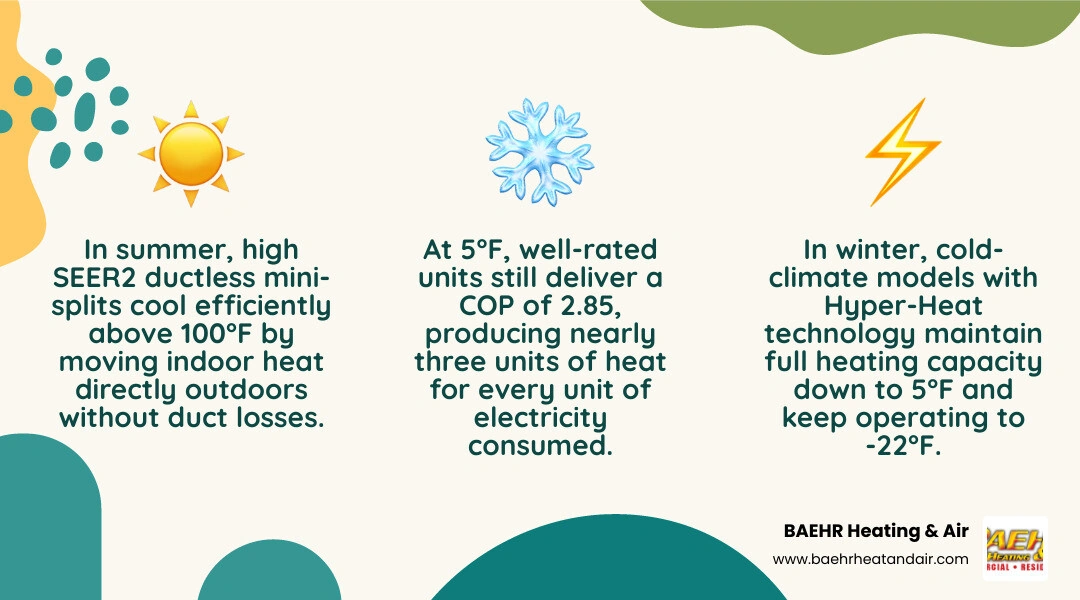
- High SEER2 ratings (often 18–30+) mean it does this without running up your electricity bill, even when temperatures top 100°F
- No duct losses — refrigerant travels directly to each indoor unit, bypassing hot attic air entirely
In winter:
- The system reverses direction, extracting heat from cold outdoor air and moving it inside
- Cold-climate models (like those with Hyper-Heat technology) maintain full heating capacity down to 5°F and continue operating efficiently as low as -13°F to -22°F
- At 5°F, a well-rated unit can still deliver a COP (coefficient of performance) of around 2.85 — meaning nearly three units of heat for every one unit of electricity used
If you live anywhere from Auburn up through Grass Valley, Nevada City, or Truckee, that dual capability is exactly what your home needs. The Sierra foothills throw both extremes at you — triple-digit summer days and hard freezes in winter — sometimes within the same season.
A real-world example makes this concrete: a high-performance home in Nevada City, California used just three ductless wall-mounted units to condition 2,390 square feet, achieving zero-net energy status with a 6.5 kW solar array. The system maintained 100% heating capacity at 5°F. That's not a manufacturer claim — it's a documented case study from a foothill home facing the same climate swings you deal with every year.
The rest of this guide walks you through the engineering behind that performance, how to size and install a system for your specific elevation, and what real-world efficiency looks like across every season.
The Science of How Ductless Mini Splits Handle Both Hot Sierra Summers and Cold Foothill Winters
To understand how these systems dominate the erratic foothill climate, we have to look at the physics of heat transfer. Traditional heating systems rely on combustion (burning wood, propane, or natural gas) or electric resistance (which uses a high-draw heating element) to generate warmth. Air conditioners use a compressor to chill indoor air.
Ductless mini splits do something much smarter: they do not create heat or cold. Instead, they act as thermal transport vehicles.
By utilizing advanced refrigeration cycles, Ductless Mini Split Systems pump refrigerant between an outdoor compressor and indoor air handlers. In the summer, the refrigerant absorbs heat from your living spaces and releases it outdoors. In the winter, the process reverses: the system harvests ambient heat from the freezing outdoor air—yes, there is still thermal energy in sub-zero air—and compresses it to elevate the temperature before releasing it inside.

The magic behind this continuous, highly efficient transfer is inverter technology. Traditional HVAC systems are either 100% on or 100% off. When your home drifts away from the set temperature, the system kicks on at full blast, overshoots the target, turns off, and waits for the cycle to repeat. This constant cycling is incredibly energy-intensive.
Inverter-driven, variable-speed compressors operate like a cruise control system. If your home in Lake Wildwood or Penn Valley needs just a tiny bit of cooling to stay at 72°F, the compressor runs at a quiet, low-speed sip. If a sudden heatwave hits, it ramps up smoothly to handle the load, then scales back down to maintain comfort without wasting power.
Conquering the Heat: How Ductless Mini Splits Handle Both Hot Sierra Summers and Cold Foothill Winters in Auburn, CA
In lower-elevation foothill communities like Auburn, Loomis, Rocklin, and Lincoln, summer heatwaves are relentless. July and August frequently bring afternoons well over 100°F.
Traditional ducted central air conditioning units struggle in these conditions, particularly due to duct losses. Most ducted systems run through attics that can easily reach 130°F or higher during a summer afternoon. Even well-insulated ductwork will absorb that radiant attic heat, warming the air before it ever reaches your living room. Industry data shows that traditional ducted systems can lose up to 30% of their total energy efficiency through leaky or poorly insulated attic ductwork.
By choosing Mini Split Heat Pumps Auburn CA, you bypass this issue entirely. Mini splits deliver refrigerant directly to individual wall-mounted, floor-mounted, or ceiling cassette units. There are no ducts to run through superheated attics, meaning 100% of the cooling power is delivered straight into your living space.
Furthermore, modern mini splits designed for hot climates boast exceptional SEER2 (Seasonal Energy Efficiency Ratio) ratings. While standard central air conditioners typically offer SEER2 ratings between 14 and 16, ductless mini splits regularly reach 18 to 30+. This translates directly into lower energy bills during peak summer cooling seasons under local utility time-of-use rates.
Defeating the Freeze: How Ductless Mini Splits Handle Both Hot Sierra Summers and Cold Foothill Winters in High Elevations
As you climb higher in elevation toward Grass Valley, Nevada City, and Truckee, the winter climate becomes the primary comfort challenge. Winter nights frequently drop below freezing, and high-altitude towns can experience sub-zero cold snaps.
For many years, older heat pump designs were discouraged in cold climates because their heating capacity dropped off sharply as outdoor temperatures fell below 40°F. Homeowners had to rely on expensive propane furnaces or drafty electric baseboard heaters to stay warm.
Fortunately, modern cold-climate mini splits have completely rewritten the rules of winter heating. Thanks to specialized hyper-heating inverter technology, these systems can extract heat from outdoor air even when it feels bitterly cold outside. By utilizing high-pressure scroll compressors and optimized refrigerant paths, cold-climate mini splits retain 100% of their heating capacity down to 5°F and continue to operate efficiently down to -13°F or lower.
To evaluate winter performance, we look at HSPF2 (Heating Seasonal Performance Factor) and COP (Coefficient of Performance). While electric baseboard heaters have a COP of 1.0 (meaning 100% of the electricity used is converted directly into heat), a cold-climate mini split can achieve a COP of 2.85 at 5°F. That means it is 285% efficient at near-freezing temperatures, delivering Year Round Comfort with Heat Pumps for a fraction of the operating cost of electric resistance heating.
Cold-Climate Engineering: Surviving Sierra Nevada Winters
Operating an outdoor mechanical unit in snowy, sub-freezing weather requires heavy-duty engineering. When a heat pump extracts heat from freezing outdoor air, moisture in that air naturally condenses and freezes on the outdoor unit's metal coils. Without smart mitigation, this ice buildup would choke off airflow and cause the system to shut down.
To prevent this, cold-climate mini splits are designed with automated defrost cycles. When the system detects frost accumulation, it temporarily reverses the refrigeration cycle for a few minutes. It runs in "cooling mode" without turning on the indoor fans, sending warm refrigerant through the outdoor coils to melt the ice quickly.
Another essential cold-weather feature is the integrated base pan heater. When ice melts during a defrost cycle, the water runs down to the bottom of the outdoor unit. In sub-freezing temperatures, this water would immediately re-freeze in the pan, building up a "glacier" of ice that could bend the fan blades or damage the compressor. A base pan heater is a low-wattage heating element that keeps the bottom pan warm, allowing meltwater to drain away safely.
To understand how this engineering translates to real-world performance compared to traditional heating options, review the comparison below:
| Heating System Type | Typical Heating Efficiency (COP) | Low-Temp Performance Limit | Energy Source | Major Foothill Drawbacks |
|---|---|---|---|---|
| Cold-Climate Mini Split | 2.0 to 4.0 (200%–400% efficient) | Operates down to -22°F | Electricity | Requires proper outdoor unit snow protection |
| Standard Heat Pump | 1.5 to 2.5 (150%–250% efficient) | Drops off sharply below 35°F | Electricity | Suffers capacity loss during hard mountain freezes |
| Propane Furnace | 0.80 to 0.96 (80%–96% efficient) | Unaffected by outdoor temp | Propane | High fuel delivery costs; combustion safety risks |
| Electric Baseboard | 1.0 (100% efficient) | Unaffected by outdoor temp | Electricity | Extremely high operating costs; uneven heating |
For a complete breakdown of heat pump technology and seasonal adaptation, check out our Home Heat Pump Ultimate Guide.
Sizing and Siting for Sub-Zero Performance
Sizing a mini split for a mountain home in Truckee or Nevada City requires a different approach than sizing a system for a home in Auburn or Rocklin. In mild climates, HVAC systems are sized primarily to handle the summer cooling load. In cold climates, the winter heating load is almost always the dominant factor.
To ensure your system keeps you warm during the coldest nights of the year, we perform a detailed, room-by-room Manual J load calculation. This calculation factors in:
- Local ASHRAE winter design temperatures (the lowest temperatures your area typically experiences)
- Your home's insulation levels (attic, walls, and floors)
- Window types (double-pane vs. historic single-pane)
- Air leakage rates
If a system is undersized, it will struggle to maintain your target indoor temperature when the thermometer drops below freezing. However, oversizing a system too much can lead to short-cycling in the summer, which hurts dehumidification and efficiency.
When Installing Mini Split Heat Pumps in cold climates, we size the system to meet the heating load at your local design temperature. In high elevations, we may recommend a small amount of supplemental heat (such as a wood stove or a few strategic wall heaters) to assist on those rare, historic sub-zero nights, allowing your mini split to run at maximum efficiency during the other 99% of the year.
Single-Head vs. Multi-Head Configurations
When planning a mini split system, you must choose between a single-head configuration (one outdoor compressor connected to one indoor air handler) and a multi-head configuration (one larger outdoor compressor connected to up to five indoor air handlers).
Each configuration has distinct pros and cons for foothill homes:
Single-Head Systems:
- Pros: Maximum energy efficiency. Because each indoor unit has its own dedicated compressor, the system can modulate its output with incredible precision. If one unit is off, no refrigerant flows to it, eliminating standby energy loss.
- Cons: Requires multiple outdoor compressors placed around your home, which can impact exterior aesthetics.
Multi-Head Systems:
- Pros: Allows you to heat and cool multiple rooms (zones) using only one outdoor unit. This is highly beneficial if you have limited outdoor space or want to keep your home's exterior uncluttered.
- Cons: Slight efficiency losses. In a multi-head system, a small amount of refrigerant often continues to circulate through lines connected to indoor heads that are turned off. This can lead to minor parasitic heat loss in winter or cooling loss in summer. Additionally, long line-set runs can slightly degrade overall capacity.
To maximize your investment, we often design hybrid systems—using single-head units for large, high-use living spaces and a multi-head system for a cluster of bedrooms. Learn more about optimizing your layout in our guide on Maximizing Efficiency Mini Split Heat Pump.
Installation Best Practices for Foothill and Mountain Homes
In variable climates, a mini split is only as good as its installation. Foothill and mountain environments present unique physical challenges, from heavy snow loads to steep terrain and high winds.
Standard installation techniques that work well in flat, warm valleys will fail in places like Truckee or Grass Valley. Achieving long-term reliability requires strict adherence to local installation standards, which you can read about in detail on our Mini Split Installation Auburn page.
Protecting the Outdoor Compressor from Snow and Ice
The outdoor compressor is the heart of your mini split system, and it must be protected from winter weather. If you place a compressor directly on a ground-level concrete pad in a snowy climate, several problems will occur:
- Snow Burial: Heavy snow accumulation will block the intake and exhaust grilles, forcing the system to shut down.
- Ice Damming: Meltwater from your roof or the unit's own defrost cycles will pool beneath the system and freeze, eventually encasing the bottom of the compressor in solid ice.
- Falling Ice Damage: Heavy icicles shedding from roof eaves can drop with enough force to crush the outdoor unit's fan shroud.
To prevent these issues, we mount outdoor units in snowy areas on heavy-duty wall brackets or elevated steel ground stands. The unit should be raised at least 12 to 24 inches above the local average snow-depth line.
Additionally, we install a protective sloped canopy or "snow roof" over the outdoor compressor. This roof shields the unit from falling snow and ice while maintaining the clear vertical space required for proper airflow. If you are deciding on the best setup for your home, our comparison of Choosing Between an AC and Heat Pump offers further insights into equipment selection.
Indoor Air Handler Placement for Optimal Airflow
Where you mount the indoor air handlers inside your home dramatically affects both heating and cooling comfort.
Because hot air naturally rises and cold air sinks, air handler placement must balance these physical properties:
- High-Wall Mounts: Ideal for cooling-dominated climates like Rocklin and Lincoln. Placing the unit high on the wall allows it to throw cold air across the ceiling, where it naturally sinks to cool the room evenly.
- Floor-Mounted Consoles: Highly recommended for heating-dominated climates like Truckee and Nevada City. Mounted low on the wall (similar to a traditional radiator), these units blow warm air along the floor, where it rises naturally to warm the living space. This minimizes temperature stratification (where your head is warm but your feet are freezing).
Proper placement also prevents short-cycling. If an indoor unit is placed too close to a drafty window or in a tight corner with poor air circulation, its internal sensors will misread the room's temperature, shutting the unit off before the rest of the space is comfortable. Discover how proper zoning and placement improve daily comfort in our guide to the Benefits of Mini Split Heat Pumps.
Comparing Mini Splits to Traditional Foothill Heating Systems
Many foothill homes built in the 1980s and 1990s rely on a combination of a central propane furnace and a standard outdoor air conditioner, or worse, expensive electric baseboard heaters.
When comparing these setups to modern ductless mini splits, several stark contrasts emerge:
Ductwork Efficiency:A traditional ducted system pushes conditioned air through hundreds of feet of metal or flexible ductwork. Even in a well-built home, air leaks and thermal conduction through duct walls waste significant energy. Ductless mini splits deliver comfort directly to the room, eliminating 100% of duct-related energy losses.
Zoned Control vs. Single-Thermostat Control:Traditional central systems use a single thermostat to control the temperature of the entire house. If your upstairs bedrooms are too hot, the AC runs until those rooms cool down, leaving the downstairs living areas freezing. Ductless mini splits allow you to set different temperatures for every single room, ensuring you only pay to heat or cool the spaces you are actually using.
Infrastructure Requirements:Installing a traditional central system in an older home without existing ductwork is incredibly invasive and expensive, requiring you to cut open walls and sacrifice closet space. Mini splits require only a small, three-inch hole through the exterior wall to connect the indoor and outdoor units, preserving your home's architectural integrity.
For a deeper dive into the mechanical differences, check out our comparison of Heat Pump vs Gas Furnace Infrastructure.
Frequently Asked Questions about Sierra Mini Split Performance
Do mini splits work when temperatures drop below freezing?
Yes, modern cold-climate mini splits are engineered specifically to operate in sub-freezing temperatures. While standard heat pumps lose capacity as the temperature drops, units equipped with advanced cold-climate technology maintain 100% of their heating capacity down to 5°F and can continue operating efficiently down to -13°F or lower.
How do Sierra Nevada summers affect mini split efficiency?
Sierra Nevada summers are hot and exceptionally dry. Mini splits thrive in dry heat because they do not have to spend energy removing high levels of humidity from the air. Because they bypass hot attics and deliver cooling directly to each room, they maintain high SEER2 efficiency even when outdoor temperatures exceed 100°F.
Is backup heat necessary for foothill winters?
For homes in lower-elevation foothill areas like Auburn, Rocklin, or Loomis, a cold-climate mini split can easily serve as your sole heating source. In high-elevation, sub-zero mountain climates like Truckee, we may recommend keeping a small supplemental heat source (such as a wood stove or propane fireplace) to assist the system during rare, historic cold snaps, though the mini split will still handle the vast majority of your heating needs.
Conclusion
Whether you are trying to keep your home cool during a scorching afternoon in Auburn or warm during a snowy winter night in Truckee, ductless mini splits offer a highly efficient, reliable, and customizable comfort solution. By eliminating duct losses, utilizing variable-speed inverter technology, and offering targeted zone control, these systems are perfectly suited to handle the dramatic climate swings of the Sierra Nevada foothills.
At BAEHR Heating & Air, we are committed to helping local homeowners find the perfect HVAC solutions for their homes. To keep your system running at peak efficiency year-round, we offer an annual maintenance membership covering two comprehensive visits per system each year.
If you are ready to experience the comfort and energy savings of a modern ductless system, visit our Ductless Mini Split Systems page or contact us today to schedule a consultation with our experienced local team.
Ready to breathe easy?
Schedule service or request a free estimate. Honest assessments and upfront pricing on every visit across Nevada County.