

Cooling System Options Comparisons for Homeowners: Heat Pumps vs. Traditional AC
When an AC fails, deciding between a heat pump and standard AC is critical. Review these options comparisons for homeowners to decide with confidence today.
Facing a Summer Breakdown: Evaluating Your System Replacement Choices
Are you facing a total cooling failure during peak July heat, leaving you scrambling through options comparisons for homeowners to find the right replacement? At BAEHR Heating & Air, we see this exact scenario every summer here in Grass Valley. A sudden breakdown in the middle of summer forces a major decision on a tight timeline. Your house is rapidly warming up, the thermostat reads 85 degrees inside, and you need a permanent solution quickly. This is the exact moment when you must decide between replacing just your broken air conditioner or upgrading your entire mechanical setup.
Need help right away? Explore our air conditioning services or schedule AC maintenance in Grass Valley today.
The primary decision point usually comes down to choosing a modern heat pump or sticking with a traditional gas furnace and AC combination. Making the right choice right now impacts your indoor comfort, your home's air quality, and your long-term energy consumption for years to come.
The technical reality: Evaluating these systems requires an objective look at how they actually operate under heavy summer loads. You need to understand the mechanics, the efficiency ratings, and the installation requirements without the pressure of a sales pitch. By breaking down the specific differences in how these systems handle heat, humidity, and airflow, you can make an educated choice that fits your home's specific ductwork and your family's comfort needs.
Cooling Mechanics: Variable-Speed Heat Pumps vs. Traditional AC
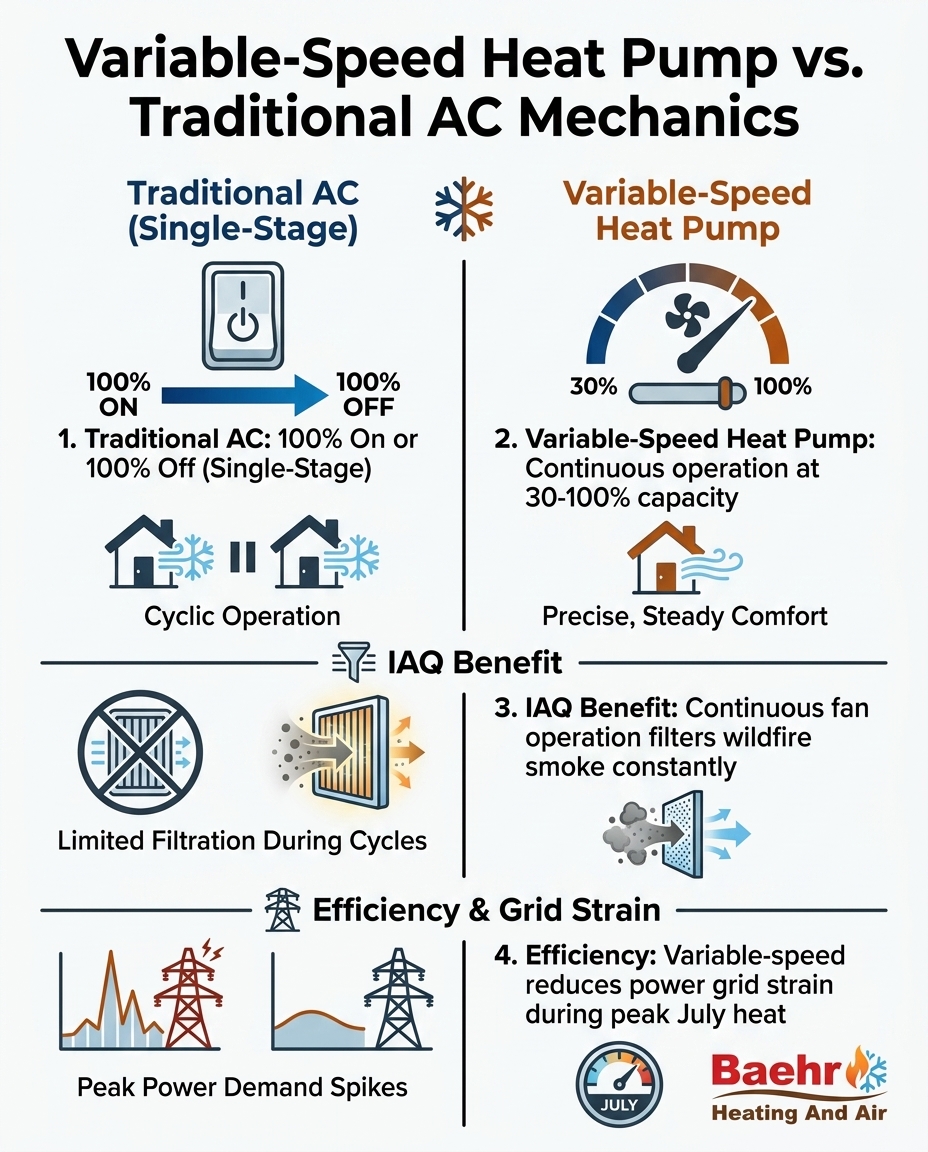
To make an informed decision, you have to look under the hood. The fundamental difference between a variable-speed heat pump vs. two-stage gas furnace setup (or a standard single-stage AC) lies in how the compressor manages the cooling cycle. Traditional air conditioners operate on a strict binary system. They are either running at 100% capacity or they are completely off.
When the thermostat detects that the house is too warm, a single-stage system blasts cold air until the target temperature is reached, then shuts down. This creates noticeable temperature swings, frequent on-and-off cycling, and massive power spikes every time the compressor kicks on. It is similar to driving a car by either flooring the gas pedal or slamming on the brakes—it gets you there, but it is not a smooth ride.
Modern variable-speed compressors use inverter technology to operate continuously at lower capacities. Instead of shutting off entirely, the system ramps down to 30% or 40% capacity, maintaining a steady flow of conditioned air. This continuous air circulation eliminates hot and cold spots, provides far superior dehumidification, and avoids the heavy electrical draw of constant startups. If you have ever needed an AC repair because a hard-starting compressor finally burned out—a pattern our technicians see frequently during July heatwaves—you understand the toll that continuous on-and-off cycling takes on mechanical parts.
| System Feature | Traditional Single-Stage AC | Variable-Speed Heat Pump |
|---|---|---|
| Operational Cycle | 100% On or 100% Off | Continuous at 30% to 100% capacity |
| Temperature Consistency | Noticeable 2-3 degree swings | Precise, holding within 0.5 degrees |
| Dehumidification | Limited (only when running) | Excellent (constant air over cold coils) |
| Energy Draw | High spikes on startup | Low, steady electrical consumption |
Indoor Air Quality: Combating Sierra Foothill Wildfire Smoke
Your cooling system does more than just lower the temperature; it is the primary defense mechanism for your home's indoor air quality. Having worked through countless fire seasons in Grass Valley, our team at BAEHR Heating & Air knows that with hot, dry Sierra Foothill summers regularly bringing heavy wildfire smoke into the region, how your system circulates air becomes a critical factor. When evaluating replacement options, you must consider how the equipment handles environmental stressors like heavy particulate matter.
The filtration gap: Traditional setups only filter the air when the thermostat triggers a cooling cycle. On a mildly warm day, your system might only run for ten minutes every hour. That means for 50 minutes out of every hour, the air in your home is sitting stagnant, and smoke particles that seep indoors are not being pulled through your HVAC filter. If you find yourself wondering why your AC is blowing warm air or struggling to keep the house comfortable, a clogged filter from heavy smoke is often the culprit, but the system still only filters when actively cooling.
Variable-speed systems solve this problem through continuous fan operation. Because the system runs almost constantly at a low speed, it continuously pulls indoor air through your filtration media. This means smoke, dust, and allergens are actively scrubbed from your home's air 24 hours a day. This continuous circulation also provides superior dehumidification, pulling moisture out of the air at a steady rate, which drastically improves indoor comfort during hot, dry, and smoky spells.
Energy Efficiency, SEER2 Ratings, and Title 24 Compliance
Replacing a cooling system today requires navigating updated energy regulations and efficiency standards. In 2023, the Department of Energy implemented the SEER2 (Seasonal Energy Efficiency Ratio 2) testing standards. This was a major shift in how cooling systems are evaluated.
The updated SEER2 metrics require systems to be tested under higher external static pressure, which better reflects real-world operating conditions. Older SEER ratings often looked great on paper but fell short when installed in homes with restrictive ductwork. SEER2 gives you a much more accurate picture of how a system will actually perform during peak heat.
Local regulatory factors: As a homeowner in California, you also have to factor in Title 24 energy efficiency standards. These state mandates require specific SEER2 and EER2 minimums for all new cooling system installations. Depending on the scope of your replacement, Title 24 may also require mandatory duct testing by a third-party HERS rater to ensure your existing ductwork isn't leaking the conditioned air you are paying to produce.
Providing objective, technically sound local expertise regarding these regulations is critical. In our experience, Sierra Foothill environmental stressors and strict California mandates dictate that your mechanical choice must be highly efficient. Variable-speed systems naturally excel here. By running at lower capacities, they drastically reduce power grid strain during peak July heat compared to traditional HVAC systems, easily meeting and exceeding Title 24 compliance while keeping your monthly energy consumption in check.
If your current system is struggling to meet these efficiency standards, scheduling a professional AC tune-up can help you assess its current performance before committing to a full replacement.
Looking Ahead: How Summer Choices Impact Winter Heating Months
When your cooling system fails in July, your immediate focus is entirely on getting the house cold again. However, our installation teams often remind homeowners that the mechanical choice you make in the summer directly dictates your home's overall mechanical footprint year-round. This is where the dual-nature of heat pumps becomes a major factor in the decision-making process.
The mechanical advantage: A heat pump is essentially an ultra-efficient air conditioner equipped with a reversing valve. During the summer, it absorbs heat from inside your home and pumps it outside to provide premium cooling. While your priority is peak-summer performance, that same reversing valve means the single piece of equipment you install to solve your July breakdown will seamlessly handle your home's temperature control year-round.
Compare this to sticking with a traditional AC replacement. If you replace only the outdoor air conditioner and the indoor evaporator coil, you are still relying on your existing gas furnace as the blower and secondary system. If that furnace is already 12 to 15 years old, you are pairing brand-new, high-efficiency cooling technology with an aging, inefficient component. Eventually, that furnace will fail, requiring another costly replacement project. We recommend opting for a heat pump because it allows you to upgrade to a single, modern mechanical system that dominates summer cooling efficiently while eliminating the need to maintain a separate combustion furnace entirely.
Evaluating Installation Factors and System Footprints
Before finalizing a system choice, you have to evaluate the physical and electrical realities of your specific home. At BAEHR Heating & Air, we always conduct a careful assessment of your home's infrastructure, because not every system is a simple plug-and-play replacement. Upgrading to modern technology requires a precise evaluation.
Here are the primary installation factors our technicians evaluate:
- Electrical Panel Requirements: Modern variable-speed heat pumps operate very efficiently, but they still require dedicated electrical circuits. If you are switching from a gas furnace to a fully electric heat pump, your home's main electrical panel must have the capacity to handle the new load. Homes with older 100-amp service panels may require an electrical upgrade before a heat pump can be safely installed.
- Ductwork Compatibility: Variable-speed airflow requires properly sized ductwork to function correctly. If your existing ducts are undersized, crushed, or highly restrictive, a high-efficiency system will struggle to push air, leading to premature motor failure. A static pressure test is necessary to determine if duct modifications are required.
- Physical Footprint: Outdoor heat pump condensers are often taller and larger than older, traditional AC condensers. You must evaluate the physical space on your side yard or patio to ensure the new unit meets manufacturer clearance requirements for proper airflow. Some modern heat pumps use side-discharge designs, which offer a slimmer profile for tight spaces.
- Integration Complexities: If you decide to install a new high-efficiency AC but keep your existing furnace, the indoor cooling coil must match the exact specifications of the outdoor unit. Integrating new variable-speed cooling technology with an older, standard blower motor often limits the efficiency gains you actually experience inside the home.
Common Questions About Cooling System Replacements
Can a heat pump replace an air conditioner?
Yes, a heat pump functions exactly like an air conditioner during the summer. It uses the exact same refrigeration cycle to absorb heat from your indoor air, remove humidity, and pump that heat outside. The only difference is that a heat pump has the mechanical ability to reverse this process when needed.
Do heat pumps cool as well as central AC?
Modern heat pumps cool just as effectively as traditional central AC units, and in many cases, they perform better. Variable-speed heat pump models run continuously at lower speeds, which provides superior dehumidification and much more consistent indoor temperatures without the constant on-and-off cycling of standard central air.
Should I replace my furnace when my AC fails in summer?
If the furnace is over 15 years old, replacing both simultaneously ensures mechanical compatibility and saves on future labor costs. Upgrading your failed AC to a heat pump system actually eliminates the need for a separate gas furnace entirely, giving you a single, highly efficient system.
How does wildfire smoke affect a new cooling system's efficiency?
Heavy smoke clogs air filters rapidly, forcing the system's blower motor to work much harder to pull air, which significantly reduces overall efficiency. Variable-speed systems filter air continuously, which provides better overall indoor air quality during fire season but does require you to check and replace your filters more frequently.
What are the Title 24 requirements for AC replacement in California?
Title 24 mandates specific SEER2 and EER2 minimum efficiency ratings for all new cooling system installations across the state. It also requires third-party duct testing in many replacement scenarios to ensure your ductwork isn't leaking, guaranteeing that the new system operates at its promised efficiency.
Making the Right Mechanical Choice for Your Home
Ultimately, the choice between a heat pump and a traditional AC comes down to your specific efficiency goals and your indoor air quality needs. If your priority is combating summer smoke with continuous filtration, or if you want to eliminate your reliance on an aging gas furnace, a variable-speed heat pump offers a clear mechanical advantage. If you are simply looking for a straightforward cooling replacement, a high-efficiency standard AC can still drastically improve your comfort.
The most important step is relying on a clear, unbiased technical comparison when evaluating your options. Every house breathes differently. We encourage you to have our BAEHR Heating & Air professionals evaluate your home's specific ductwork, static pressure, and electrical capacity before making a final decision.
Understanding your system's capabilities is the best way to protect your investment. To ensure your chosen equipment runs smoothly for years to come, learn more about our comprehensive AC maintenance in Grass Valley and keep your home comfortable no matter how hot the summer gets.
Ready to breathe easy?
Schedule service or request a free estimate. Honest assessments and upfront pricing on every visit across Nevada County.