

AC Contactor Burned Out: Causes & Symptoms
When Your AC Goes Silent in the Sierra Foothills: Recognizing a Burned-Out Contactor. Understanding ac contactor burned out causes and symptoms in Sierra…
When Your AC Goes Silent in the Sierra Foothills: Recognizing a Burned-Out Contactor
Understanding ac contactor burned out causes and symptoms in Sierra Foothill heat could be the difference between a quick repair and a full system replacement. If your outdoor unit is humming but not cooling, making a rapid clicking sound, or has simply stopped responding on a 105°F afternoon, a burned-out or failing contactor is one of the most likely culprits.
Here is a quick overview of what to look for:
Common symptoms of a burned-out AC contactor:
- Outdoor unit hums but the compressor does not start
- Rapid chattering or clicking sounds from the outdoor cabinet
- System runs constantly and won't shut off
- Warm air blowing from vents despite the unit appearing to run
- Visible burn marks, pitting, or a faint burning smell near the outdoor unit
Most common causes in Sierra Foothill heat:
- Extreme ambient temperatures pushing electrical panel temps above 140°F
- Repeated short cycling caused by oversized or aging systems
- Voltage fluctuations common in rural foothill utility grids
- Pest intrusion from earwigs and ants attracted to the electromagnetic coil
- Agricultural dust and wildfire smoke coating contact surfaces and accelerating wear
The Sierra Foothills run some of the harshest summer conditions in Northern California. Temperatures in foothill communities regularly hit triple digits, and that sustained heat punishes every electrical component inside your outdoor AC unit — especially the contactor. Under normal conditions, a contactor can last 10 to 15 years or roughly 100,000 switching cycles. In extreme heat with short cycling, that lifespan can shrink to just 3 to 5 years. This small, inexpensive component is also one of the most consequential — a failing contactor left unchecked can destroy a compressor that costs many times more to replace.
The sections below explain exactly what a contactor does, why Sierra Foothill heat burns them out faster, and what signs tell you it is time to call a professional before the damage spreads.
What is an AC Contactor and How Does It Work?
To understand why this little part is so critical, think of the AC contactor as the ultimate gatekeeper of your home’s cooling system.
In a standard residential split system, your indoor thermostat runs on a low-voltage 24-volt control signal. However, the heavy-duty components in your outdoor condenser unit—specifically the compressor and the condenser fan motor—require a high-voltage 240-volt power circuit to run. Obviously, sending 240 volts of electricity directly through your delicate indoor thermostat would result in a very literal, very dangerous fireworks show in your living room.
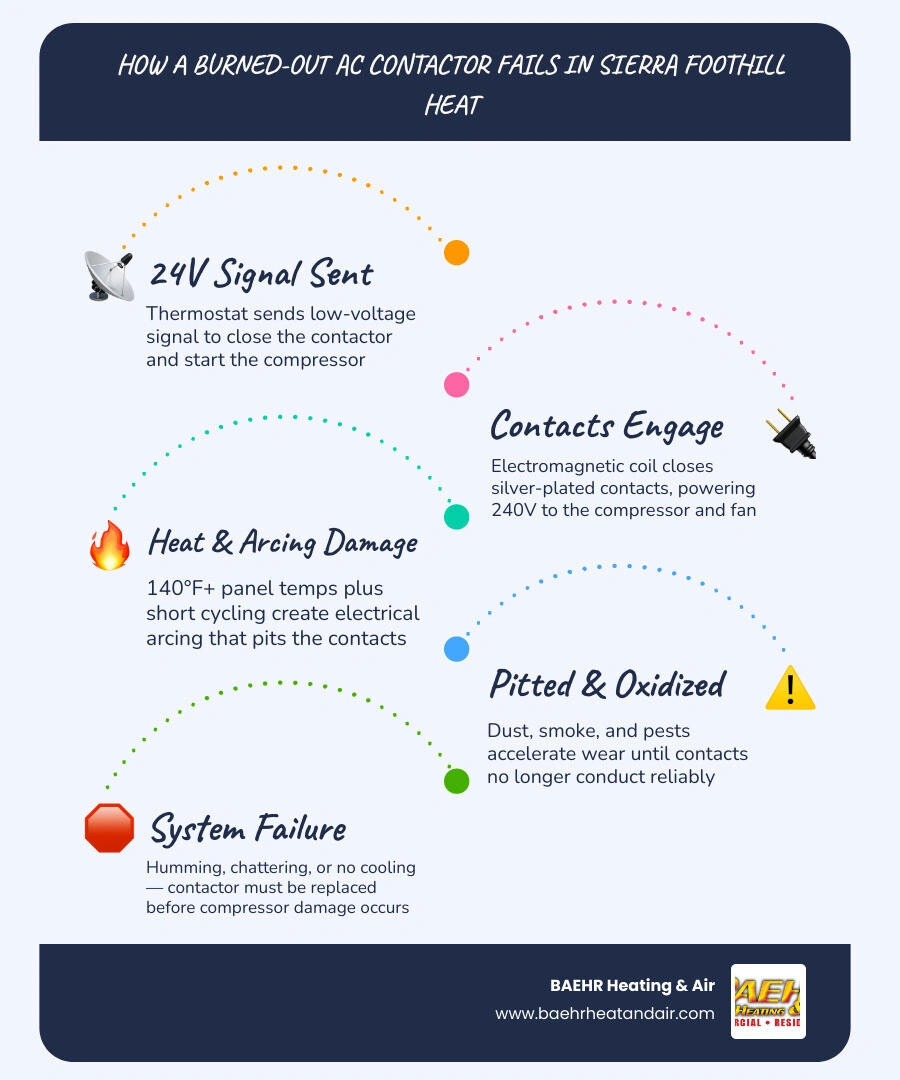
This is where the AC contactor comes in. It is a heavy-duty electrical relay located inside the outdoor unit's control panel. When your indoor temperature rises above your set thermostat limit, the thermostat sends that low-voltage 24V signal down to the contactor's electromagnetic coil.
This coil magnetizes, creating a physical pull that draws down a spring-loaded metal bridge (the armature). When this bridge drops, it pushes two highly conductive silver-alloy contact points together. This action closes the high-voltage 240V circuit, allowing electricity to flood into the compressor and fan motor, kicking your cooling system into gear. When the home reaches the desired temperature, the thermostat cuts the 24V signal, the electromagnet loses its pull, the spring pushes the contacts apart, and the system safely shuts down.
Because this mechanical action occurs thousands of times every single summer, the contactor is one of the most active electrical components in your system. This constant movement makes it highly susceptible to Common HVAC Repair Problems, especially when local climate factors push your system to its absolute limits.
AC Contactor Burned Out Causes and Symptoms in Sierra Foothill Heat
When the summer sun beats down on communities like Grass Valley, Nevada City, and Auburn, your air conditioner is forced to run longer, harder, and more frequently. This intense workload accelerates a process known as electrical arcing.
Every single time those contact points open or close, a tiny electrical spark (or arc) jumps across the microscopic gap between them. This arc is incredibly hot—often hot enough to vaporize microscopic amounts of the protective silver-alloy plating on the contacts. Over time, this arcing causes the smooth metal surfaces to become cratered, blackened, and "pitted."
As pitting worsens, electrical resistance increases. High resistance generates intense localized heat, creating a runaway failure loop: the hotter the contacts get, the more they pit; the more they pit, the hotter they get. Eventually, the contactor either burns out completely or welds itself shut. Recognizing these failures early is key to preventing catastrophic damage, which is why homeowners should stay alert for Signs Your AC Needs Immediate Repair.
Primary Causes of an AC Contactor Burned Out in Sierra Foothill Heat
While normal wear and tear will eventually claim any electrical part, several local environmental and infrastructure factors in the Sierra Foothills act as major accelerators for contactor burnout:
- Extreme Electrical Panel Temperatures: When outdoor temperatures hit 100°F or higher in Lincoln or Rocklin, the temperature inside your AC unit's metal electrical control box can easily soar past 140°F. This extreme ambient heat degrades the thin protective insulation wrapping the contactor's electromagnetic coil, leading to internal short circuits and total coil burnout.
- Pest Infestations (The Earwig Problem): Homeowners in rural foothill areas like Penn Valley and Lake Wildwood are all too familiar with local pests. Earwigs, ants, and beetles are naturally attracted to the warm electromagnetic fields emitted by energized contactor coils. These insects crawl between the open contact points. When the contactor closes, the bugs are crushed, creating an insulating barrier of debris that prevents clean electrical contact. This leads to massive arcing, localized fires, and ruined components.
- Agricultural Dust and Wildfire Smoke: The Sierra Foothills are prone to dry, dusty summers and seasonal wildfire smoke. Fine ash and agricultural dust settle inside the outdoor electrical cabinet. When mixed with the natural moisture of humid mornings, this dust forms a gritty, semi-conductive paste on the contact points, causing high electrical resistance and rapid burnout.
- Voltage Fluctuations on Rural Grids: Power delivery in older, wooded, or rural areas can sometimes be unstable. Voltage drops below 85% of the nominal rating weaken the magnetic force of the contactor's coil. Instead of pulling the contacts firmly together, the weak magnet causes the contactor to rapidly bounce or "chatter." This rapid-fire arcing can destroy a contactor in a matter of minutes.
Warning Symptoms of an AC Contactor Burned Out in Sierra Foothill Heat
If your contactor is failing or has already burned out, your system will usually try to tell you. Watch out for these classic warning signs:
- A Loud Humming or Buzzing from the Outdoor Unit: If the contactor's electromagnetic coil is damaged or under-pressurized due to low voltage, it will emit a loud, angry hum. The fan and compressor may refuse to start, leaving you with a noisy, warm metal box in your yard.
- Rapid Chattering or Clicking Noises: If you hear a sound resembling a playing card in bicycle spokes coming from your outdoor unit, the contactor is likely "chattering." This happens when the coil cannot hold the contacts closed, causing them to slam open and shut repeatedly.
- The System Won't Start at All: When the contactor coil burns out completely, the connection between your thermostat and the high-voltage power line is severed. Your indoor blower might run, but the outdoor unit will remain completely dead. If you are troubleshooting this issue, check out our guide on Why Is Your AC Not Turning On? How to Fix.
- The AC Runs Constantly and Won't Shut Off: Sometimes, the intense heat of electrical arcing causes the metal contact points to literally weld themselves together. When this happens, the contactor cannot spring open, even when the thermostat is satisfied. Your AC will continue to run indefinitely, risking a frozen evaporator coil and massive energy waste.
The Danger of Ignoring a Failing Contactor
Leaving a failing contactor unattended is a massive gamble. Because this small part regulates the flow of high-voltage electricity, any malfunction can directly threaten the most expensive component in your entire HVAC system: the compressor.
When contacts become pitted and dirty, they do not deliver a clean flow of electricity. Instead, they cause a significant voltage drop. Operating a compressor on low voltage forces it to draw locked-rotor amperage (LRA) to keep running. This excess amperage generates extreme heat inside the compressor's motor windings, rapidly degrading their insulation. What starts as a simple electrical issue can quickly turn into a completely burned-out compressor motor, forcing a premature and highly expensive system replacement.
| Contactor State | How It Affects the System | Impact on Energy Bills | Risk to Compressor |
|---|---|---|---|
| Normal Operation | Clean 240V power delivery; smooth starts and stops. | Optimized efficiency; normal utility costs. | None; operates within safe parameters. |
| Pitted / High Resistance | Low voltage delivered to compressor; intermittent starting. | Moderate increase due to high start-up draw. | High; causes winding degradation and overheating. |
| Chattering / Bouncing | Rapid-fire power cycling; extreme electrical arcing. | Spikes in energy usage from constant surges. | Extreme; can destroy compressor valves and motors. |
| Welded Closed | System runs continuously; cannot shut off. | Massive energy bills from 24/7 operation. | Extreme; risk of liquid refrigerant floodback and failure. |
If you suspect your system is struggling with power delivery, it is wise to run through basic AC Repair Troubleshooting Before Calling a Pro, starting with checking your home's electrical panel for tripped breakers.
Preventive Maintenance and Professional AC Repair in Grass Valley
The best way to handle a burned-out contactor is to prevent the burnout from happening in the first place. This is where seasonal maintenance becomes your home's best friend.
During a professional tune-up, a technician will open the outdoor electrical panel to perform several critical safety checks. They will physically inspect the contactor for signs of pitting, measure the voltage drop across the closed contacts (which should never exceed 0.5 volts), and test the electrical resistance of the electromagnetic coil.
Furthermore, technicians will always verify the health of your system's run capacitor. A weak capacitor puts extra strain on the contactor, causing it to work harder and wear out much faster. By catching a pitted contactor or a failing capacitor in the spring, you avoid the headache of a total system breakdown on a triple-digit summer day in Loomis or Truckee.
It is crucial to emphasize that contactor diagnosis and replacement is not a safe DIY project. The electrical panel in your outdoor unit houses lethal 240-volt circuits. Additionally, the nearby run capacitor stores a massive electrical charge even after the main power disconnect has been pulled. One slip of a screwdriver can result in severe electrical shock, permanent equipment damage, or personal injury.
Protect your home and your safety by trusting these high-voltage tasks to experienced professionals who provide certified AC Repair Services.
Frequently Asked Questions About AC Contactors
Will my AC fan still run if the contactor is bad?
Yes, in many cases, the outdoor condenser fan motor may continue to spin even if the compressor fails to start, or vice versa. This is particularly common in systems utilizing single-pole contactors, which only interrupt one leg of the 240V power supply, or when a double-pole contactor suffers a partial mechanical failure on one side. This is highly dangerous, as running the fan without the compressor—or running the compressor without the fan—can cause liquid refrigerant to flood back into the system, leading to catastrophic compressor failure.
Can I clean or sand down pitted contacts instead of replacing them?
No. While it might be tempting to use sandpaper or a metal file to smooth out pitted contact points, this is a very short-lived and hazardous temporary fix. Modern contactor points are coated with a highly specialized, thin layer of silver-alloy plating designed to resist electrical arcing. Filing or sanding the contacts completely strips this plating away, exposing the raw copper underneath. Raw copper oxidizes incredibly fast when exposed to the outdoor air. A sanded contactor will typically oxidize, overheat, and weld itself shut or burn out completely within a few weeks of the repair.
How long does an AC contactor typically last in hot climates?
Under ideal conditions with stable voltage and moderate weather, a high-quality AC contactor can easily last 10 to 15 years. However, in hot, dry climates like the Sierra Foothills, that lifespan is often cut in half. The combination of triple-digit summer heat, regional dust, pest intrusion, and grid fluctuations means that contactors in areas like Rocklin, Lincoln, and Auburn often need to be proactively replaced every 3 to 5 years as part of a smart preventive maintenance strategy.
Conclusion
A burned-out AC contactor may be a small part, but it has a massive impact on your home's comfort, your energy bills, and the overall lifespan of your cooling system. Taking proactive care of your air conditioner is the best way to ensure your family stays cool and comfortable all summer long.
At Baehr Heating & Air, we are proud to serve our neighbors across the Sierra Foothills, including Grass Valley, Nevada City, Penn Valley, Lake Wildwood, Auburn, Rocklin, Loomis, Lincoln, and Truckee. To make keeping up with your system's health as simple and stress-free as possible, we offer an annual maintenance membership. This program covers two comprehensive system tune-ups per year, helping us catch worn contactors, weak capacitors, and dirty coils before they leave you stranded in the heat.
Don't wait for the next major heatwave to test your system's limits. Schedule Professional AC Repair in Grass Valley with our friendly, customer-first team today, and enjoy total peace of mind this summer!
Ready to breathe easy?
Schedule service or request a free estimate. Honest assessments and upfront pricing on every visit across Nevada County.