4.9



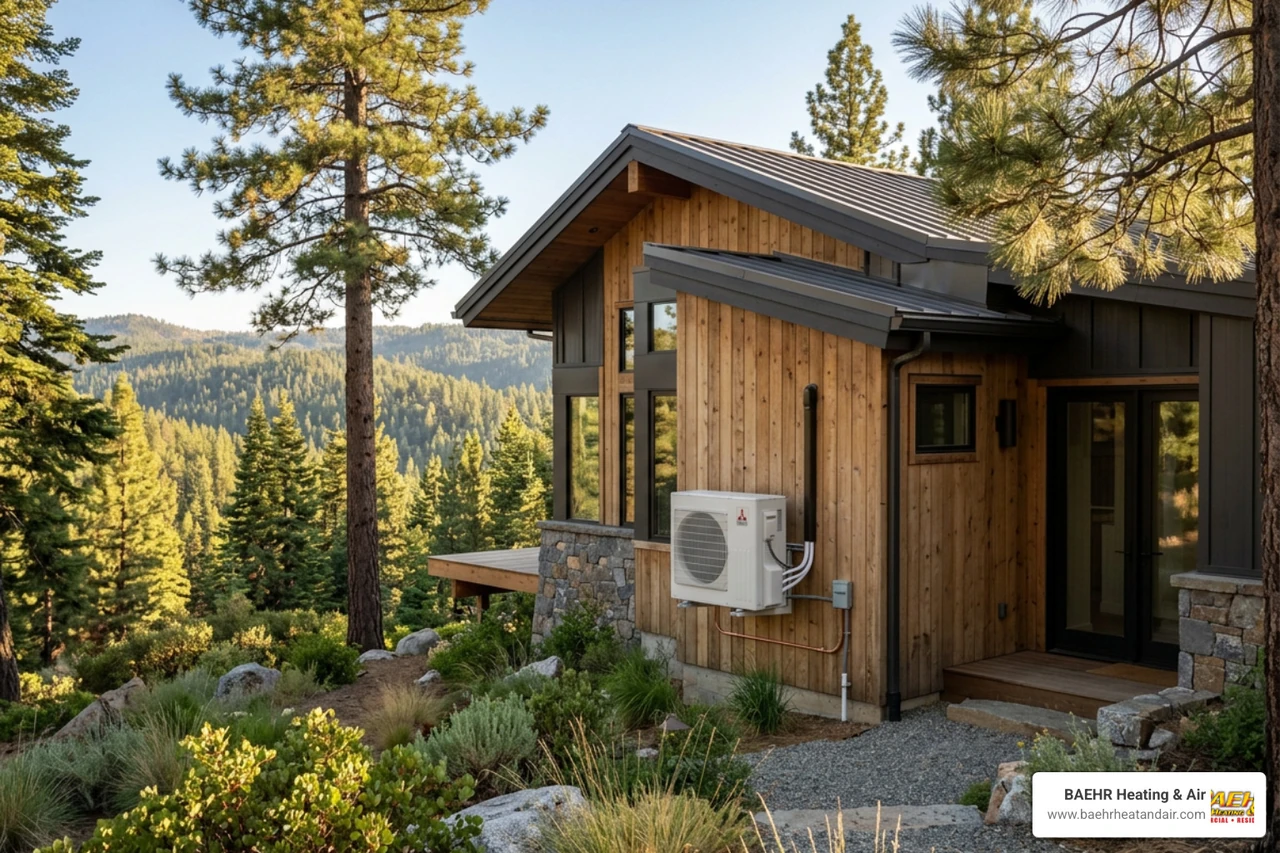
How California Title 24 affects mini split installation in the Sierra Foothills is something every homeowner and contractor in this region needs to understand before pulling a permit or selecting equipment. Here is a quick summary:
Title 24 Part 6 — California's Building Energy Efficiency Standards — applies to every new installation, replacement, and addition that requires a building permit. The 2022 Energy Code (effective January 1, 2023) tightened several requirements for heat pump systems, and the 2025 Energy Code (effective January 1, 2026) goes further, making heat pump space heating the baseline expectation for new construction. For Sierra Foothills homeowners in Auburn, Grass Valley, and the surrounding mountain communities, these rules have real consequences for how a mini split must be selected, sized, documented, and verified before an inspector signs off.
The mistake many contractors and homeowners make is assuming that a ductless system means a simpler permit process. It does not. In fact, ductless mini splits create a handful of unique compliance challenges that ducted systems do not face — from refrigerant charge verification to airflow documentation across multiple indoor heads.

The Sierra Foothills is one of the most geographically diverse regions in California. This means that a one-size-fits-all approach to HVAC simply does not work here. Under Title 24, California is divided into 16 distinct climate zones, and our service areas span three of them:
Because of this extreme variation, the way how california title 24 affects mini split installation in the sierra foothills depends heavily on your exact elevation and climate zone. For instance, Climate Zone 16 is a heating-dominated mountain climate. In Truckee or high-elevation areas of Nevada City, the heating design temperatures drop well below freezing, making high-performance heating a priority. Conversely, in Lincoln or Rocklin (Climate Zone 11), summer cooling loads are intense, requiring systems that can handle triple-digit heat without breaking a sweat.
When we design a system, Title 24 requires us to look at the specific climate zone data to ensure the heat pump can meet both the heating and cooling demands of that zone. If you are looking to upgrade your home's climate control, installing Mini Split Heat Pumps Auburn CA requires careful planning to ensure the system is calibrated to handle the transitional weather of Placer County while remaining fully compliant with state energy codes.
To legally install a mini split in California, the equipment must be officially certified and listed in the California Energy Commission’s (CEC) Modernized Appliance Efficiency Database System (MAEDbS). If a manufacturer’s specific outdoor and indoor unit combination is not registered in this database, a building inspector cannot sign off on the permit.
Historically, under older iterations of the energy code (such as the 2008 standards), heat pumps only had to clear a low hurdle of a 7.7 HSPF and a 13 SEER to be used for heating in California. Today, the standards are much more stringent. Under the current code cycle, systems must meet updated SEER2 and HSPF2 metrics, which use more realistic static pressure testing conditions.
| Metric | Minimum Title 24 Requirement (Systems <65,000 BTU) | Typical High-Efficiency Mini Split Performance |
|---|---|---|
| SEER2 (Cooling Efficiency) | 15.0 | 20.0 to 30.0+ |
| HSPF2 (Heating Efficiency) | 7.8 | 9.0 to 12.0+ |
| Compressor Type | Variable-Speed Preferred | Variable-Speed (Inverter-Driven) |
Because almost all modern ductless systems utilize advanced inverter-driven, variable-speed compressors, they easily exceed these baseline efficiency thresholds. However, compliance is not just about the numbers; it is about the certified combination. The outdoor condenser and the specific indoor head configuration (whether wall-mounted, floor-mounted, or ceiling cassettes) must be tested together and have a registered AHRI (Air-Conditioning, Heating, and Refrigeration Institute) reference number that matches the MAEDbS database.
When you choose a Ductless Mini Split for your home, we verify these database listings before a single line is run, ensuring your project glides through the local building department's review process.
Accessory Dwelling Units (ADUs) have exploded in popularity across Placer and Nevada Counties. Whether you are building a backyard cottage in Grass Valley or a guest house in Penn Valley, Title 24 treats ADUs as new construction. This means they must meet the full, rigorous suite of energy standards.
When planning an ADU, designers can choose between two compliance pathways:
For many smaller ADUs, a single-zone or multi-zone mini split is the most practical choice. However, Title 24 mandates that a proper load calculation (typically using ACCA Manual J) be performed. This calculation determines the exact heating and cooling loads of the space based on wall orientation, insulation, and window surface area.
If you are planning an ADU project, coordinating Mini Split Installation Grass Valley CA early in the design phase ensures the energy modeling software reflects the exact equipment you want to use, preventing costly design revisions down the road.
Once a mini split is installed, the state of California requires third-party verification to ensure the system actually performs as designed. This is where a Home Energy Rating System (HERS) rater comes in. The HERS rater is an independent inspector certified by providers like CalCERTS or CHEERS who visits the job site to perform field verifications.
The compliance process relies on three critical forms:
For traditional ducted systems, HERS testing typically involves a "duct blast" test to measure duct leakage, along with airflow and fan watt draw measurements. However, ductless mini splits do not have ducts, which means they skip duct leakage testing entirely.
Instead, the primary HERS hurdle for ductless systems is refrigerant charge verification. Because ductless units do not have standard service ports that allow for traditional superheat or subcooling measurements without risking a change in the highly sensitive factory charge, Title 24 requires the weigh-in method (per Reference Residential Appendix RA3.2).
During installation, we must physically weigh the refrigerant charge using highly calibrated digital scales, document the exact lineset length, calculate any necessary additional ounces, and record the precise weights. The HERS rater then verifies this documentation and inspects the physical lineset run.
By carefully Installing Mini Split Heat Pumps using these exact manufacturer and state-mandated protocols, we ensure your system passes HERS verification on the first visit.
If you are replacing an old, inefficient system or adding a mini split to an existing home in Nevada City or Loomis, your project falls under the "Alterations and Additions" rules of Title 24.
The compliance requirements for retrofits are generally less strict than for new construction, but they still carry important triggers:
When scheduling a Mini Split Installation Nevada City CA, we perform a comprehensive evaluation of your existing electrical panel and structure to design a compliance strategy that minimizes disruption and avoids unnecessary infrastructure upgrades.
In high-altitude areas like Truckee, or even the heavily wooded, microclimate-prone pockets of Lake Wildwood, designing a mini split system requires deep local expertise.
Title 24 establishes a strict rule: heating and cooling equipment may not be oversized by more than 15% of the calculated design load (per Manual J). This rule is designed to prevent the efficiency losses and short-cycling associated with oversized, traditional single-stage systems. However, this creates a unique challenge for small-house, low-load situations. If you are building a highly insulated, compact studio or ADU, your calculated heating load might be incredibly tiny—sometimes below what even a standard 3/4-ton (9,000 BTU) mini split can output at minimum capacity. Fortunately, because variable-speed mini splits modulate their output down to a fraction of their maximum capacity, they handle these low-load scenarios beautifully, though the paperwork must still be meticulously filed to satisfy the local building department.
Furthermore, physical placement in mountain environments is critical. In heavy snow zones like Truckee, outdoor condensers must be mounted on engineered snow stands or wall brackets well above the local historical snow-pack line to prevent ice accumulation and airflow blockages.
Additionally, we equip systems in these areas with crankcase heaters to prevent refrigerant migration during freezing winter nights, ensuring reliable heating when the temperature plummets. If you are planning a Mini Split Installation Truckee CA, we design the physical layout to withstand the elements while satisfying every line of the California Energy Code.
Yes. While ductless mini splits are exempt from duct leakage testing (since they have no ducts), they still require HERS verification for refrigerant charge. This must be done using the documented weigh-in method. If a contractor tells you that HERS testing is not required for a ductless system, they are not following current Title 24 guidelines.
No. Every new HVAC installation, changeout, or addition in Placer and Nevada Counties requires a mechanical permit, and most require an electrical permit as well. Installing a system without a permit can lead to code enforcement fines, complicate future home sales, and potentially void your equipment warranty.
Title 24 limits HVAC equipment to 15% above the calculated Manual J load to prevent inefficient short-cycling. For very small, highly insulated ADUs with extremely low heating and cooling loads, finding equipment small enough to fit within that 15% margin can be tough. In these cases, we utilize variable-speed systems with wide modulation ranges and work directly with the compliance software to prove that the system will operate efficiently.
Navigating the complexities of California Title 24 does not have to be a headache. Understanding how california title 24 affects mini split installation in the sierra foothills is simply a matter of pairing the right high-efficiency technology with meticulous design, professional load calculations, and compliant installation practices.
At BAEHR Heating & Air, we are proud to serve our neighbors throughout the Sierra Foothills, including Lake Wildwood, Rocklin, Penn Valley, Nevada City, Grass Valley, Loomis, Auburn, Lincoln, and Truckee. Our customer-first team is fully trained in the latest Title 24 standards, ensuring your project is designed right, permitted correctly, and passes HERS inspection with flying colors. To keep your new system running at peak efficiency for years to come, we also offer an annual maintenance membership that covers two comprehensive system visits per year, giving you ultimate peace of mind.
Ready to upgrade your home comfort with a fully compliant, high-efficiency system? Contact us today to schedule your professional Mini Split Installation and let our expert team handle the details from start to finish.
Get Fast HVAC Help

Upgrade your home’s comfort, efficiency, and air quality with solutions tailored to your needs. From system upgrades to energy-saving improvements, our team delivers reliable service and long-lasting results you can trust.
.avif)