

AC Repair: When to Call BAEHR
Need AC Repair: When to Call BAEHR? See the clear signs of a true HVAC crisis to avoid catastrophic failure and unnecessary after-hours fees today.
Identifying a True HVAC Crisis: When to Make the Call
Your air conditioning is running nonstop, but the house still feels uncomfortably warm, leaving you searching for information on Emergency AC Repair: When to Call BAEHR for immediate help. In our years serving the local area, our team at BAEHR has seen firsthand how a sudden cooling failure is incredibly stressful, especially when outdoor temperatures are actively climbing. The immediate challenge is making a clear, level-headed decision: do you shut down the equipment and call for professional help right away, or is it safe to turn the unit off and schedule service during standard business hours? Making the right call protects your expensive HVAC equipment from catastrophic mechanical failure while simultaneously protecting your household from unnecessary emergency service fees.
For comprehensive diagnostics, explore our <a href="https://example.com/blog/ac-repairtrashed">AC Repair solutions, or request immediate <a href="https://example.com/blog/emergency-ac-repairtrashed">Emergency AC Repair if you are facing a critical system failure right now.
During the peak summer heat, a malfunctioning air conditioner rapidly shifts from a minor domestic annoyance to a serious safety concern. In regions like the Sierra Foothills, where extreme heat waves regularly push outdoor temperatures to dangerous levels, the indoor environment can heat up much faster than most homeowners anticipate. A well-insulated home traps heat, turning the living space into an oven within a matter of hours. The triage process requires you to objectively look at the symptoms your system is displaying. A strange rattling noise might just be a loose fan blade, while a complete loss of airflow could indicate a seized blower motor or a frozen evaporator coil. By understanding exactly what constitutes a true crisis, you can take control of the situation, secure your home, and ensure that when our professional technicians arrive, they are addressing a genuine emergency rather than a routine maintenance issue.
The Triage Framework: Health, Safety, and Equipment Protection
The Problem: When answering calls from local homeowners, our dispatch team frequently notices a struggle to differentiate between an air conditioning system that is merely struggling to keep up with extreme weather and a system that has suffered a total mechanical failure. When a unit is running constantly but failing to lower the indoor temperature, panic often sets in.
The Cause: This confusion stems from a lack of clear diagnostic criteria. A pattern we see often during peak summer heat is an AC unit falling behind by a few degrees simply because it has reached its maximum design capacity. However, if the system is blowing warm air, making violent grinding noises, or failing to cycle on entirely, the underlying cause is likely a failed component such as a capacitor, compressor, or refrigerant leak.
The Solution: Implement a strict go/no-go triage framework based on health, safety, and equipment protection. If the situation poses a threat to the occupants or risks destroying the compressor, it is an emergency. If the issue is simply a lack of comfort, the system should be shut down at the thermostat to prevent further damage while you await a standard AC Service appointment.
| System Status | Observable Symptoms | Recommended Action |
|---|---|---|
| Struggling | Running constantly, indoor temp is 2-3 degrees above set point, air is cool but weak. | Monitor closely, leave system on, schedule standard service. |
| Failing | Blowing warm air, strange noises, rapid cycling on and off. | Turn off at thermostat, evaluate safety risks, call for service. |
| Critical Emergency | Electrical burning smells, sparking, severe water leaks, total shutdown. | Shut off power at breaker, call a professional technician immediately. |
Assessing Vulnerable Household Members
Health and safety are the primary drivers of any HVAC emergency. The Centers for Disease Control and Prevention (CDC) guidelines note that prolonged exposure to extreme indoor temperatures can rapidly lead to heat exhaustion or heat stroke. You must evaluate who is inside the home. Infants, elderly residents, and individuals with cardiovascular or respiratory conditions are highly vulnerable to rapid temperature spikes. If your household includes vulnerable members, a complete system failure automatically escalates to a mandatory emergency call.
Furthermore, regional climate factors heavily influence this decision. In our local service area, wildfire smoke and severe Air Quality Index (AQI) alerts frequently necessitate keeping all windows tightly closed. When you cannot safely open windows to ventilate the house, functional air conditioning and filtered indoor air become a critical health requirement, not a luxury. BAEHR prioritizes situations where health and safety are actively compromised, bringing trusted local expertise to urgent repair decisions.
Electrical Smells and Safety Hazards: Immediate Action Required
Certain symptoms bypass the triage evaluation entirely and demand immediate action. In our experience, when high-voltage electrical components begin to fail, they pose a severe fire risk. If you notice a widening thermostat temperature differential accompanied by the acrid smell of burning plastic or an ozone-like odor, the situation is critical. Take these exact safety steps to secure the system before our technicians arrive:
- Do not touch the equipment: Never attempt to inspect the internal wiring of the indoor air handler or the outdoor condenser while power is actively flowing.
- Turn off the thermostat: Switch the thermostat from "Cool" to the "Off" position immediately to stop the system from calling for cooling.
- Locate your electrical panel: Find your home's main circuit breaker box.
- Flip the HVAC breakers: Identify the breakers labeled for the air conditioner (there may be separate breakers for the indoor and outdoor units) and switch them firmly to the "Off" position.
- Call for professional service: Once the power is isolated, contact a professional technician immediately. This is not a repair to put off.
Why Electrical Issues Can't Wait
Ignoring electrical smells or repeatedly resetting a tripped circuit breaker can lead to catastrophic compressor failure. A breaker trips because the system is pulling excessive electrical current—often due to a failing motor or a grounded compressor. Forcing the system to restart by flipping the breaker back on pushes that excessive current through compromised wiring, which can melt components or start an electrical fire. Professional diagnostics are absolutely required in this scenario; homeowners should never attempt to test or repair high-voltage AC electrical components under any circumstances.
Total System Failure During Extreme Temperature Warnings
A complete system breakdown during a severe weather event is a textbook emergency. At BAEHR, we define "total system failure" as a state where the equipment is completely unresponsive: the thermostat screen might be blank, the outdoor condenser refuses to kick on, or the indoor blower motor is entirely dead. When an AC system fails completely during a heatwave, the right next step is securing professional service as soon as you can to prevent the home from becoming uninhabitable.
During the peak summer heat, the physics of indoor heat gain work against you. With Sierra Foothills summer temperature averages frequently exceeding 95 degrees, the sun's radiant energy quickly penetrates the roof and windows. Without the air conditioner actively removing that thermal energy, the indoor temperature can rise by 10 to 15 degrees in just a few hours. This rapid heat gain turns a comfortable living room into a hazard, particularly on the upper floors of a two-story home where heat naturally rises.
The quick fix to check first: Before making the emergency call, verify that the failure isn't a simple power issue. Check that the thermostat has fresh batteries, ensure the emergency shut-off switch near the indoor unit hasn't been accidentally bumped, and confirm the main breaker hasn't tripped once. If those basic checks do not restore power, the system requires professional intervention. BAEHR understands how local extreme weather events raise the stakes — see When Your AC Quits in Auburn for what homeowners in Auburn and the surrounding areas should do next.
Water Leaks, Frozen Coils, and Refrigerant Issues
The Problem: You notice a puddle of water forming rapidly around the indoor air handler, or you feel warm air blowing from the vents while the outdoor unit continues to run loudly.
The Cause: Our technicians typically find these symptoms point to either a severe restriction in airflow or a significant loss of refrigerant. When airflow is blocked by a severely clogged filter or a failing blower motor, the evaporator coil drops below freezing. The moisture in the air then freezes directly onto the coil, creating a solid block of ice. Alternatively, a cracked drain pan or a completely clogged condensate drain line will cause hundreds of gallons of water to back up and overflow into your home over a few days.
The Solution: The immediate response is to turn the system off at the thermostat. If the coil is frozen, a technician cannot perform a repair or check refrigerant levels until the ice has completely melted, which can take up to 24 hours. Shutting the system down allows this thawing process to begin immediately.
Monitoring Your Thermostat for Clues
Tracking the indoor temperature versus the set temperature provides critical diagnostic clues. A widening thermostat temperature differential—where you set the cooling to 72 degrees but the room temperature steadily climbs to 78 degrees—clearly signals a loss of cooling capacity. If this widening gap is accompanied by significant water pooling that threatens to damage your drywall, flooring, or the furnace control board located beneath the coil, it escalates to an emergency requiring immediate shutdown and a priority call. If there is no water damage occurring and the coil is simply frozen, you must still turn the system off, but the actual repair can often be scheduled as a priority next-day appointment once the ice melts.
Situations That Can Safely Wait for Standard Business Hours
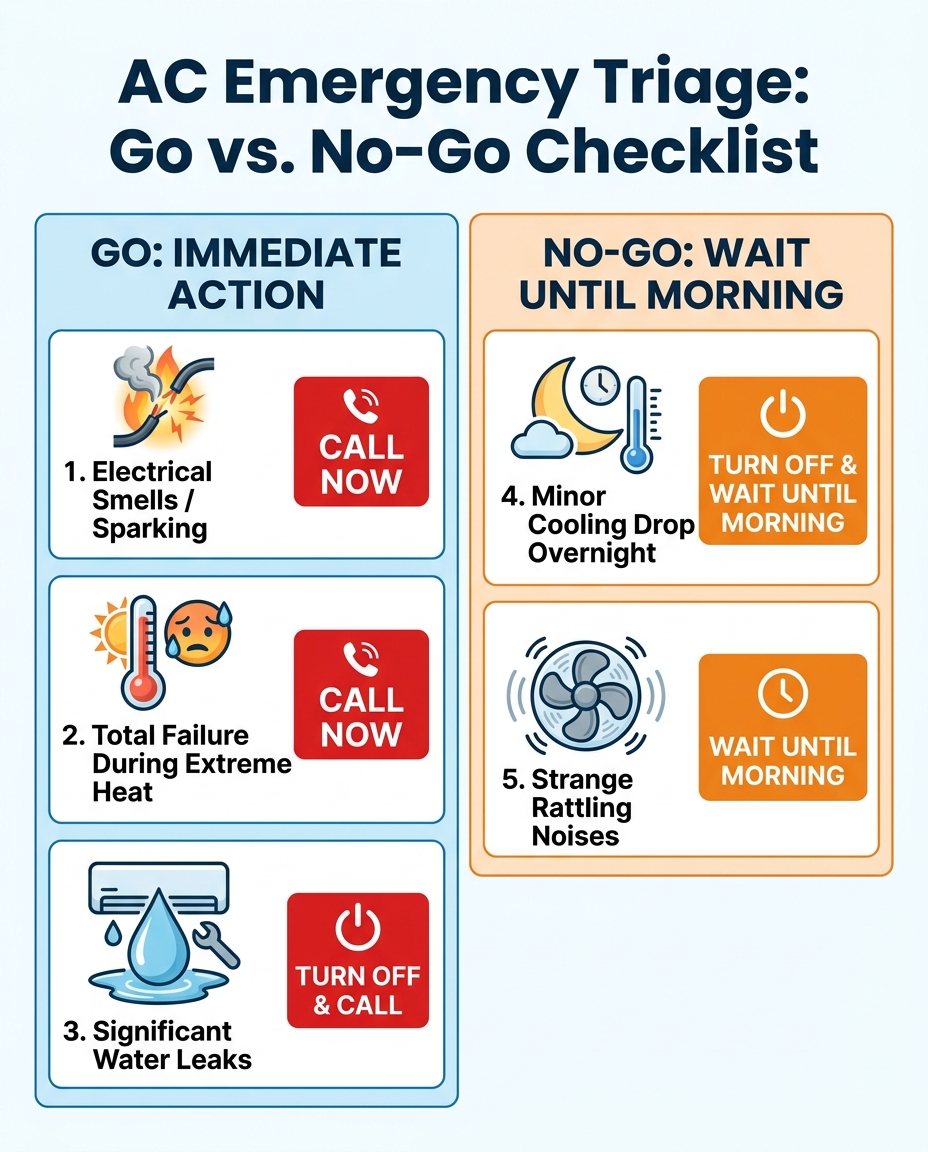
Understanding the "no-go" criteria is just as important as knowing when to call. We always advise our local customers that not every malfunction requires a midnight dispatch. By correctly identifying non-critical issues, you can stay calm and schedule a standard AC Maintenance or repair visit during normal business hours. The key is to safely shut down the system to prevent further mechanical damage while you wait.
- Minor cooling drops overnight: If you notice a slight widening in the thermostat temperature differential late in the evening (e.g., the house is 74 degrees instead of 72), but the air coming from the vents is still relatively cool, the system is likely low on refrigerant or struggling with a dirty condenser coil. Turn the system off, open windows if the outdoor AQI permits, and call in the morning.
- Strange but non-threatening noises: A rattling sound from the outdoor unit often indicates a loose panel, a twig caught in the fan grate, or a vibrating refrigerant line. While annoying, it does not pose an immediate safety risk. Shut the unit off to prevent the fan blade from taking damage, and wait for standard hours.
- A clogged condensate drain without property damage: If your system has a safety float switch installed, a clogged drain line will automatically shut the system down to prevent a flood. The system will not turn back on until the line is cleared. Since the safety switch is doing its job and preventing water damage, this is an inconvenience rather than a crisis.
- Thermostat screen is blank but batteries are dead: Always check the AA or AAA batteries in your thermostat before assuming the system is broken. A simple battery swap often resolves the issue instantly.
In all of these scenarios, turning the equipment off at the thermostat is the safest course of action. Running a compromised system overnight forces it to work harder, which can easily turn a minor repair into a major compressor replacement.
Making the Right Call for Your Comfort and Safety
Navigating an unexpected cooling failure requires a clear, objective look at the symptoms. By relying on a definitive checklist, you can confidently determine your next steps. Electrical burning smells, significant water leaks actively damaging your home, and total system failure during the peak summer heat equal a true emergency. In these situations, shutting down the equipment and isolating the power is the best way to protect your investment and your household.
If your situation meets these critical criteria, it is time to take action. Understanding exactly Emergency AC Repair: When to Call BAEHR ensures that you receive the immediate, professional intervention required to restore your home's safety. Protect your equipment by turning it off, and reach out to our team for expert help when you need it most.
Frequently Asked Questions
What is considered a true AC emergency?
Our team considers a true emergency to involve situations that threaten health, safety, or property. This includes electrical burning smells, sparking, total system failure during extreme heat waves, and massive water leaks. If vulnerable individuals are in the home during a severe heat event, a broken AC is an immediate crisis.
Should I turn off my AC if it is blowing warm air?
Yes, you should turn the system off immediately at the thermostat. Blowing warm air usually indicates a frozen evaporator coil, a failed compressor, or a severe refrigerant leak. Leaving the system running will only cause further mechanical damage and waste electricity.
Can I wait until morning for an AC repair?
You can safely wait until morning if the issue involves minor cooling drops, strange rattling noises, or if the outdoor temperatures are mild enough to keep the home comfortable. Always turn the system off overnight to prevent exacerbating the mechanical issue.
Is a leaking air conditioner an emergency?
It depends on the volume of water and the location of the unit. A massive leak that is actively ruining drywall, flooding a finished basement, or dripping onto electrical furnace components is an emergency. A minor drip outside near the condenser is not.
How does wildfire smoke impact a broken AC system?
Wildfire smoke severely limits your ability to ventilate your home using open windows. When the outdoor air quality is hazardous, a functional AC system is required to filter the indoor air and maintain safe temperatures, making a breakdown a much higher priority.
What should I check before calling for emergency HVAC service?
Always check the simple fixes first. Verify that the thermostat has fresh batteries, ensure the main circuit breaker has not tripped, and check that the indoor air filter is not completely blocked with dust. If these basic items are fine, you need professional diagnostics.
Ready to breathe easy?
Schedule service or request a free estimate. Honest assessments and upfront pricing on every visit across Nevada County.