4.9




Can a heat pump handle the cold winters of Nevada County and the truckee area? Yes — and in most cases, a properly specified cold-climate heat pump can do it efficiently, even at elevations above 5,800 feet. Here is a quick summary before we go deeper:
Quick Answer by Location
| Location | Typical Winter Low | Heat Pump Viable? | Notes |
|---|---|---|---|
| Auburn / Grass Valley | Rarely below 25°F | Yes, standard cold-climate models | Excellent fit; minimal backup needed |
| Nevada City | Occasionally near 20°F | Yes, cold-climate models | Proper sizing is key |
| Truckee / Tahoe area | Can reach single digits or below 0°F | Yes, hyper-heat or cold-climate specific models required | Must be rated for -15°F operation |
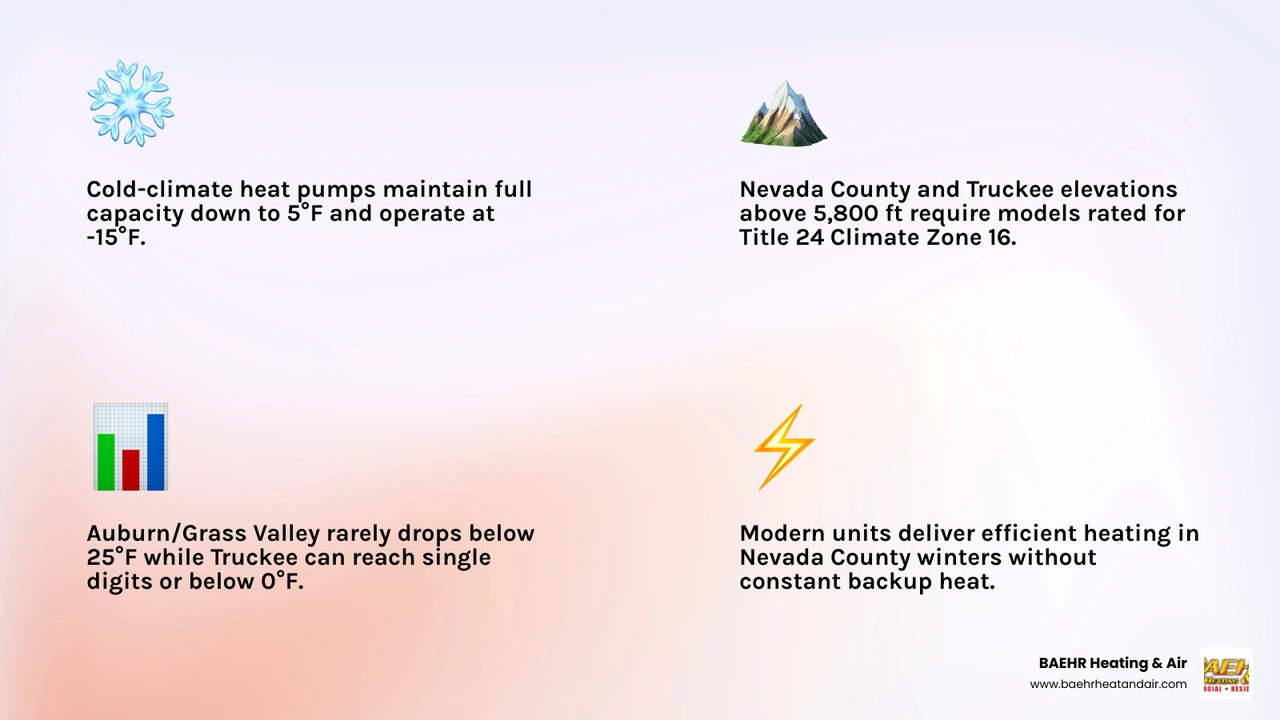
The short version: modern cold-climate heat pumps maintain full heating capacity at 5°F and can continue operating down to -15°F. That covers nearly every winter low recorded in Nevada County — and even the harshest nights in Truckee. The key word, though, is modern. Older or improperly sized units are a different story, and elevation adds real complexity that generic HVAC advice ignores entirely.
This guide walks through everything Nevada County and Truckee homeowners need to know — from how these systems perform in Title 24 Climate Zone 16 to real-world efficiency numbers, backup heat options, ground-source alternatives, and available incentives.
When homeowners in Grass Valley, Nevada City, or Auburn start planning an HVAC upgrade, they often wonder if they are asking too much of an all-electric system. For decades, the industry standard for these foothill communities was a split system: a gas or propane furnace for the winter, and a traditional air conditioner for our hot dry summers.
But as we look at the climate profiles across our service areas, the answer to can a heat pump handle the cold winters of nevada county and the truckee area is a resounding yes. The physical reality of how a heat pump operates makes it uniquely suited to our region. Rather than generating heat by burning fossil fuels, a heat pump uses advanced refrigerant cycles to extract ambient thermal energy from the outdoor air and move it indoors.
Even when the outdoor air feels freezing to us, it still contains a massive amount of thermal energy. In foothill towns like Auburn and Grass Valley, winter temperatures rarely drop below 25°F. At these moderate winter temperatures, a standard high-efficiency heat pump operates in its absolute sweet spot.
Once you cross the Sierra crest into Truckee, however, the heating demand changes dramatically. At elevations above 5,800 feet, winter is not just a season; it is a serious environmental challenge. Truckee regularly experiences heavy snowpack, sustained sub-freezing temperatures, and extreme low-temperature snaps that would cause an older, single-stage heat pump to struggle.
This is why choosing the right type of equipment is so critical. If you live in the high country, installing a standard heat pump designed for mild coastal climates will lead to high utility bills and cold rooms. To keep your home comfortable, you must install Air Source Heat Pumps in Truckee, CA that are specifically certified for cold-climate operation. These specialized units use advanced variable-capacity technology to handle the heavy lifting of a true Sierra winter.
To understand how a heat pump conquers high-altitude cold, we have to look at the differences between standard single-stage equipment and modern variable-capacity heat pumps (VCHPs).
Traditional heat pumps operate like a light switch: they are either 100% on or completely off. When the outdoor temperature drops, a single-stage system has to cycle on and off constantly, losing efficiency and struggling to extract enough heat from the thin, cold air.
Modern cold-climate variable-capacity heat pumps (ccVCHPs) act more like a dimmer switch. They utilize inverter-driven compressors that can modulate their speed in tiny increments. If your home only needs a small amount of heat, the compressor runs at a quiet, low speed. When a Sierra storm rolls in and the temperature plummets, the compressor ramps up to high speed, maintaining a steady indoor climate.
Many of these advanced cold-climate systems feature proprietary "hyper-heat" or flash-injection technology. This process injects a portion of the refrigerant directly back into the compressor, allowing the system to maintain high heating capacity even when the outdoor air is well below freezing.
In California’s Title 24 Building Energy Efficiency Standards, Truckee and the surrounding high-altitude communities are classified under Climate Zone 16 (CZ 16). This zone is defined by its high heating degree days and extreme winter design temperatures.
According to engineering models for Climate Zone 16, a detailed variable-capacity heat pump model reduced auxiliary electric strip heating energy use by a massive 97.8% compared to a standard heat pump model. Furthermore, because variable-capacity systems are so efficient at part-load conditions, a cold-climate variable-capacity system in CZ 16 actually required a 29% smaller nominal capacity unit than a typical standard heat pump when autosized to the design heating day.
If you are looking at upgrading your system in the foothills, exploring Heat Pump Systems in Nevada City, CA will show you that these variable-speed systems provide incredibly consistent, draft-free comfort without the sudden blasts of hot air associated with older propane furnaces.
One of the most common myths we hear is that heat pumps stop working entirely once the temperature drops below 32°F. While this may have been true for systems installed in the 1980s, modern cold-climate technology has completely rewritten the rulebook.
High-performance cold-climate heat pumps are designed to operate and provide efficient heating at outdoor temperatures as low as -15°F. They can deliver 100% of their rated heating capacity down to 5°F without needing any assistance from auxiliary heat. Given that Truckee's average winter lows hover in the teens—and rarely drop below zero—a properly sized cold-climate system has more than enough muscle to heat your home on the coldest nights of the year without relying on backup systems.
However, there is an important physical process that all air-source heat pumps must undergo in freezing weather: the defrost cycle.
When outdoor temperatures are below 35°F and there is moisture in the air, frost can accumulate on the outdoor unit's coils. To maintain airflow and heat transfer efficiency, the heat pump will periodically enter a defrost cycle. The system temporarily reverses its operation, running in cooling mode for a few minutes to send warm refrigerant to the outdoor coil and melt the ice.
During this brief defrost cycle, if a system does not have a way to mitigate it, you might feel a brief "cold blow" from your vents. To prevent this, most ducted heat pump installations include small auxiliary electric resistance heating coils (often called "heat strips") inside the indoor air handler. These strips turn on automatically during the defrost cycle to temper the air, ensuring that only warm, comfortable air is delivered to your living spaces.
For homeowners in the high-elevation areas of Truckee and the Tahoe Basin, choosing the right heat pump technology means weighing the pros and cons of air-source systems against ground-source (geothermal) systems.
While air-source systems extract heat from the ambient air, ground-source heat pumps (GSHPs) tap into the stable thermal energy buried deep underground. Below the frost line, the earth maintains a relatively constant temperature year-round (usually between 45°F and 55°F). This provides an incredibly stable heat source, regardless of how cold the mountain air gets.
| Feature | Air-Source Heat Pump (ASHP) | Ground-Source Heat Pump (GSHP) |
|---|---|---|
| Heat Source | Outdoor ambient air | Stable ground temperature below frost line |
| Low-Temp Performance | Declines slightly as temperatures drop below 0°F | Remains highly stable and consistent year-round |
| Snowpack Impact | Compressor must be elevated above snow shedding zones | Loops are buried safely underground; no snow issues |
| Installation Complexity | Moderate; outdoor unit placed on pad or wall brackets | High; requires vertical drilling or horizontal trenching |
| Lifespan | 12 to 15 years | 20+ years for indoor unit; 50+ years for ground loops |
| Best Suited For | Auburn, Grass Valley, Nevada City, and typical Truckee homes | Large properties, custom builds in deep snow zones like Tahoe Donner |
Ground-source heat pumps are incredibly efficient, delivering three to five units of heating energy for every single unit of electricity consumed. Because they do not have to battle sub-zero air temperatures, their efficiency remains exceptionally high even during extreme cold snaps.
Furthermore, GSHPs solve a major physical challenge in Truckee: deep snowpack. An air-source heat pump’s outdoor compressor must be carefully sited. It needs to be elevated on a heavy-duty stand or wall brackets to keep it clear of accumulating snow and out of the way of roof snow-shedding zones. A ground-source system completely avoids this issue because its heat exchange loops are buried deep underground, safe from winter weather.
Historically, GSHP systems installed in Truckee have proven to be highly durable and cost-effective over their lifespans. Systems installed in homes in the Tahoe Donner neighborhood back in the mid-1990s are still running and performing effectively today. Additionally, local institutions like Alder Creek Middle School have successfully utilized geothermal heating for decades to keep operating costs low.
However, ground-source systems require vertical bore wells or horizontal trenches, which can be highly complex to install in rocky Sierra soils. For most residential retrofits, a high-quality cold-climate air-source system is the most practical choice. If you want to explore professional installation options for your mountain home, scheduling a consultation for Heat Pump Installation in Truckee, CA is the best way to determine which system fits your property's unique layout and snow load requirements.
To evaluate whether a heat pump makes sense for your home, it helps to understand how we measure heating efficiency. We use a metric called the Coefficient of Performance (COP).
A standard electric resistance space heater has a COP of 1.0, meaning it converts 100% of its electrical energy into heat. A standard gas or propane furnace operates at an efficiency of 80% to 95%, meaning it actually loses some energy up the flue pipe.
In contrast, because heat pumps move heat rather than generating it, they can achieve a COP of 3.0 to 4.0 at moderate temperatures. That means they are 300% to 400% efficient. Even when temperatures drop below zero in Truckee, a cold-climate heat pump still operates at a COP of 1.5 to 2.0, making it significantly more efficient than any standard electric heater or fossil-fuel furnace.
For some homeowners, particularly those with existing, functional gas or propane furnaces, a hybrid (dual-fuel) system is an incredibly smart way to transition to electric heating.
In a hybrid setup, we install a high-efficiency heat pump alongside your existing furnace. The system is managed by an intelligent thermostat that monitors the outdoor temperature.
If you want to understand how these dynamics apply to your specific property, reading The Ultimate Guide to Home Heat Pumps will give you a deeper look at system configurations and how they perform across different regional climates.
When it comes to heat pump performance, installation quality is just as important as the brand of equipment you choose. A poorly installed system can suffer from a 30% reduction in operating efficiency, leading to higher utility bills and premature equipment failure.
The process must always begin with an accurate Manual J load calculation. This engineering calculation evaluates your home’s insulation levels, window types, air leakage, and local climate data to determine the exact heating and cooling capacity your home requires. Sizing a heat pump is a delicate balancing act:
During the physical installation, professional HVAC technicians must follow strict best practices. This includes performing a dry nitrogen purge while brazing the copper refrigerant lines to prevent internal oxidation and scale buildup. It also requires conducting a meticulous vacuum evacuation measured in microns to ensure the system is completely free of moisture and non-condensable gases before charging the refrigerant.
Once your system is installed, how you interact with your thermostat also has a massive impact on its performance and efficiency.
With a traditional gas furnace, many homeowners are used to programming deep "nighttime setbacks"—dropping the thermostat to 60°F at night and ramping it back up to 70°F at 6:00 AM. While this saves fuel with a furnace, it is highly inefficient for a heat pump.
When a heat pump is asked to raise the indoor temperature by more than 2 or 3 degrees all at once, it views this sudden demand as an emergency. To heat the home as quickly as possible, it will often activate its auxiliary electric backup heat strips. Because electric resistance heat is far less efficient than the heat pump's compressor, this morning ramp-up can cause your electricity usage to spike.
Additionally, if thousands of homes across California all program their heat pumps to ramp up simultaneously on cold winter mornings, it creates a massive "morning peak" on the regional electrical grid. To keep your operating costs low and protect the grid, the best strategy is to "set it and forget it." Keeping your thermostat at a consistent temperature allows the variable-capacity compressor to run at its lowest, most efficient speeds day and night.
Navigating the transition to electric heating can bring up a lot of questions. Here are some of the most common concerns we hear from our neighbors in the foothills and mountain communities.
Yes. Modern cold-climate heat pumps are engineered to handle extreme cold snaps. High-performance models can maintain full heating capacity down to 5°F and continue to extract heat from the air down to -15°F.
To ensure absolute peace of mind during rare, historic cold snaps, we typically design systems with built-in redundancies. This can include sizing the system to handle the home's heating load at the median of extreme winter temperatures, installing auxiliary electric backup heat strips inside the air handler, or configuring the system as a hybrid dual-fuel setup with an existing gas or propane furnace. With proper system design, your home will remain perfectly warm and cozy, no matter what the thermometer says outside.
Because heat pumps play a major role in California's clean energy goals, there are substantial financial incentives available to help homeowners make the switch.
When you combine these programs, you can significantly offset the upfront cost of your upgrade. If you are ready to explore these incentives for your home, scheduling an assessment for Heat Pump Installation in Nevada City, CA is the perfect first step to secure your rebates and plan your installation.
A high-quality gas or propane furnace typically has an operating lifespan of 15 to 20 years. This is largely because a furnace only runs during the cold winter months, remaining dormant for the rest of the year.
A heat pump, on the other hand, is an all-in-one heating and cooling system. It works year-round—heating your home in the winter and acting as a high-efficiency air conditioner during our hot Sierra summers. Because a heat pump runs during all four seasons, its typical operating lifespan is 12 to 15 years.
To maximize the lifespan and efficiency of your heat pump, regular preventative maintenance is absolutely essential. Dirty air filters, clogged outdoor coils, or minor refrigerant leaks can force the compressor to work much harder than necessary, leading to premature wear and high energy bills.
If you ever experience issues with your system during a winter storm, securing prompt Heat Pump Repair in Truckee, CA will ensure your system is quickly restored to peak operating condition.
So, can a heat pump handle the cold winters of nevada county and the truckee area? Not only can it handle them, but when properly sized and professionally installed, a modern cold-climate heat pump is one of the most comfortable, efficient, and reliable heating solutions available for our unique mountain and foothill climates.
At BAEHR Heating & Air, our customer-first team is dedicated to helping you find the perfect heating and cooling solution for your home. We serve homeowners across the region, including Lake Wildwood, Rocklin, Penn Valley, Nevada City, Grass Valley, Loomis, Auburn, Lincoln, and Truckee.
To help you keep your system running at peak efficiency year-round, we offer an annual maintenance membership for $310 that covers two comprehensive system visits per year. This proactive care ensures your heat pump is ready to handle whatever winter throws our way.
Are you ready to experience the quiet, consistent comfort of a modern cold-climate heat pump? Schedule your heat pump consultation today with our local HVAC experts and let us design a system tailored perfectly to your home and elevation.
Get Fast HVAC Help

Upgrade your home’s comfort, efficiency, and air quality with solutions tailored to your needs. From system upgrades to energy-saving improvements, our team delivers reliable service and long-lasting results you can trust.
.avif)