

How to Prevent AC Capacitor Failure in Sierra Foothill Summer Heat
Why AC Capacitors Fail During Sierra Foothill Summer Heat — And What It Means for Your Home. Understanding why do AC capacitors fail during Sierra Foothill…
Why AC Capacitors Fail During Sierra Foothill Summer Heat — And What It Means for Your Home
Understanding why do AC capacitors fail during Sierra Foothill summer heat starts with one core fact: capacitors are small, heat-sensitive electrical components, and the Sierra foothills are one of the harshest environments they can operate in.
Quick Answer: Why AC Capacitors Fail in Sierra Foothill Summers
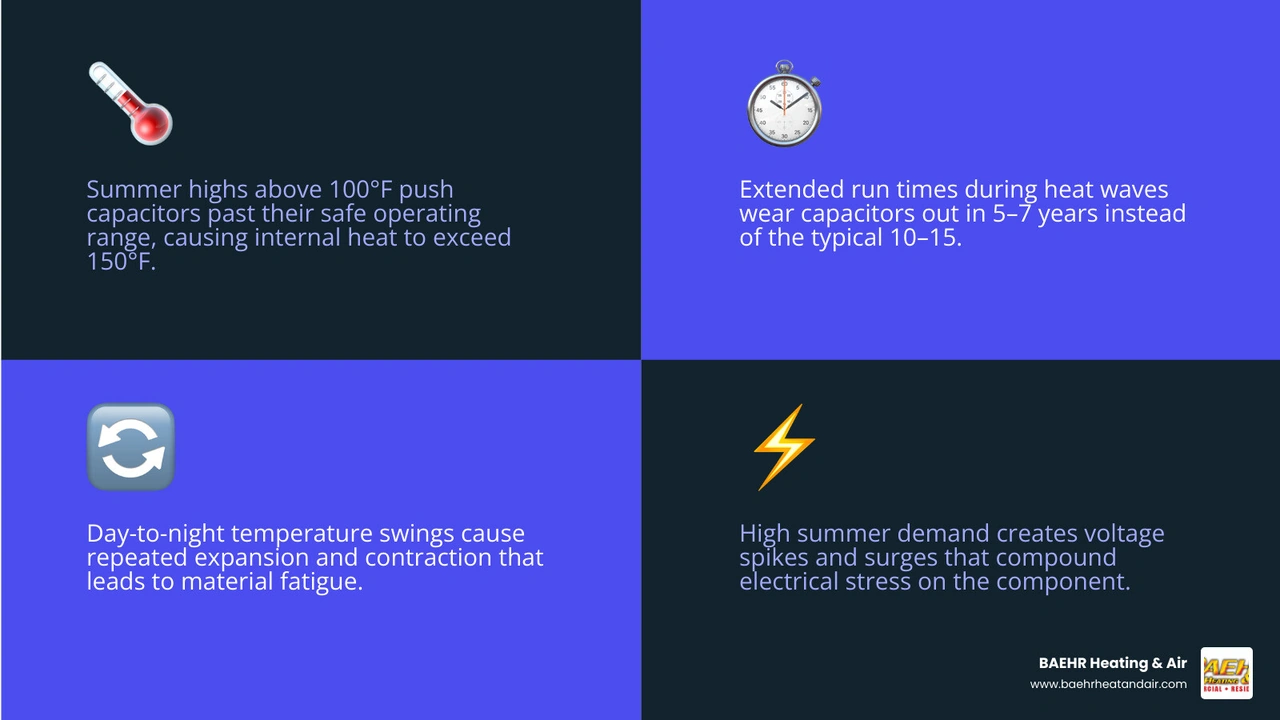
- Extreme ambient heat — Summer temperatures regularly push into the 100°F+ range, forcing capacitors to operate well above their design comfort zone
- Internal overheating — Internal capacitor temperatures can exceed 150°F, breaking down the dielectric material that makes them work
- Extended run times — Systems run nearly non-stop during heat waves, accelerating wear far faster than in milder climates
- Thermal cycling — Hot days followed by cool Sierra foothill nights cause the capacitor casing to expand and contract repeatedly, weakening it over time
- Power grid stress — High summer demand creates voltage fluctuations that add electrical strain to an already heat-stressed component
- Environmental exposure — Wildfire smoke, oak dust, and debris clog condenser units, trapping heat around electrical components
The result? Capacitors that might last 10–15 years in a mild climate often fail in as little as 5–7 years in the Sierra foothills — sometimes much sooner.
Capacitor failure is behind roughly 30% of all AC service calls, and some technicians report it as the cause in 7 out of 10 summer repairs. If your AC suddenly stops cooling on a 105°F August afternoon in Auburn, Grass Valley, or Lincoln, a failed capacitor is one of the first things a technician will check.
Why Do AC Capacitors Fail During Sierra Foothill Summer Heat?
To truly grasp why do AC capacitors fail during Sierra Foothill summer heat, it helps to think of the capacitor as a temporary, high-powered storage battery. Its primary job is to store up electrical energy and release it in a massive burst to kickstart your air conditioner's heavy-duty motors—specifically the compressor and the condenser fan. Once the motors are spinning, the run capacitor continues to supply a steady, phase-shifted electrical flow to keep them running efficiently.
However, these components are highly sensitive to their thermal environment. When the blistering summer heat hits regions like Rocklin, Loomis, and Penn Valley, several destructive forces begin to act on the capacitor simultaneously:
- Extreme Ambient Temperature and Thermal Stress: Most standard residential AC capacitors are designed to operate safely up to an internal limit of around 158°F (70°C). While a 100°F day in Nevada City or Lake Wildwood might seem well below that threshold, the temperature inside your outdoor condenser unit's electrical cabinet is vastly higher. Heated by direct sunlight and the thermal energy rejected by the condenser coils, cabinet temperatures frequently climb past 140°F. Under heavy electrical loads, the capacitor's internal temperature easily surges past its 158°F safety limit.
- Relentless Run Times: During a foothill heatwave, your AC doesn't get a break. Instead of cycling on and off normally, it might run at an 80% to 90% duty cycle. This continuous operation generates constant internal heat within the capacitor, leaving no window of time for the component to cool down.
- Dielectric Breakdown: Inside the metal canister of a capacitor, thin layers of metal foil are separated by a "dielectric" material—usually a polymer film soaked in a synthetic oil. This oil and film act as insulation, keeping the electrical charges separated until they are needed. As high temperatures bake the unit, this delicate chemical barrier begins to degrade. The dielectric oil can break down, vaporize, and create internal gas pressure.
When you are Troubleshooting AC Capacitor Failure, the most obvious physical sign of this chemical breakdown is a bulging, mushroomed, or dome-shaped top. In severe cases, the internal pressure causes the metal canister to rupture, leaking a greasy, oily residue and rendering the component completely useless.
How Extreme Temperature Fluctuations Explain Why Do AC Capacitors Fail During Sierra Foothill Summer Heat
While the valley floor experiences sustained baking heat, the Sierra foothills are famous for a different climatic pattern: massive diurnal temperature swings. It is not uncommon for a summer day in Grass Valley or Penn Valley to reach 102°F by mid-afternoon, only to plunge down to a cool 62°F after midnight.
While these cool mountain breezes are incredibly refreshing for us, they present a unique mechanical challenge for your air conditioner's electrical systems. This rapid heating and cooling cycle is known as thermal expansion and contraction.
During the peak heat of the day, the metal casing, internal plastic films, and metallic foils of the capacitor expand at slightly different rates. When the temperature drops rapidly at night, these materials contract. This constant daily tug-of-war causes material fatigue. Over weeks and months of a long foothill summer, this physical wear weakens the internal connections and structural integrity of the capacitor, making it far more vulnerable to electrical failure when the next heatwave rolls in.
Power Grid Fluctuations and Why Do AC Capacitors Fail During Sierra Foothill Summer Heat
Another critical piece of the puzzle is the local power grid. During high-demand summer months, thousands of air conditioners across Northern California turn on simultaneously, placing immense strain on utility infrastructure.
This regional demand spike often leads to voltage fluctuations, momentary drops in power (brownouts), and sudden electrical surges. When the voltage supplied to your home dips, your AC motors must draw more current (amperage) to perform the same amount of work. This sudden surge in current places immediate, intense electrical stress on the capacitor.
Furthermore, sudden power surges or rapid grid recovery spikes can instantly overwhelm a capacitor's voltage rating, burning through the weakened dielectric insulation in a fraction of a second. This combination of thermal baking and electrical grid instability creates the perfect storm for capacitor failure.
Environmental Stressors Unique to the Sierra Foothills
Operating an air conditioner in the Sierra foothills is fundamentally different than operating one in a coastal valley. The geography itself plays a major role in how long your HVAC components will survive.
- Elevation Effects: At higher elevations, such as in Truckee or the upper stretches of Nevada City, the air is thinner. Thinner air is a less effective cooling medium. Because air density is lower, the outdoor condenser fan cannot transfer heat away from the condenser coils—and the electrical cabinet—as efficiently as it would at sea level. This elevates the baseline operating temperature of the entire outdoor unit.
- Wildfire Smoke and Particulate Matter: In recent years, late-summer wildfire smoke has become an unfortunate reality in the foothills. Particulate matter from smoke, combined with heavy spring oak pollen and dry summer dust, settles directly onto the outdoor condenser coils.
- Dust Accumulation and Airflow Restriction: When these coils become blanketed in grime, the system can no longer reject heat effectively. The compressor has to work much harder, drawing more electrical current and raising the temperature inside the unit. If you need AC Service Grass Valley CA, a technician will often find that a failed capacitor was triggered by a dirty, clogged condenser coil that went uncleaned.
To put this into perspective, let's look at how these geographic and environmental factors directly impact the typical lifespan of an AC capacitor:
| Region / Climate Type | Typical Capacitor Lifespan | Primary Stress Factors |
|---|---|---|
| Mild Coastal Climates (e.g., Bay Area) | 10 to 15 Years | Low run times, moderate temperatures, stable grid |
| Inland Valley Climates (e.g., Sacramento) | 5 to 8 Years | High ambient heat, extended run times |
| Sierra Foothill Climates (e.g., Auburn, Grass Valley) | 3 to 6 Years | Extreme heat, rapid diurnal temp swings, elevation, wildfire smoke, grid fluctuations |
Warning Signs Your Capacitor Is About to Fail
Fortunately, capacitors rarely fail in complete silence. They usually drop hints that they are struggling before they give out entirely. Recognizing these indicators early can save you from a hot, uncomfortable afternoon waiting for an emergency repair.
- Loud Humming or Clicking Noises: If you walk past your outdoor condenser unit and hear a loud, low-pitched humming sound, but the fan isn't spinning, the run capacitor is likely failing. The motor is receiving electrical current but lacks the phase-shifted torque needed to spin up. You may also hear a clicking sound as the system attempts to start over and over again.
- Hard Starting (Struggling to Turn On): If your air conditioner seems to shudder, hesitate, or make a loud, strained noise when it first kicks on, it is experiencing "hard starting." This occurs when a weakened capacitor can no longer deliver the necessary electrical jolt, forcing the compressor motor to labor just to get moving. This is an urgent warning sign; ignoring it can quickly lead to more severe Warning Signs AC System About to Fail.
- The AC Blows Warm Air: If the capacitor powering your compressor fails but the fan capacitor is still working, the outdoor fan will spin, but the compressor will remain off. This results in your system circulating uncooled air throughout your home. If you are wondering Why Is Your AC Blowing Hot Air, a dead compressor capacitor is one of the most common culprits.
- Flickering Lights Upon System Startup: Because a failing capacitor forces the AC compressor to pull massive amounts of "locked rotor amps" directly from your home's electrical panel to start, you might notice your indoor lights dim significantly or flicker every time the cooling system turns on.
How to Prevent Capacitor Failure in Your Home
While you can't control the outdoor temperature or the local power grid, there are several highly effective steps you can take to protect your AC capacitor and extend its operational life.
1. Keep Your Condenser Coils Clean
As mentioned, dirty coils trap heat inside the unit, forcing the compressor to run hotter and draw more power. Gently washing your outdoor condenser coils with a garden hose (with the power turned off at the disconnect box) removes dust, pollen, and wildfire residue. For a comprehensive look at maintaining your system locally, check out our AC Maintenance Auburn Guide.
2. Provide Strategic Shade (While Maintaining Airflow Clearance)
Reducing the amount of direct, blistering sunlight that hits your outdoor unit can lower the temperature inside the electrical cabinet by 10 to 15 degrees. You can plant shrubs or build a small shade structure, but you must maintain at least two feet of clear space on all sides of the unit and five feet of clearance above it to ensure proper heat rejection.
3. Install Dedicated HVAC Surge Protection
Because power fluctuations are common during peak summer months in the foothills, installing a high-quality surge protector directly at your AC's outdoor disconnect box is cheap insurance. It will absorb sudden voltage spikes before they can reach and destroy your capacitor or control board.
4. Schedule Annual Professional Tune-Ups
During a professional maintenance visit, an HVAC technician doesn't just look at the capacitor; they use a digital multimeter to measure its actual capacitance, measured in microfarads (µF). If a capacitor rated for 45 µF has dropped below its safe tolerance limit (usually ±6%), we can replace it proactively before it fails completely and leaves you stranded in the heat. This is just one of the Top 5 Benefits of Regular AC Service and Maintenance. If you live in higher-altitude areas, scheduling an AC Tune Up Truckee CA before the peak summer heat arrives is the best way to ensure system reliability.
Frequently Asked Questions About Foothill AC Failures
Can I run my AC with a failing capacitor?
We strongly advise against it. Operating your air conditioning system with a weak or failing capacitor forces the compressor and fan motors to run at much higher temperatures and draw excessive electrical current. This can quickly burn out the motor windings, leading to a much more expensive repair, such as a total compressor failure. If your system is AC Not Cooling, turn it off at the thermostat and call a professional to diagnose the electrical components.
How long do capacitors last in the Sierra foothills?
While capacitors in mild coastal climates can easily last a decade, the extreme heat, diurnal temperature swings, and environmental stressors of the Sierra foothills typically reduce their lifespan to 3 to 6 years. Regular preventive testing during your annual tune-up is key to catching them before they fail. If you suspect your system is struggling in the heat, scheduling Air Conditioning Repair Lincoln CA can get your electrical components checked and replaced quickly.
What happens if my evaporator coil fails alongside the capacitor?
If your indoor evaporator coil is clogged, leaking refrigerant, or failing, it severely restricts airflow and heat transfer. This forces the entire system to run much longer cycles to cool your home. This extended runtime drastically increases the heat load and electrical stress on the outdoor capacitor. If your AC Evaporator Coil Is Failing, it creates a cascading chain reaction of strain that will rapidly wear out your capacitor and compressor.
Protect Your Comfort This Summer with BAEHR Heating & Air
Preventive care is the absolute best way to ensure your air conditioner survives the demanding Sierra foothill summers. At BAEHR Heating & Air, we are dedicated to keeping your home cool and comfortable through every heatwave.
One of the easiest ways to protect your system is through our annual maintenance membership. For a convenient yearly investment, our membership covers two comprehensive system visits per year, ensuring your coils are clean, your electrical components are tested, and your system is running at peak efficiency when you need it most.
Don't wait for your AC to quit on the hottest day of the year. Contact us today to secure your peace of mind and Schedule Grass Valley AC Repair or maintenance with our friendly, expert team.
Ready to breathe easy?
Schedule service or request a free estimate. Honest assessments and upfront pricing on every visit across Nevada County.