

All About Cold Climate Heat Pumps vs Standard Units
When Temperatures Plunge: What Cold Climate Heat Pumps Do That Standard Units Can't. If you've been wondering what is a cold climate heat pump and how is it…
When Temperatures Plunge: What Cold Climate Heat Pumps Do That Standard Units Can't
If you've been wondering what is a cold climate heat pump and how is it different from a standard unit, here's the short answer: a cold climate heat pump (CCHP) is a specially engineered heating and cooling system designed to keep delivering reliable, efficient heat even when outdoor temperatures drop well below freezing — down to -15°F or colder — while standard heat pumps begin losing significant capacity around 30°F and often need backup heat by the time it hits 20°F.
Quick Answer: Cold Climate vs. Standard Heat Pump
| Feature | Standard Heat Pump | Cold Climate Heat Pump |
|---|---|---|
| Effective temperature range | Down to ~25-30°F efficiently | Down to -15°F or colder |
| Capacity at 5°F | ~40-50% of rated capacity | 85-100% of rated capacity |
| Capacity at -13°F | ~20-40% | 70-85% |
| Backup heat needed? | Often required below 25°F | Rarely needed; sometimes optional |
| Key technology | Single- or two-stage compressor | Variable-speed inverter + vapor injection |
| Efficiency vs. gas heat | Moderate advantage | Up to ~400% efficiency (4x gas) |
| ENERGY STAR Cold Climate certified? | No | Yes (HSPF2 ≥ 8.1 ducted / 8.5 ductless; COP ≥ 1.75 at 5°F) |
For homeowners in Truckee and the Sierra Nevada, this distinction is not a minor technical detail — it's the difference between a system that coasts through a cold snap and one that struggles and drives up your electricity bill running backup resistance heat. The Sierra Nevada regularly sees overnight lows that push standard heat pumps to their limits, which is exactly why understanding the CCHP vs. standard comparison matters before you invest in a new system.
The good news: modern cold climate heat pumps are a proven, mature technology in 2026. Field data from cold-weather states like Maine, New York, and Minnesota confirm that these systems hold their own in genuinely brutal winters. The technology has improved dramatically over the past decade, driven by advances in variable-speed compressors, smarter refrigerant circuits, and enhanced defrost controls that simply weren't available in older units.
This guide walks you through everything you need to know — how CCHPs work, how to size one correctly for a Sierra Nevada home, which certifications to look for, and what installation looks like in practice.
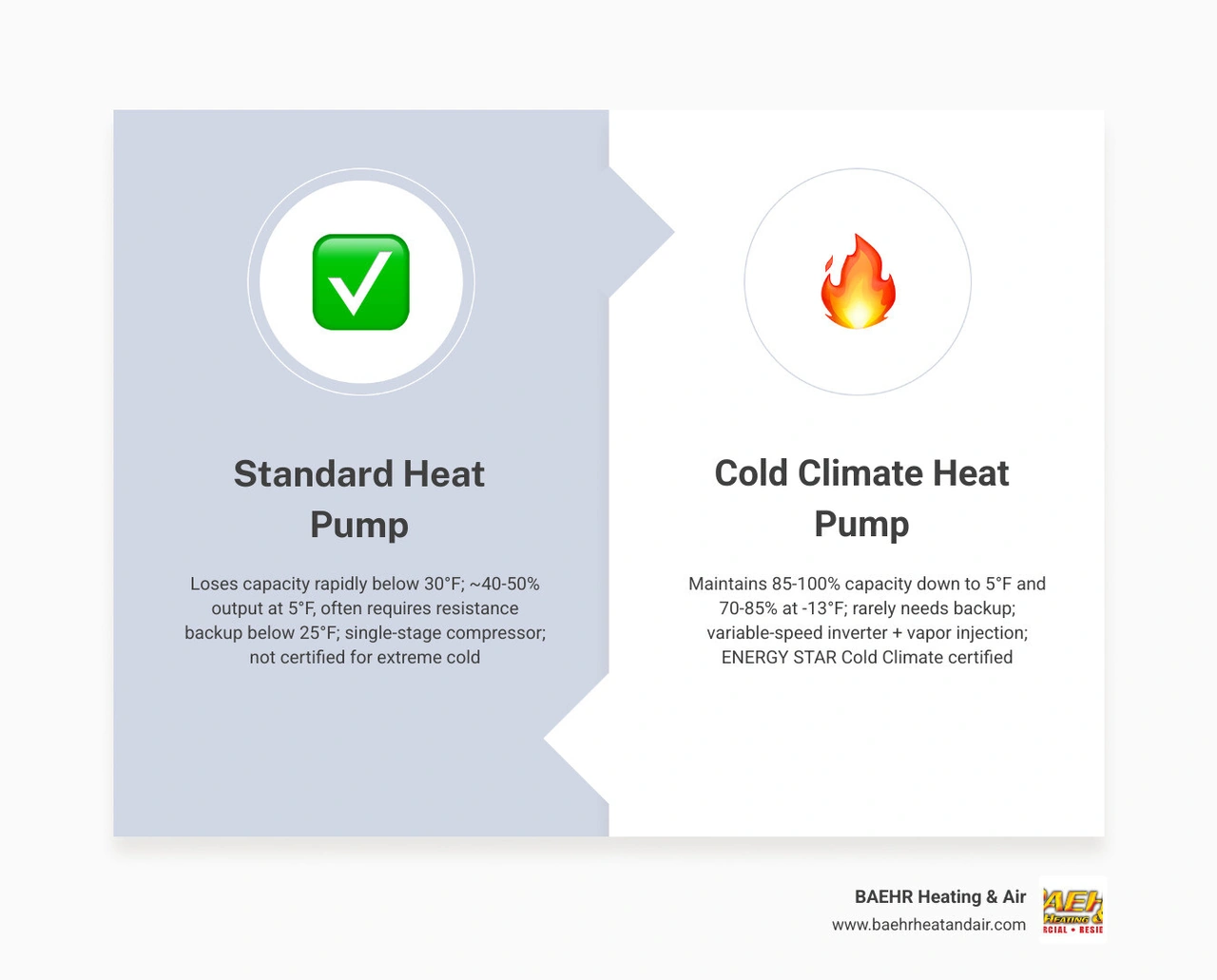
What Is a Cold Climate Heat Pump and How Is It Different From a Standard Unit?
To understand how a cold climate heat pump works, it helps to look at the basic physics of heat transfer. No matter how freezing it feels outside in Grass Valley or Nevada City, there is actually still a substantial amount of thermal energy present in the outdoor air. A heat pump's job is to capture that ambient heat and move it indoors.
Standard Heat Pump Systems are incredibly efficient in mild weather. However, as the temperature drops, two things happen simultaneously: your home loses heat faster (increasing your heating load), and a standard heat pump loses its ability to extract heat from the outdoor air (decreasing its heating capacity). This is the classic "cold weather conundrum" of traditional heat pumps.
Standard units typically use single-stage or two-stage compressors. When temperatures drop below 30°F, these compressors cannot cycle fast enough or handle the low refrigerant pressures required to harvest heat efficiently. As a result, their capacity drops off a cliff. A standard unit might only deliver 50% of its rated heating output at 25°F, forcing the system to activate auxiliary electric resistance heat strips—which are essentially giant, power-hungry hair dryers built into your ductwork—or switch over entirely to a backup furnace.
A cold-climate heat pump, on the other hand, is engineered specifically to maintain its heating capacity in sub-freezing conditions. By utilizing advanced compressor designs and specialized refrigerant cycles, a CCHP can deliver up to 100% of its rated heating capacity down to 5°F, and continue operating efficiently at temperatures as low as -15°F or even -22°F.
Understanding What Is a Cold Climate Heat Pump and How Is It Different From a Standard Unit
The fundamental difference lies in thermodynamics and refrigerant management. All heat pumps use a refrigerant cycle to absorb heat in one place and release it in another. In heating mode, the refrigerant evaporates in the outdoor coil, absorbing heat from the air, and then condenses in the indoor coil, releasing that heat into your living space.
For a heat pump to extract heat from 10°F air, the refrigerant circulating through the outdoor coil must be significantly colder than 10°F. Modern CCHPs use advanced refrigerants with exceptionally low boiling points—often around -44°F. This physical property allows the refrigerant to remain a boiling, vaporizing liquid even when exposed to sub-zero mountain air, enabling continuous heat extraction.
As detailed in our Home Heat Pump Ultimate Guide, standard units simply cannot maintain the required pressure differences to keep this process running efficiently when the temperature differential between the indoor and outdoor air becomes extreme. CCHPs solve this with a completely redesigned refrigeration circuit that maintains a steady capacity curve, ensuring your home stays warm without relying on expensive backup heat.
Key Technologies: Variable-Speed Compressors and Vapor Injection
Several breakthrough engineering features allow cold climate heat pumps to perform this thermodynamic magic:
- Variable-Speed Inverter Compressors: Unlike standard compressors that are either 100% "on" or "off," inverter-driven compressors can modulate their speed incrementally anywhere from 40% to over 100% capacity. In mild weather, they run at low, highly efficient speeds. When a Sierra winter storm hits, the compressor can "overspeed" to boost heating capacity and meet the increased demand.
- Enhanced Vapor Injection (EVI): This is the crown jewel of CCHP technology. EVI introduces a second, smaller electronic expansion valve that injects a portion of superheated refrigerant vapor directly into the middle of the compression cycle. This lowers the compressor's operating temperature, increases the mass flow rate of the refrigerant, and significantly boosts heating capacity at extremely low outdoor temperatures.
- Oversized Heat Exchangers: CCHPs feature larger outdoor coils with advanced fin designs. This provides more surface area to maximize heat transfer from the freezing outdoor air.
- Electronic Expansion Valves (EEVs): While standard systems often use mechanical expansion valves, CCHPs utilize electronic valves controlled by microprocessors. This allows for incredibly precise refrigerant flow adjustments based on real-time outdoor temperatures.
- Advanced Defrost Cycles: Frost accumulation is natural when running a heat pump in cold, humid weather. CCHPs feature intelligent, sensor-driven defrost systems that only activate when absolutely necessary, minimizing the energy spent melting ice off the outdoor coils.
Performance and Sizing for Sierra Nevada Winters
Sizing an HVAC system in the Sierra Nevada foothills and mountains is a unique challenge. In communities like Auburn, Loomis, and Rocklin, winters are relatively mild, but summers can be hot. Conversely, up the canyon in Truckee, winter temperatures regularly dip into the single digits, while summer cooling needs are minimal.
Because of these diverse microclimates, choosing a system requires balancing both heating and cooling performance. If you are Choosing Between an AC and Heat Pump, a cold climate heat pump is often the ideal year-round solution because it handles both tasks with a single footprint.
Sizing a Heat Pump for Cold Climates
Historically, HVAC contractors sized heat pumps based on the home's cooling load. In a mild climate, this works perfectly. However, if you size a standard heat pump to match a Truckee home's modest summer cooling load, the unit will be drastically undersized for the winter heating load.
To solve this, CCHPs are sized using a more comprehensive approach:
- ACCA Manual J Load Calculation: We perform a room-by-room thermal analysis of your home, accounting for insulation levels, window performance, air infiltration, and local design temperatures. This tells us exactly how much heat your home loses on the coldest night of the year.
- ACCA Manual S Equipment Selection: Using the Manual J data, we select equipment based on its low-temperature performance curves rather than its nominal cooling capacity.
- NEEP Sizing Charts: We consult extended performance data from the Northeast Energy Efficiency Partnerships (NEEP) database to verify how much heating capacity a specific model retains at 5°F and -13°F.
Because CCHPs use variable-speed compressors, we can safely size the system to meet 100% of your heating load without worrying about the system being "oversized" for summer cooling. When cooling is needed, the inverter compressor simply scales down to its lowest speed, providing quiet, continuous dehumidification without short-cycling. If your older system is struggling to keep up, a professional Heat Pump Replacement designed around these cold-climate sizing principles can completely transform your home's winter comfort.
Choosing the Right System: What Is a Cold Climate Heat Pump and How Is It Different From a Standard Unit?
When shopping for a CCHP, you should look past standard marketing labels and focus on verified performance ratings. Key specifications to evaluate include:
- ENERGY STAR Cold Climate Certification: To earn this designation, a heat pump must meet strict efficiency baselines, including a Coefficient of Performance (COP) at 5°F of 1.75 or greater, and a heating capacity at 5°F that is at least 70% of its capacity at 47°F.
- HSPF2 (Heating Seasonal Performance Factor): This rating measures the system's heating efficiency over an entire season. Look for a system with an HSPF2 of 8.1 or higher for ducted systems, and 8.5 or higher for ductless systems. Top-tier cold climate models can reach HSPF2 ratings of 10.0 or higher.
- COP at 5°F: This represents the real-time efficiency at freezing temperatures. A COP of 2.0 means the system delivers two units of heat energy for every one unit of electricity consumed (200% efficiency). Many high-end CCHPs maintain COPs between 1.75 and 2.5 even in extreme cold, easily outperforming standard electric resistance heating.
Investing in a system that meets these rigorous standards ensures Year Round Comfort with Heat Pumps, providing highly efficient cooling in July and reliable, powerful heating in January.
System Configurations and Installation Best Practices
Cold climate heat pumps are highly versatile and can be configured to match almost any home layout, whether you are retrofitting a historic cabin in Nevada City or building a modern home in Lincoln.
Ducted vs. Ductless Systems in Cold Climates
Depending on your home's existing layout, you can choose between several configurations:
- Central Ducted Systems: If your home already has a ductwork system in place, a central ducted CCHP can directly replace your old furnace and air conditioner. However, it is vital to assess the condition of your ducts. Because heat pumps supply air at slightly lower temperatures (90°F to 110°F) compared to a gas furnace (120°F to 140°F), leaky or uninsulated ducts can result in significant heat loss.
- Ductless Mini-Splits: These systems are incredibly popular in mountain regions. They feature an outdoor condenser connected to one or more indoor air handlers mounted directly on the wall or ceiling. Ductless mini-splits offer the highest efficiencies because they eliminate duct losses entirely and allow for precise zone control.
- Dual-Fuel (Hybrid) Systems: In some applications, a CCHP is paired with a high-efficiency gas or propane furnace. The heat pump handles the heating duties for 90% of the winter. If temperatures drop below a predetermined "crossover point" (usually around 15°F or 20°F), the system automatically switches to the furnace. This is an excellent option for homes with existing gas infrastructure that want to minimize electricity consumption during peak winter utility rates.
When planning an upgrade, evaluating your Heat Pump vs Gas Furnace Infrastructure is a crucial first step to determine which configuration will deliver the best performance and efficiency for your specific property.
Installation and Maintenance Best Practices
A cold climate heat pump is a highly sophisticated piece of machinery, and its performance depends heavily on the quality of the installation. When we perform a Heat Pump Installation, we follow strict best practices to ensure reliable cold-weather operation:
- Elevated Outdoor Placement: In snowy regions like Truckee, the outdoor unit must be mounted on a heavy-duty stand at least 18 to 24 inches above the ground to keep it clear of snow accumulation and ice dams.
- Gabled Roof Protection: We avoid placing outdoor units directly under roof valleys or eaves where falling snow and ice could damage the fan or coil.
- Wind Baffles: Strong winter winds can interfere with the outdoor unit's fan and defrost cycle. Installing wind baffles protects the coil and ensures steady airflow.
- Electrical Service Assessment: Because CCHPs can draw more power when running at maximum capacity in sub-zero weather, we always evaluate your electrical panel to determine if a service upgrade is necessary.
- Line Set Insulation: Refrigerant lines must be thoroughly insulated with high-quality, weather-resistant sleeve material to prevent thermal loss as the hot refrigerant travels from the outdoor unit into your home.
Once installed, keeping your system running at peak performance requires consistent care. Enrolling in regular Heat Pump Maintenance ensures your filters are clean, your refrigerant levels are correct, and your defrost drains remain clear of ice and debris throughout the winter.
Frequently Asked Questions about Cold Climate Heat Pumps
If your system is acting up or you want to learn more about how to keep it running smoothly, our professional Heat Pump Repair team is always here to help. Below are some of the most common questions we hear from local homeowners.
Do heat pumps really work below zero?
Yes, modern cold climate heat pumps absolutely work below zero. Thanks to advanced variable-speed inverter compressors and Enhanced Vapor Injection (EVI) technology, certified CCHPs can operate effectively down to -15°F or even -22°F.
The physics behind this comes down to the temperature of the refrigerant. Because the refrigerant circulating through the outdoor coil is kept at an extremely low temperature (often below -40°F), it remains colder than the sub-zero outdoor air. Heat naturally flows from a warmer area to a colder area, allowing the refrigerant to continuously extract thermal energy from the freezing air, compress it to raise its temperature, and deliver reliable warmth indoors.
Do cold climate heat pumps need backup heat?
In many homes, a properly sized cold climate heat pump can handle 100% of the heating load without any backup heat. However, depending on your local climate zone and home insulation, we may recommend a backup strategy:
- Electric Resistance Strips: These can be installed inside the indoor air handler to act as an emergency backup during extreme, unprecedented cold snaps.
- Dual-Fuel Setup: If you live in a region with high electricity rates or frequent winter storms, pairing your CCHP with an existing gas or propane furnace provides peace of mind and allows you to switch fuel sources based on whichever is more economical at the time.
What is the lifespan of a cold climate heat pump?
With professional installation and regular care, a high-quality cold climate heat pump typically lasts between 12 and 15 years. Because these systems work hard year-round—providing both heating in the winter and cooling in the summer—they experience consistent operational use.
Scheduling annual Heat Pump Service is the single best way to maximize your system's lifespan, protect the compressor from unnecessary wear and tear, and ensure it operates at peak efficiency for years to come.
Conclusion
Understanding what is a cold climate heat pump and how is it different from a standard unit is the key to making an informed decision about your home's comfort. While standard units are excellent for mild climates, a true cold climate heat pump is a necessity for reliable, efficient heating during Sierra Nevada winters.
At BAEHR Heating & Air, our customer-first team is dedicated to helping you find the perfect heating and cooling solution for your home. We proudly serve Lake Wildwood, Rocklin, Penn Valley, Nevada City, Grass Valley, Loomis, Auburn, Lincoln, and Truckee. To keep your system running flawlessly year-round, we offer an annual maintenance membership for $310 that covers two comprehensive maintenance visits per system each year.
Ready to upgrade your home comfort or schedule your next system tune-up? Explore our Heat Pump Systems today or contact us to speak with one of our local home comfort experts!
Ready to breathe easy?
Schedule service or request a free estimate. Honest assessments and upfront pricing on every visit across Nevada County.