

How to Clean Mini Split Filters Often During Wildfire Smoke Season in Nevada County
Why Knowing How Often to Clean Mini Split Filters During Wildfire Smoke Season in Nevada County Can Protect Your Health. How often to clean mini split…
Why Knowing How Often to Clean Mini Split Filters During Wildfire Smoke Season in Nevada County Can Protect Your Health
How often to clean mini split filters during wildfire smoke season in Nevada County depends on how bad the smoke is outside. Here is a quick answer:
| Outdoor Conditions | How Often to Clean Mini Split Filter |
|---|---|
| Normal (no smoke) | Every 2-4 weeks |
| Light to moderate smoke | Every 1-2 weeks |
| Heavy smoke (AQI 151+) | Every 5-7 days |
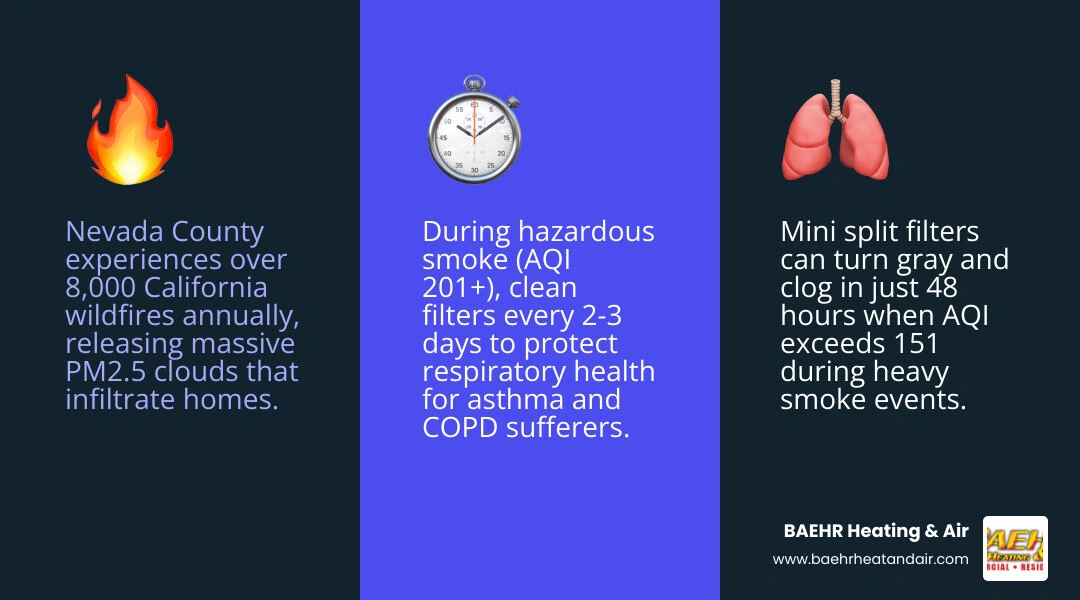
| Hazardous smoke (AQI 201+) | Every 2-3 days or as soon as visibly gray |
Nevada County sits in the Sierra Nevada foothills — right in the heart of California wildfire country. In 2024 alone, California recorded over 8,000 wildfires burning more than one million acres. When smoke rolls through Grass Valley, Nevada City, and the surrounding foothills, it does not stay outside. Fine smoke particles, known as PM2.5, slip into your home and get pulled straight through your mini split system.
The problem is that most mini split filters are basic mesh screens designed to protect the evaporator coil — not to purify your air. Under normal conditions, cleaning them every few weeks is enough. But during a smoke event, that same filter can turn gray in as little as 48 hours and become a bottleneck that strains your system and pushes dirty air back into your living space.
Filters that normally last 90 days can clog in just 2 to 3 weeks during heavy smoke exposure. For Nevada County homeowners with asthma, COPD, or young children at home, that gap between cleanings is not a small detail — it is a real health risk.
How Often to Clean Mini Split Filters During Wildfire Smoke Season in Nevada County
When wildfire smoke settles over the Sierra Nevada foothills, your daily routine changes, and your HVAC maintenance schedule must change with it. Under normal weather conditions, we recommend checking and washing your mini split's mesh filters every 30 days. However, when active fires are burning nearby, that standard 30-day cycle is simply not enough.
During active smoke events, you should clean your mini split filters every 5 to 7 days. If the smoke is exceptionally heavy and the Air Quality Index (AQI) climbs into the "Hazardous" range, you may need to inspect and rinse them every 2 to 3 days.
Because mini split indoor heads recirculate the air already inside your room, they are constantly pulling in any smoke particles that manage to sneak through the gaps in your doors, windows, and floorboards. If you live in a historic home in Nevada City, a mountain retreat in Truckee, or a ranch in Grass Valley, your home's envelope is likely prone to some level of smoke infiltration.
Keeping up with this accelerated cleaning schedule prevents your system from choking on fine particulates. If you are unsure about the overall health of your system before the fire season peaks, scheduling professional Mini Split Maintenance Grass Valley CA, Mini Split Maintenance Nevada City CA, or Mini Split Maintenance Truckee CA can ensure your system is fully prepared to handle the extra workload.
How Wildfire Smoke Impacts Mini Split Performance and Indoor Air Quality
To understand why more frequent cleaning is required, it helps to look at the differences between normal household dust and the microscopic debris carried by wildfire smoke.
Wildfire smoke is not just ash; it is a complex, toxic mixture of water vapor, carbon monoxide, carbon dioxide, volatile organic compounds (VOCs), hydrocarbons, and fine particulate matter known as PM2.5. PM2.5 particles are smaller than 2.5 microns in diameter—about 30 times smaller than a single strand of human hair.
Because these particles are so small, they easily bypass basic filtration. Even worse, wildfire smoke contains oily, sticky residues from burning pine needles, bark, and synthetic materials. When these oily particulates are pulled into your mini split, they do not just sit loosely on the filter like household dust. They stick to the mesh, creating a dense, varnished glaze that blocks air from passing through.
| Feature | Normal Household Dust | Wildfire Smoke & Ash |
|---|---|---|
| Particle Size | 10 to 100 microns (visible) | 0.1 to 2.5 microns (microscopic PM2.5) |
| Texture | Dry, fibrous, easily vacuumed | Oily, sticky, highly adhesive |
| Filter Impact | Gradual accumulation over 30–90 days | Rapid clogging and glazing in 5–7 days |
| System Impact | Mild reduction in airflow over time | Severe airflow restriction, coil freezing, motor strain |
| Odor | Neutral or dusty | Strong, persistent, chemical wood-smoke smell |
When a mini split filter is coated in this sticky glaze, the system must work twice as hard to draw air across the evaporator coils. This restriction in airflow causes the pressure inside the system to drop, which can lead to frozen evaporator coils, water leaks inside your home, and even blower motor burnout.
To protect your home's comfort and keep your indoor environment safe, keeping your filtration system in peak condition is vital. If you are noticing persistent dust or a lingering smoky odor indoors, exploring options for Indoor Air Quality Grass Valley CA or Indoor Air Quality Nevada City CA can help restore a clean breathing environment.
Why You Must Know How Often to Clean Mini Split Filters During Wildfire Smoke Season in Nevada County
The primary reason to stay on top of your mini split filter cleaning is to protect your family’s respiratory health. Fine PM2.5 particles are small enough to bypass your body’s natural defenses, traveling deep into your lungs and entering your bloodstream.
In the United States, over 25 million people live with asthma, including more than 6 million children. During major wildfire events, emergency room visits for asthma, COPD, and cardiovascular distress spike significantly across Northern California.
As we navigate the warm summer months of June 2026, keeping our indoor air clean is more critical than ever. Failing to clean your filters frequently means your mini split will eventually stop trapping these microscopic irritants altogether, allowing them to recirculate endlessly through your bedrooms and living spaces. By understanding the mechanics of your system and taking proactive steps, you can significantly Enhance Indoor Air Quality and create a safe haven from the smoky air outside.
Step-by-Step Guide to Cleaning Your Mini Split Filters
Cleaning the reusable mesh filters in your mini split is a straightforward process that does not require any specialized tools. Here is how to do it safely and effectively during the smoke season:
- Power Down the Unit: Always turn off your mini split using the remote control, and for extra safety, turn off the power at the circuit breaker or local disconnect switch before opening the indoor unit.
- Open the Front Panel: Gently lift the front plastic cover of the indoor wall unit until it clicks into its open position.
- Slide Out the Mesh Filters: Locate the plastic tabs on the bottom of the mesh screens. Gently push the tabs up slightly to unhook the filters, then slide them down and out of the unit.
- Vacuum the Loose Debris: Before getting the filters wet, use the brush attachment on your vacuum cleaner to gently sweep away loose ash, dust, and pet dander. Vacuuming prevents the debris from turning into a muddy paste when rinsed.
- Rinse Under Lukewarm Water: Take the filters to a sink or bathtub. Rinse them with cool or lukewarm water from the clean side of the filter to the dirty side, pushing the dust off the mesh rather than deeper into it. If the filter has a sticky, oily smoke residue, use a few drops of mild dish soap and gently agitate it with your fingers. Avoid using harsh chemical cleaners or stiff scrub brushes, which can tear the delicate mesh.
- Air Dry Completely: Shake off any excess water and lay the filters flat in a shaded, clean indoor area to dry. Never reinstall wet filters, as damp mesh will rapidly attract mold, bacteria, and fresh smoke particles, creating a musty odor and clogging the system instantly. Let them dry for at least 30 to 60 minutes.
- Reinstall and Power On: Slide the dry filters back into their tracks, click them into place, close the front panel, and restore power to your system.
Adjusting How Often to Clean Mini Split Filters During Wildfire Smoke Season in Nevada County Based on AQI
To make your maintenance routine as efficient as possible, you should use local air quality resources to guide your cleaning schedule. Real-time monitoring websites like AirNow.gov and PurpleAir.com provide hyper-local Air Quality Index (AQI) readings for Nevada County communities, from the lower elevations of Penn Valley and Lake Wildwood to the higher mountain passes of Truckee.
- AQI 0 to 50 (Good): Stick to your standard monthly cleaning routine.
- AQI 51 to 100 (Moderate): Check the filters every two weeks. Clean them if you have pets or if you notice a light gray tint on the mesh.
- AQI 101 to 150 (Unhealthy for Sensitive Groups): Inspect your filters weekly. If anyone in your home manages asthma or allergies, rinse the filters every 7 days regardless of visual appearance.
- AQI 151 to 200 (Unhealthy): Clean your filters every 5 to 7 days. At this stage, smoke is actively leaking into most homes, and the mini split will load up with fine particles quickly.
- AQI 201+ (Very Unhealthy / Hazardous): Inspect the filters every 2 to 3 days. Clean them immediately if they appear gray or if you smell a faint scent of wood smoke indoors.
Recommended Filter Upgrades and Standalone Air Purifiers
While keeping your factory mesh filters clean is essential for protecting your mini split's internal components, these basic screens are typically rated below a MERV 4 equivalence. This means they are designed to catch large particles like hair, carpet fibers, and heavy dust, but they let microscopic PM2.5 smoke particles pass right through.
To truly clean your indoor air during wildfire season, you need to look at filtration upgrades and supplemental systems:
- Carbon and Aftermarket Inserts: Some mini split manufacturers offer small, slide-in activated carbon or electrostatic allergy strips that sit behind the main mesh filter. Activated carbon is highly effective at capturing volatile organic compounds (VOCs) and neutralizing the heavy, acrid smell of wood smoke. These inserts cannot be washed and must be replaced every 30 to 60 days during active fire seasons.
- The MERV 13 Standard: In central HVAC systems, upgrading to a MERV 13 filter is the gold standard for wildfire protection, as MERV 13 filtration achieves greater than a 75% reduction in indoor PM2.5 during smoke events. However, because mini split blowers are small, they cannot handle the airflow resistance of a thick, pleated MERV 13 filter without starving the system of air and causing mechanical failures.
- The Power of Standalone HEPA Purifiers: Because you cannot easily retrofit a true HEPA filter directly into a ductless wall unit, the most effective strategy is to pair your mini split with a standalone portable HEPA air purifier. EPA-supported studies have found that using portable air cleaners reduces smoke particles by 63% to 88% in real-world homes.
When you run a standalone HEPA purifier in the same room as your mini split, the two systems work in harmony: the mini split manages the room's temperature and humidity, while the HEPA unit continuously scrubs the fine PM2.5 particles out of the air.
If you are trying to decide on the best setup for your home's layout, reading up on Choosing the Right Air Purifier or consulting with a professional about a Whole House Air Purifier Grass Valley CA can help you establish a highly effective, multi-layered defense against outdoor pollution.
Frequently Asked Questions About Mini Split Maintenance During Smoke Season
What are the signs that my mini split filter needs immediate cleaning during a smoke event?
During heavy smoke events, do not wait for your calendar to tell you when to clean your system. Look out for these key warning signs:
- The Smell of Smoke Indoors: If you notice a campfire or burnt-toast smell when the mini split is running, your filters are likely saturated and allowing smoke odors to bypass the system.
- Visible Ash or Gray Discoloration: Open the front cover. If the normally blue or white plastic mesh is dark gray or coated in fine black soot, it needs an immediate rinse.
- Weak Airflow: If you turn the fan speed to "High" but only feel a weak breeze coming from the louvers, the filter is choked with debris.
- Longer Run Times: If your system is running constantly without ever reaching your thermostat's set temperature, clogged filters are restricting the heat transfer process.
- Physical Symptoms: If family members start experiencing scratchy throats, watery eyes, or increased coughing while indoors, it is a clear sign your indoor air quality has degraded.
Can I upgrade my mini split to a MERV 13 or HEPA filter?
Generally, no. You cannot directly install a standard MERV 13 or HEPA filter into a ductless mini split wall head. HEPA and high-MERV filters are incredibly dense, requiring powerful blower motors to push air through their tightly woven fibers.
Ductless mini splits are designed for high efficiency and use low-static blower wheels. Forcing them to pull air through a thick pleated filter will restrict airflow, cause the evaporator coils to freeze up, increase your energy bills, and potentially burn out the fan motor.
Instead, keep your washable factory mesh clean to protect the coils, and use a standalone portable HEPA air purifier to handle the fine particulate filtration.
What other maintenance steps protect my indoor air quality when wildfire smoke is present?
To maximize your protection during a smoke event, take these additional steps:
- Set the Fan to "Recirculate" or "Auto": Ensure your system is not pulling in fresh outdoor air. Most ductless mini splits naturally recirculate indoor air, but if you have a ducted model with a fresh-air intake, close the damper during active smoke events.
- Seal Your Home's Envelope: Keep all windows and doors closed. Use weatherstripping or rolled-up damp towels to seal drafty gaps under exterior doors.
- Clean the Outdoor Condenser: Once the smoke clears, turn off the system and use a garden hose on low pressure to gently rinse ash and soot out of the outdoor unit's aluminum coils. Clean coils are essential for efficient heat transfer.
- Avoid Indoor Air Pollutants: Do not burn candles, use incense, or vacuum with a non-HEPA vacuum during active smoke days, as these activities kick up fine particulates that will immediately clog your mini split filters.
Conclusion
Managing how often to clean mini split filters during wildfire smoke season in Nevada County is one of the simplest and most effective ways to protect your home’s comfort and your family's health. By shifting from a monthly routine to a 5-to-7-day cleaning cycle during active smoke events, you can keep your system running efficiently, prevent costly mechanical breakdowns, and keep fine PM2.5 particulates out of your lungs.
At BAEHR Heating & Air, we are dedicated to keeping our neighbors in Grass Valley, Nevada City, Truckee, Lake Wildwood, Penn Valley, Auburn, Loomis, Lincoln, and Rocklin breathing clean, safe air all year long. Our customer-first team is always here to help you navigate the challenges of the Sierra foothill wildfire seasons.
To make preventative care completely stress-free, we offer an annual maintenance membership that covers two comprehensive system visits per year. This ensures your heating and cooling systems are cleaned, inspected, and optimized before the summer heat and smoke arrive.
If your mini split is due for a deep cleaning, or if you want to discuss advanced indoor air quality filtration options for your home, contact us today to schedule your professional Mini Split Maintenance Grass Valley CA visit. Let us help you keep your home a clean, cool, and comfortable sanctuary.
Ready to breathe easy?
Schedule service or request a free estimate. Honest assessments and upfront pricing on every visit across Nevada County.