

How to Install a Ductless Mini Split Step by Step in Nevada County
How a Ductless Mini Split Is Installed Step by Step in Nevada County. How is a ductless mini split installed step by step in Nevada County — here's the quick…
How a Ductless Mini Split Is Installed Step by Step in Nevada County
How is a ductless mini split installed step by step in Nevada County — here's the quick version:
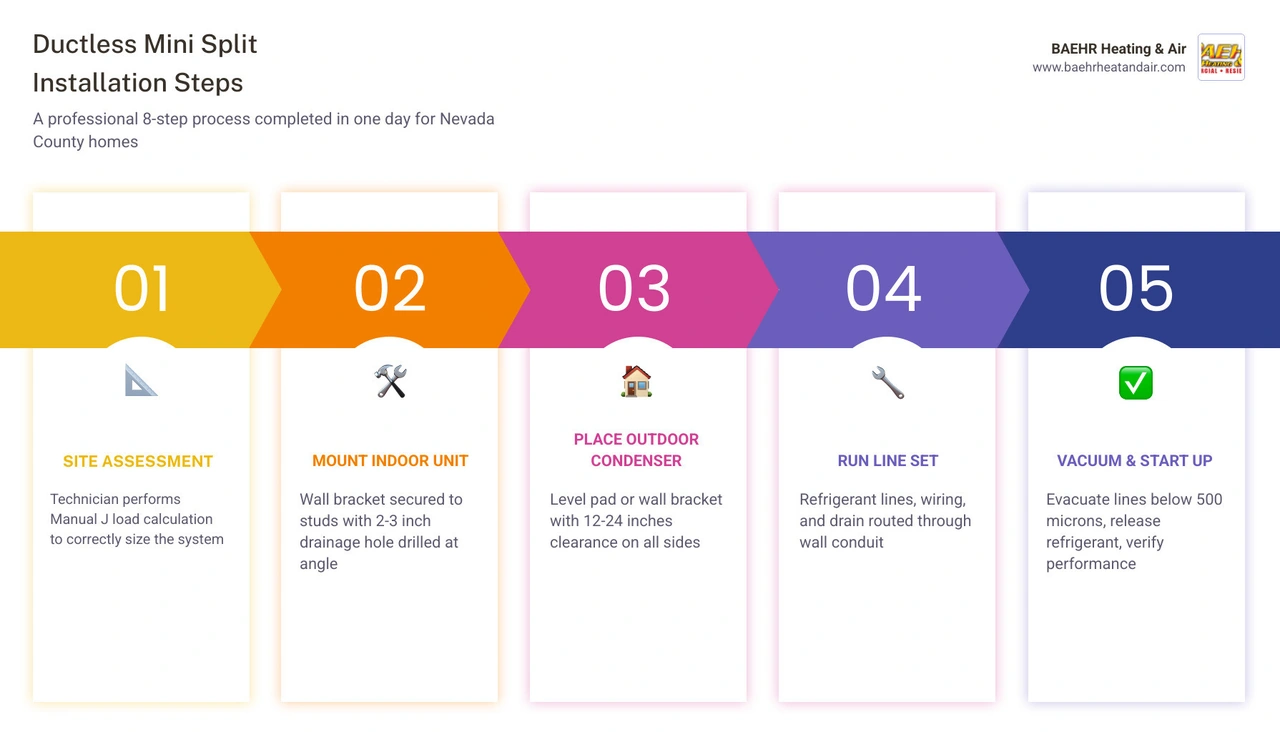
- Site assessment — A technician performs a Manual J load calculation to correctly size the system for your home.
- Mount the indoor unit — A wall bracket is secured to studs, with a 2–3 inch hole drilled through the exterior wall at a slight downward angle for drainage.
- Place the outdoor condenser — The unit is set on a level pad or wall bracket with 12–24 inches of clearance on all sides.
- Run the line set — Refrigerant lines, electrical wiring, and a condensate drain line are routed through the wall conduit.
- Wire the system — A dedicated 240V circuit with a local disconnect is connected per local code.
- Vacuum and pressure test — The technician evacuates the lines to below 500 microns and performs a decay test to confirm there are no leaks.
- Release refrigerant and start up — Pre-charged refrigerant is released, the system is powered on, and airflow and temperature difference are verified.
- Homeowner walkthrough — You learn how to operate controls, set zones, and maintain filters.
Most single-zone installs in Nevada County are completed in one day — typically 4 to 8 hours.
If you've been wondering whether a ductless mini split makes sense for your Nevada County home, you're not alone. More homeowners in Nevada City and Grass Valley are making the switch — especially in older homes that were never built with ductwork. Traditional ducted systems can lose 20–30% of their energy through leaky ducts, and in a region where summers push into the 90s and winter nights drop well below freezing, that inefficiency adds up fast. A ductless system sidesteps that problem entirely. Understanding exactly how the installation works — and what's involved locally — helps you plan the project with confidence and avoid costly surprises.
Understanding Ductless Technology vs. Traditional HVAC
To appreciate why so many families throughout Nevada City, Grass Valley, and Penn Valley are upgrading to Ductless Mini Split Systems, it helps to look at how these systems compare to traditional heating and cooling setups.
Traditional central HVAC systems rely on a network of metal or flexible ducts hidden in your attic, crawlspace, or walls to distribute conditioned air. While this works well for uniform layouts, it comes with a major hidden drawback: duct leakage. Over time, seams separate, tape degrades, and pests can chew through duct walls. The U.S. Department of Energy reports that leaky ductwork typically wastes 20% to 30% of your heating and cooling energy. With a ductless mini split, there are no ducts to leak. The conditioned air is delivered directly into the room from the indoor air handler, meaning practically zero energy is lost in transit.
Window air conditioners, on the other hand, are noisy, block your natural light, and present a security risk. They also let in drafts and are incredibly inefficient. While a standard window AC unit typically operates at a meager 10 to 12 SEER (Seasonal Energy Efficiency Ratio), modern ductless mini split systems routinely achieve ratings of 20+ SEER. This leap in efficiency translates directly to lower utility bills.
| Feature | Ductless Mini Split Systems | Traditional Central HVAC | Window AC Units |
|---|---|---|---|
| Ductwork Required | No | Yes | No |
| Average SEER Rating | 20+ SEER (highly efficient) | 14 to 18 SEER | 10 to 12 SEER |
| Energy Loss | Near 0% (no duct losses) | 20% to 30% via leaky ducts | High (gaps around window) |
| Zoned Temperature Control | Yes (room-by-room) | No (single thermostat) | Yes (but limited to one room) |
| Noise Level | Whisper-quiet (indoor units) | Moderate (loud duct expansion) | Very loud |
| Security Risk | None (requires a small 3" hole) | None | High (easy entry point) |
By utilizing inverter-driven compressors, a ductless mini split doesn't constantly cycle fully on and off like a traditional furnace or central air conditioner. Instead, the compressor adjusts its speed dynamically to match the exact temperature demands of the room. This steady, low-energy operation keeps your living spaces at a perfectly consistent temperature without the sudden drafts or noisy blasts of air.
Local Considerations for Nevada County Homeowners
Installing a climate control system in our slice of the Sierra Nevada foothills requires a bit of local know-how. From the historic Victorians of Nevada City to the ranch-style homes of Grass Valley and the rural properties of Lake Wildwood, we face unique structural and environmental challenges.
Local Permitting and Regulations
First and foremost, installing a mini split isn't a simple plug-and-play job. The Nevada City Building Department, Nevada County Planning Department, and neighboring jurisdictions like Placer County require building permits for these installations. These permits ensure that all electrical work is up to code, the system is safely grounded, and the refrigerant lines are run in compliance with environmental standards. When you partner with us for your Ductless AC Installation in Nevada City, CA, we handle the entire permit acquisition process so you don't have to navigate the local bureaucracy.
Navigating PG&E and Rebates
As of June 2026, PG&E offers attractive rebates for homeowners upgrading to high-efficiency electric heat pumps. Because ductless systems are incredibly efficient, many qualifying models can offset a portion of your initial investment through these utility programs. We help you select qualifying ENERGY STAR certified systems and assist with the paperwork to maximize your savings.
Wildfire Smoke and Indoor Air Quality
Nevada County residents know all too well that summer comfort isn't just about temperature; it's also about breathing clean air. During wildfire season, outdoor air quality can plummet. Traditional window units draw in outdoor air through leaky window seals, and central systems can pull smoky air through attic duct leaks.
Mini splits circulate and filter the air already inside your home. Because indoor air can actually be 2 to 5 times more polluted than outdoor air under normal conditions, having dedicated, multi-stage filtration on your indoor units is a game-changer. These systems capture dust, pollen, and smoke particles, keeping your indoor breathing zone clean and safe.
How Is a Ductless Mini Split Installed Step by Step in Nevada County?
Now let's walk through the actual physical process of how we transform your home's comfort. Before a single tool is lifted, proper site preparation is critical. We never rely on "rules of thumb" like matching a system solely to square footage. Instead, we perform a comprehensive Manual J load calculation. This scientific assessment takes into account:
- The age and insulation levels of your home
- The orientation of your windows and daily sun exposure
- Ceiling heights and local climate data
This ensures your system is sized perfectly — avoiding the short-cycling of an oversized unit or the constant struggling of an undersized one. Once the planning is complete, we begin the physical installation process, which you can read more about in our guide on Installing Mini Split Heat Pumps.
Phase 1: How Is a Ductless Mini Split Installed Step by Step in Nevada County (Indoor Setup)
The indoor unit (often called the "head") is responsible for delivering quiet, filtered air directly into your living space.
Step 1: Selecting the Location
We find a spot on an exterior-facing wall where the unit can distribute air evenly throughout the room. To ensure proper airflow and simple maintenance access, we always maintain at least 6 inches of clearance from the ceiling and position the unit at least 6 feet off the floor.
Step 2: Mounting the Indoor Bracket
We use a level to position the heavy-duty metal mounting bracket against the wall. Using a stud finder, we secure the bracket directly into the wooden wall studs with heavy-duty wood screws. It must be perfectly level; an unlevel bracket can cause the condensate drain pan to overflow, leading to water damage on your drywall.
Step 3: Drilling the Conduit Penetration
This is the moment of truth that makes many DIYers nervous: drilling a hole straight through the side of your house. We use a heavy-duty drill equipped with a 3-inch hole saw to cut a clean opening through the drywall, insulation, sheathing, and exterior siding.
Crucially, we drill this hole at a slight downward angle toward the outside. This downward slope is essential because it allows water from the indoor unit's condensate tray to drain naturally via gravity. If the hole is drilled level or sloping upward, water will back up and leak down your interior walls.
Phase 2: How Is a Ductless Mini Split Installed Step by Step in Nevada County (Outdoor Setup and Connections)
With the indoor unit prepped, we move outside to set up the heart of the system: the outdoor compressor/condenser.
Step 4: Placing the Outdoor Condenser
The outdoor unit needs a solid, level foundation to prevent vibration noise and mechanical wear. We place a durable, weather-resistant condenser pad on level ground, or mount heavy-duty steel brackets directly to the exterior wall if space is tight.
In rural parts of Nevada County — like Lake Wildwood, Penn Valley, and the outskirts of Grass Valley — we often elevate the condenser slightly on risers. This prevents encroaching vegetation, pine needles, and winter snow accumulation from blocking the essential airflow around the coils. We always ensure there is 12 to 24 inches of clear space around the outdoor unit for optimal heat transfer and future servicing.
Step 5: Routing and Connecting the Line Set
We carefully wrap the copper refrigerant lines, control/communication wiring, and the condensate drain line together into a neat bundle. We slide this bundle through the 3-inch wall penetration from the inside out.
On the outside wall, we run these lines inside an aesthetic, protective line set cover (often called "slim duct") that matches your home’s exterior paint. We then use an eccentric flaring tool and a precision torque wrench to connect the copper lines to both the indoor and outdoor units. Tightening these connections to the exact manufacturer-specified torque is the only way to guarantee a leak-free system for years to come.
Step 6: Electrical Wiring
Mini splits require a dedicated electrical circuit to handle the power load safely. We run a dedicated line from your main electrical panel to an outdoor weather-resistant disconnect box mounted near the condenser. From the disconnect, we run power to the outdoor unit. A 14 AWG, 4-conductor stranded cable is then run through the wall conduit to deliver power and communication signals between the outdoor condenser and the indoor head.
Step 7: Evacuation, Testing, and Commissioning
Before we can let any refrigerant flow through the system, we must ensure the copper lines are completely free of air and moisture. If moisture is left inside the lines, it can mix with the refrigerant oil to create a highly destructive acid that will destroy your compressor.
- Pressure Test: We hook up a nitrogen tank and pressurize the lines to between 300 and 500 PSI, checking for any drop in pressure over time to confirm there are zero leaks.
- Vacuum Pull: We connect a high-performance vacuum pump and a digital micron gauge to pull a deep vacuum on the lines.
- Decay Test: We pull the vacuum down to below 500 microns and perform a decay test for 10 to 15 minutes. If the micron level holds steady, we know the system is completely sealed and dry.
- Refrigerant Release: We open the service valves on the outdoor unit to release the pre-charged refrigerant into the system.
Finally, we power the system on and measure the "Delta T" — the temperature difference between the air entering the indoor unit and the air leaving it. A healthy system should show a difference of 15 to 20°F, indicating that your new mini split is running at peak efficiency.
Why Professional Installation Beats DIY in Grass Valley and Nevada City
With online tutorials readily available, it can be tempting to treat a mini split installation as a weekend DIY project. However, installing these advanced systems requires specialized skills, heavy-duty diagnostic tools, and strict adherence to local regulations. If you are planning a system upgrade, we highly recommend reading about our professional Mini Split Installation in Nevada City, CA services.
Here is why professional installation is the safest, smartest choice for your home:
- Specialized Tool Costs: To install a mini split correctly, you need over $1,500 worth of specialty tools, including a vacuum pump, a digital micron gauge, a nitrogen tank, manifold gauges, an eccentric flaring tool, and a digital torque wrench. Buying these tools for a single installation quickly erases any potential DIY savings.
- EPA 608 Certification: Under federal law, only technicians certified under Section 608 of the Clean Air Act are legally allowed to handle, test, and charge systems containing chemical refrigerants.
- Warranty Protection: Nearly all major mini split manufacturers (such as Mitsubishi, Daikin, and Carrier) explicitly state in their warranty terms that the warranty is completely voided unless the system is installed and commissioned by a licensed HVAC professional. If a DIY-installed system fails a month later, you are entirely on your own.
- Electrical Safety: Connecting a new 240V circuit breaker to an older electrical panel requires working around live wires. One wrong move can cause severe injury or an electrical fire. Our team ensures your home’s panel can handle the new load and routes all wiring safely through code-compliant conduits.
- Preventing Water Damage: A slightly miscalculated drain angle or a pinched condensate line can result in water backing up and flooding into your drywall, leading to mold growth and expensive structural repairs.
Frequently Asked Questions About Ductless Systems
Do I need a permit for mini split installation in Nevada County?
Yes. Both the Nevada City Building Department and the Nevada County Planning Department (as well as Placer County for our neighbors in Loomis, Auburn, and Lincoln) require permits for ductless mini split installations. These permits typically cover the electrical modifications (the dedicated circuit and outdoor disconnect) and the environmental safety of the refrigerant lines. Working with a licensed contractor like us ensures that your system is fully permitted, passes local inspections, and preserves your home's resale value.
How do mini splits perform in extreme winter and summer weather?
Modern mini splits are incredibly resilient. In the summer, when temperatures in places like Grass Valley and Lincoln can soar, the inverter technology keeps your home perfectly cool without breaking a sweat.
In the winter, older heat pumps used to struggle when temperatures dropped below freezing. However, modern cold-climate mini splits are designed to provide efficient, reliable heating even when outdoor temperatures drop well below freezing. They do this by extracting ambient heat from the freezing outdoor air and transferring it indoors — making them a highly dependable, year-round comfort solution for our chilly Sierra foothill winters.
What ongoing maintenance is required after installation?
To keep your system running whisper-quiet and at peak efficiency for its full 15 to 20-year lifespan, regular maintenance is essential:
- Clean the Air Filters: We recommend checking and washing the reusable plastic mesh filters inside your indoor units every 4 to 6 weeks. If you have pets or smoke, you may need to clean them more frequently.
- Keep the Outdoor Unit Clear: Periodically check the outdoor condenser to ensure that dry leaves, pine needles, or weeds aren't blocking the airflow. Maintain at least 2 feet of clear space around the unit.
- Schedule Annual Professional Tune-Ups: Just like your car, your mini split benefits from professional service. An annual checkup ensures your refrigerant levels are correct, electrical connections are tight, and the coils are clean.
Conclusion
Installing a ductless mini split is one of the single best investments you can make for your Nevada County home. It brings whisper-quiet comfort, eliminates the energy waste of leaky ducts, and gives you precise, zoned control over your indoor climate. Whether you want to cool down a hot master bedroom, heat a newly built ADU, or convert your entire home to an eco-friendly heating and cooling system, we are here to help.
At BAEHR Heating & Air, we pride ourselves on delivering a smooth, professional installation experience from start to finish. Our customer-first team serves homeowners throughout Lake Wildwood, Penn Valley, Nevada City, Grass Valley, Loomis, Auburn, Lincoln, Rocklin, and Truckee. To keep your new system running perfectly year after year, we also offer an annual maintenance membership for $310, which covers two comprehensive system visits per year to protect your investment and maximize your energy savings.
Ready to experience zoned comfort? Explore our Mini Split Installation Services today and let us handle all the steps for you! We also provide comprehensive Ductless Mini Split Services in Nevada City, CA and general HVAC Installation in Nevada City, CA to ensure your home stays cozy no matter the season. Reach out to us today to schedule your consultation!
Ready to breathe easy?
Schedule service or request a free estimate. Honest assessments and upfront pricing on every visit across Nevada County.