

How to Factor PGE Rebates Into Your AC Repair vs Replace Decision
Why PG&E Rebates and Federal Tax Credits Change the AC Repair vs Replace Decision. Understanding how PG&E rebates and federal tax credits factor into the ac…
Why PG&E Rebates and Federal Tax Credits Change the AC Repair vs Replace Decision
Understanding how PG&E rebates and federal tax credits factor into the ac repair vs replace decision can mean the difference between throwing money at a failing system and making a smart upgrade that pays for itself.
Here's a quick breakdown of how these incentives shift the math:
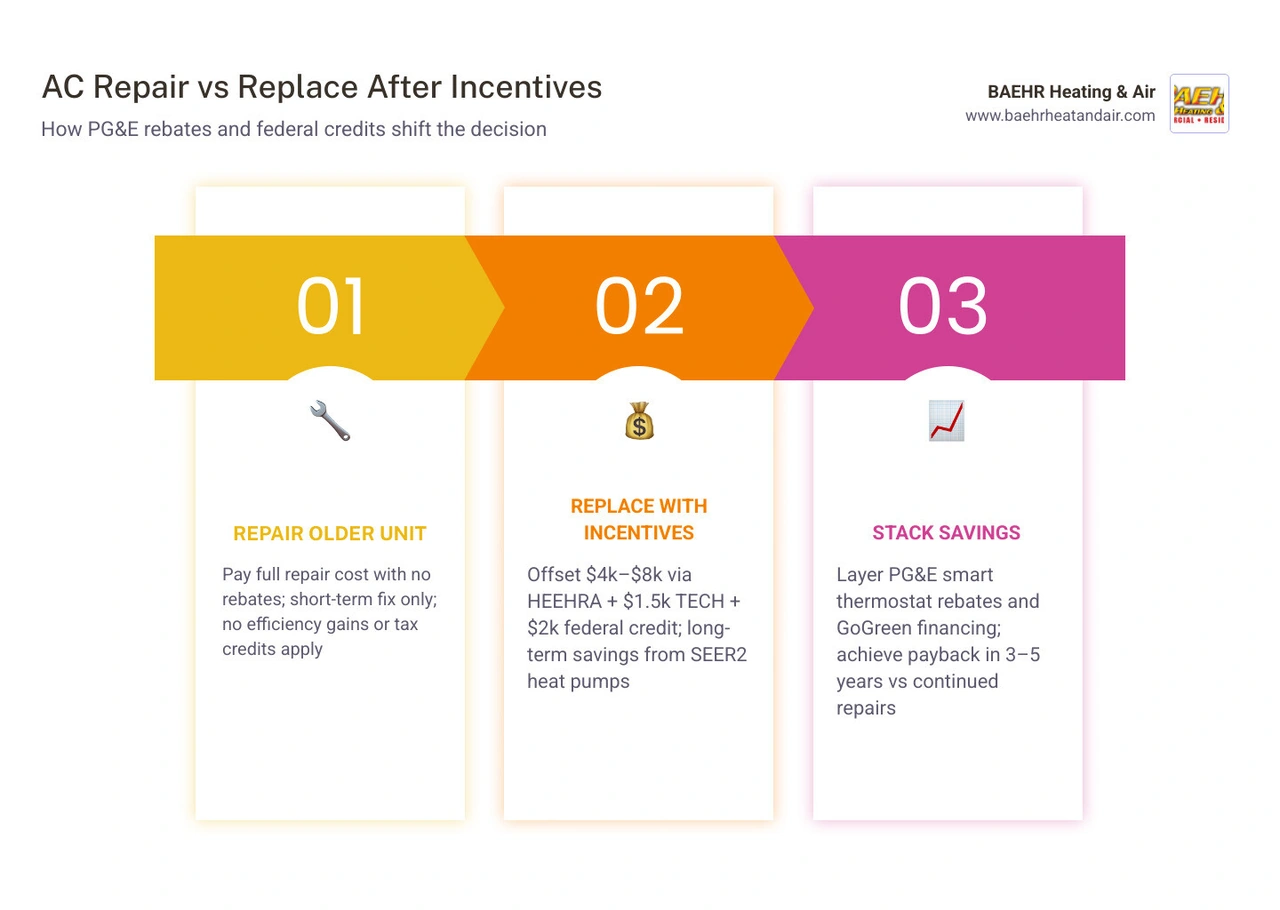
- TECH Clean California offers up to $1,000–$1,500 in statewide rebates for qualifying heat pump HVAC systems, stackable with other programs
- HEEHRA rebates provide up to $8,000 for households under 80% of Area Median Income (AMI), or up to $4,000 for households between 80–150% AMI
- Federal 25C tax credit allowed 30% of heat pump costs up to $2,000 — but this applied to systems placed in service by December 31, 2025; if you filed for 2025, you can still claim it now
- PG&E utility rebates for smart thermostats and insulation can be layered on top of state and federal programs
- The bottom line: When you stack available incentives, replacement of an older, inefficient system often becomes far more affordable than continuing to repair it
For homeowners in Grass Valley and the surrounding Sierra foothills, where summer temperatures push AC systems hard, the question isn't just "repair or replace?" — it's "how much does replacement actually cost me after every available incentive?"
That's exactly what this guide walks you through.
The Core Dilemma: When to Repair vs. Replace Your Foothill AC

When the summer sun beats down on communities like Auburn, Lincoln, or Lake Wildwood, a reliable air conditioner isn't a luxury—it is an absolute necessity. But when your older system starts blowing lukewarm air or making strange noises, you are faced with a difficult choice. Do you patch it up one more time, or do you invest in a modern replacement?
Making this decision requires looking closely at several key factors. First, consider the age of your system. If your air conditioner is approaching or has surpassed its expected service life, continuing to pour money into repairs is often a losing battle. You can learn more about what to expect from your system's twilight years by Understanding the Lifespan of Your AC.
Frequent breakdowns are another clear indicator. If you find yourself calling for service multiple times a season, those repair bills quickly add up to a significant portion of what a new system would cost. Furthermore, older systems operate at much lower efficiency levels, which shows up clearly on your monthly PG&E bills. If you are noticing these patterns, it is highly recommended to read through our guide on Recognizing 5 Common Signs That You Need to Replace Your AC Unit as well as our checklist of Air Conditioner Replacement Signs.
Evaluating Your Current System with a Guide to AC Repair Services
Before writing off your existing air conditioner, it is important to get a professional evaluation. Some issues, like a failed capacitor or a worn-out fan motor, are relatively straightforward to fix. However, major component failures—such as a seized compressor or a significant refrigerant leak in an older R-22 system—present a much tougher financial choice.
Because R-22 refrigerant has been phased out, repairing a leak in an older unit can be incredibly costly. To help you understand what a professional technician looks for during these evaluations, you can consult our Guide to AC Repair Services. If you reside in the Nevada County area, our localized AC Repair Grass Valley Guide 2025 provides excellent regional context on common failure points during our hot foothill summers.
How PG&E Rebates and Federal Tax Credits Factor Into the AC Repair vs Replace Decision for Older Units
The financial tipping point in the repair-versus-replace debate has shifted dramatically due to modern incentive programs. Historically, homeowners used the "Rule of 5,000" (multiplying the age of the system by the repair estimate; if it exceeds 5,000, you replace it). In 2026, however, this math must include the substantial discounts provided by state rebates, utility incentives, and tax credits.
When you factor in these incentives, the net cost of a new, highly efficient system drops significantly. When you pair this lower upfront cost with the immediate, long-term energy savings of a modern unit, replacing an older system often yields a much shorter payback period than keeping an old unit on life support. To help you weigh these variables, consider these 6 Things to Consider Before You Replace Your AC Unit.
How PG&E Rebates and Federal Tax Credits Factor Into the AC Repair vs Replace Decision
To truly understand how PG&E rebates and federal tax credits factor into the ac repair vs replace decision, you have to look at the total financial picture. A new air conditioning system or a modern electric heat pump is a major home upgrade. However, the availability of utility incentives, tax liability reductions, and point-of-sale rebates can dramatically lower your out-of-pocket costs. To explore the primary financial drivers behind this choice, review our breakdown of AC Repair vs Replace Decision Factors.
Navigating PG&E Rebates and Local California Incentives in 2026
For homeowners living in our service areas—stretching from the valley floors of Rocklin and Loomis up to the mountain climate of Truckee—local utility and state-level rebates are incredibly influential.
- TECH Clean California: This statewide initiative provides robust incentives for transitioning to energy-efficient heat pumps. Standard market-rate installations can qualify for $1,000 per system, with up to $2,000 available per household if you install multiple qualifying systems.
- Golden State Rebates: This program offers instant coupons on smart thermostats (up to $50) and other energy-saving products.
- Demand Response Enrollment: To qualify for many of the highest-tier state rebates, homeowners must enroll in a qualifying demand response program (such as OhmConnect). These programs pay you to reduce your energy usage slightly during peak grid events, further lowering your ongoing PG&E bills.
Understanding Federal Tax Credits and HEEHRA Rebates
On the federal level, the Inflation Reduction Act (IRA) introduced powerful programs to help homeowners electrify and upgrade their heating and cooling systems.
The Home Electrification and Appliance Rebates (HEEHRA) program is a state-administered, federally funded program designed specifically for low-to-moderate-income households. Eligibility is determined by your household income relative to your county's Area Median Income (AMI):
- Under 80% AMI: Eligible for 100% of the installation costs of a qualifying heat pump HVAC system, up to a maximum rebate of $8,000.
- 80% to 150% AMI: Eligible for 50% of the installation costs, up to a maximum rebate of $4,000.
Note on 2026 Funding Status: Due to high demand, California's HEEHRA single-family rebates became fully reserved in February 2026, and a waitlist is currently in place. However, multifamily funding remains active, and Phase II funding is highly anticipated.
Additionally, the Federal 25C Energy Efficient Home Improvement Credit provides a tax credit of 30% of the cost of a qualifying heat pump (up to $2,000 annually) or a standard high-efficiency central AC (up to $600 annually). While the enhanced 25C credit required systems to be placed in service by December 31, 2025, homeowners filing their 2025 tax returns in 2026 can still claim this credit to offset their tax liability.
Technical Requirements and Efficiency Standards for Maximum Savings
To secure these rebates and tax credits, the equipment you choose must meet strict efficiency standards. You cannot simply install any standard air conditioner and expect a check in the mail. The industry relies on standardized ratings to measure heating and cooling efficiency:
| Incentive Program | Equipment Type | Minimum SEER2 Rating | Minimum EER2 Rating | Minimum HSPF2 Rating | Maximum Incentive |
|---|---|---|---|---|---|
| Federal 25C Tax Credit | Split-System Heat Pump | 15.2+ | 10.0+ | 8.1+ | Up to 30% (Max $2,000) |
| Federal 25C Tax Credit | Split Central AC | 17.0+ | 12.0+ | N/A | Up to $600 |
| TECH Clean California | Heat Pump HVAC | Meets CEE Tier 1 or 2 | Meets CEE Tier 1 or 2 | Meets CEE Tier 1 or 2 | $1,000 - $2,000 |
| HEEHRA (Income-Qualified) | Heat Pump HVAC | ENERGY STAR Certified | ENERGY STAR Certified | ENERGY STAR Certified | $4,000 - $8,000 |
Systems that achieve ENERGY STAR Most Efficient status or meet Consortium for Energy Efficiency (CEE) Tiers 1 or 2 represent the gold standard of modern HVAC technology. Many of these qualifying systems utilize variable-speed compressors. Unlike older single-stage systems that constantly cycle 100% on or completely off, variable-speed systems run continuously at lower, highly efficient speeds, keeping your indoor climate perfectly stable while using up to 75% less energy than older resistance-based heating and cooling setups.
How PG&E Rebates and Federal Tax Credits Factor Into the AC Repair vs Replace Decision Based on SEER2 Ratings
When deciding whether to repair a 10-to-15-year-old AC unit with a SEER rating of 10 or 12, the efficiency jump to a new SEER2 16+ system is massive. This efficiency gap translates directly into lower monthly utility bills.
To successfully claim these rebates, the system must be fully certified. This requires a Qualified Manufacturer (QM) code and official AHRI (Air-Conditioning, Heating, and Refrigeration Institute) certification matching the indoor coil, outdoor condenser, and furnace or air handler as a tested, compatible system. Working with an experienced team ensures that all equipment matches perfectly, preserving your eligibility for every dollar on the table.
Step-by-Step Guide to Claiming Your Incentives and Planning Your Upgrade
Navigating the paperwork and requirements for utility and federal incentives can feel overwhelming, but following a structured roadmap makes the process seamless:
- Verify Income Eligibility: Visit the official TECH Clean California income portal to check your household's Area Median Income (AMI) tier. This determines whether you qualify for moderate-to-low-income HEEHRA rebates.
- Choose a Certified Contractor: To qualify for TECH Clean California and HEEHRA rebates, you must work with a licensed, TECH-certified contractor. They will design the system, ensure proper sizing, and process state-level rebates directly at the point of sale.
- Select Qualifying Equipment: Work with your installer to choose an ENERGY STAR certified heat pump or high-efficiency split AC that meets the SEER2, EER2, and HSPF2 requirements. Ensure you receive the manufacturer's certification statement and the AHRI certificate.
- Obtain Permits and Schedule HERS Testing: Local building codes in places like Penn Valley, Loomis, and Auburn require a permit for HVAC installations. Additionally, California law requires Home Energy Rating System (HERS) duct leakage testing to verify that your system is operating at peak efficiency.
- Explore Financing Options: If upfront costs are a concern, look into state-backed programs like GoGreen Financing, which offers low-interest, zero-down financing options without placing a lien on your property. You can learn more about these pathways in our guide to Financing Options for AC Replacement.
- Execute the Installation: Have your certified team install the new system. For comprehensive local guides on what this process looks like from start to finish, check out our Professional AC Replacement Guide and our AC Replacement Grass Valley Complete Guide.
- File Your Taxes and Claim Credits: When filing your federal tax return, use IRS Form 5695 to claim your 25C Energy Efficient Home Improvement Credit. Ensure you keep your invoice, permit records, and contractor documentation for at least three years.
Frequently Asked Questions About AC Rebates and Tax Credits
Can I stack PG&E rebates with federal tax credits?
Yes! Stacking (or incentive layering) is highly encouraged and is one of the best ways to maximize your savings. You can combine local PG&E smart thermostat rebates, statewide TECH Clean California incentives, and federal tax credits.
However, you must account for a basis adjustment when filing your taxes. This means you must subtract any point-of-sale state rebates from the total cost of the project before calculating your 30% federal tax credit on IRS Form 5695.
What are the income requirements for HEEHRA heat pump rebates in California?
HEEHRA rebates are tiered based on your county's Area Median Income (AMI). Households earning less than 80% of the local AMI qualify for the maximum rebate of up to $8,000. Households earning between 80% and 150% of the AMI qualify for up to $4,000.
Additionally, TECH Clean California offers "equity adders" of up to $2,500 for low-income households or those located in historically underinvested environmental communities, helping to cover auxiliary costs like electrical panel upgrades.
Do I need to hire a specific contractor to qualify for these rebates?
Absolutely. To qualify for TECH Clean California incentives and HEEHRA rebates, you must hire a registered, TECH-certified contractor. Furthermore, to claim federal tax credits, the system must be installed by a licensed professional.
Most major manufacturers also require professional installation to keep their equipment warranties intact. Ensuring your installer holds NATE (North American Technician Excellence) certification and EPA Section 608 compliance guarantees that your system is installed safely, legally, and to the highest industry standards.
Conclusion
When deciding whether to repair your aging air conditioner or replace it entirely, the financial landscape of 2026 makes replacement more attractive than ever before. By factoring in PG&E rebates, TECH Clean California incentives, and federal tax credits, you can dramatically lower your net investment while securing years of lower energy bills and reliable comfort.
At BAEHR Heating & Air, we take pride in being a customer-first team. We are dedicated to helping our neighbors in Grass Valley, Nevada City, Auburn, Rocklin, and across the Sierra foothills navigate these complex incentive programs to get the absolute most out of their home comfort investments.
To keep your current system running efficiently or to protect your new investment for the long haul, we offer an annual maintenance membership for $310, which covers two comprehensive system visits per year. Whether you need a trusted second opinion on a major repair or are ready to plan a Professional AC Replacement, we are here to guide you every step of the way. Reach out to us today!
Ready to breathe easy?
Schedule service or request a free estimate. Honest assessments and upfront pricing on every visit across Nevada County.