

The Definitive Guide to What Is SEER2 and Energy Bills
Why SEER2 Matters for Your Energy Bills in a Hot, Dry Foothill Climate. If you've been wondering what is SEER2 and how does it affect energy bills in a hot…
Why SEER2 Matters for Your Energy Bills in a Hot, Dry Foothill Climate
If you've been wondering what is SEER2 and how does it affect energy bills in a hot dry foothill climate, here's the short answer: SEER2 is the updated federal efficiency rating for air conditioners and heat pumps — and in regions like the Sierra Nevada foothills, where summers regularly push past 100°F, it has a direct impact on how much electricity your cooling system uses every month.
Quick Answer: SEER2 and Your Foothill Energy Bills
- SEER2 stands for Seasonal Energy Efficiency Ratio 2. It replaced the old SEER rating on January 1, 2023.
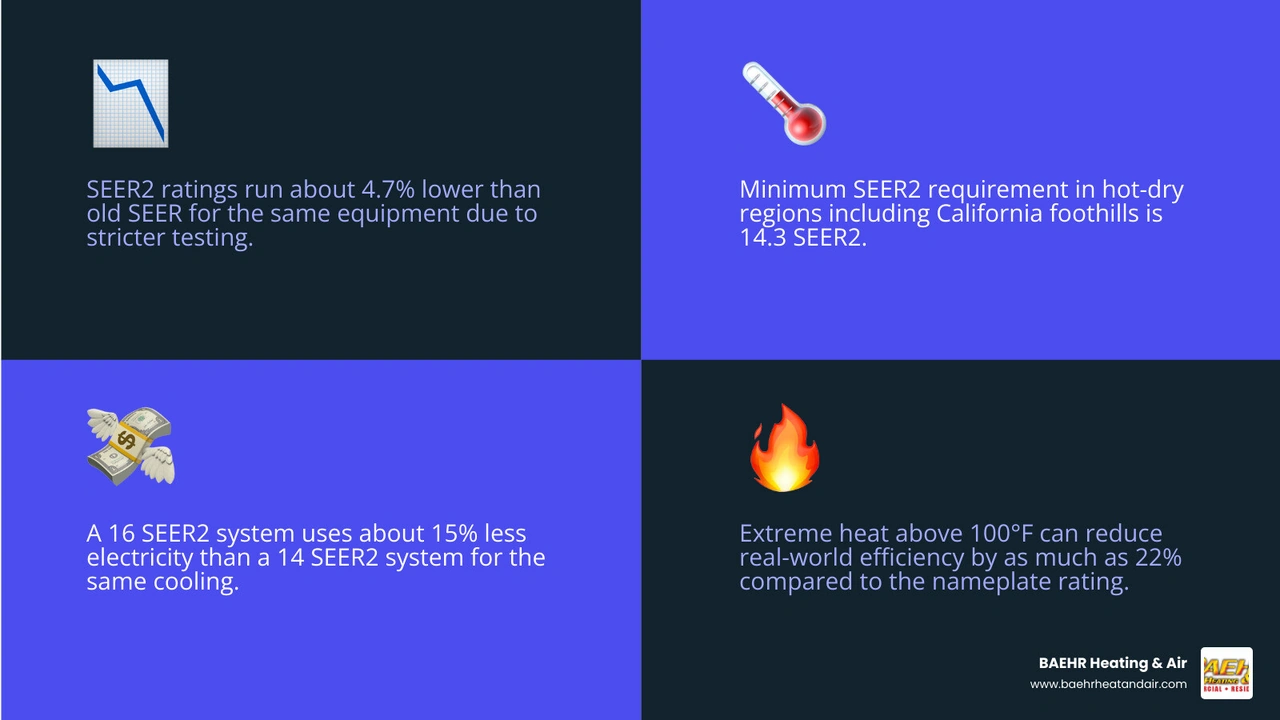
- SEER2 ratings run about 4.7% lower than old SEER numbers for the same equipment — not because systems got less efficient, but because the new test better reflects real-world conditions.
- The minimum SEER2 for the Southwest/hot-dry region (including California foothills) is 14.3 SEER2.
- A 16 SEER2 system uses roughly 15% less electricity than a 14 SEER2 system to deliver the same cooling.
- In hot-dry climates, higher-SEER2 units have shown 14–18% lower energy use than older low-efficiency units during peak summer months.
- However, extreme heat above 100°F can reduce the real-world efficiency advantage by as much as 22% compared to the nameplate rating.
- Factors like duct condition, system sizing, and installation quality affect your actual savings as much as the SEER2 number itself.
For homeowners in foothill communities like Grass Valley, Auburn, and Nevada City, where air conditioning runs hard from late May through September, understanding SEER2 is one of the most practical things you can do to manage your utility bills and make a smart equipment decision.
This guide breaks down exactly what the rating means, how it plays out in real foothill conditions, and what to look for when evaluating your current system or a potential upgrade — as of June 2026.
What Is SEER2 and How Does It Differ From SEER?
To understand how this rating impacts your wallet, we first need to look at what changed when the Department of Energy (DOE) updated its standards.
For decades, air conditioners were rated using SEER (Seasonal Energy Efficiency Ratio). SEER measured how much cooling a system delivered (in BTUs) compared to how much electricity it consumed (in watt-hours) over a simulated cooling season.
While SEER was a helpful benchmark, it had a major flaw: the laboratory testing environment did not match real-world home installations. Under the old SEER testing guidelines, systems were tested with an external static pressure of only 0.1 inches of water column (in. w.c.).
In a real home, however, air has to push through tight duct networks, returns, grilles, and air filters. This resistance creates much higher static pressure. Because of this, the DOE introduced the M1 testing standard on January 1, 2023, giving us SEER2.
Under the SEER2 protocol, systems are tested at 0.5 in. w.c. of external static pressure—five times the pressure of the old test. This change represents a much more accurate simulation of how a system performs when connected to actual ductwork.
Because the testing conditions are tougher, the resulting numerical ratings are lower. On average, a SEER2 rating is 4.7% lower than the equivalent SEER rating for the exact same piece of equipment. For example, a system that rated as a 16 SEER under the old test will typically carry a rating of 15.2 SEER2 today.
It is important to remember that the physical equipment did not become less efficient when this change occurred. In fact, to meet the higher testing thresholds, manufacturers had to upgrade their indoor blower motors (often shifting to advanced ECM blowers) and redesign coils. A 14.3 SEER2 system is actually slightly more efficient than an old 14 SEER unit, even though the numbers look nearly identical.
When you are shopping for a new unit, learning how to choose an energy efficient air conditioner means looking closely at these updated SEER2 labels to ensure you are comparing modern, real-world performance metrics.
What Is SEER2 and How Does It Affect Energy Bills in a Hot Dry Foothill Climate?
If you live in foothill communities like Grass Valley, CA, Auburn, CA, or Nevada City, CA, your cooling needs are very different from coastal California. Our Sierra Nevada foothills experience a distinct hot, dry microclimate.
Summer afternoons regularly climb into the high 90s and triple digits, while local utility companies implement peak-use pricing structures. When you run your air conditioner during these hot afternoons, you are often paying the highest electricity rates of the day.
This brings us to the core question: what is SEER2 and how does it affect energy bills in a hot dry foothill climate?
Because our climate demands long, intense cooling cycles during peak-rate periods, any increase in system efficiency translates directly into noticeable monthly savings. If your system is inefficient, it will draw maximum power during the hottest hours, compounding your energy costs.
Understanding how to balance your thermostat settings and equipment efficiency is key to keeping those bills manageable. For practical tips on keeping your home comfortable without breaking the bank, check out our guide on the 10 most cost-effective ways to cool a house and reduce AC expenses.
Understanding What Is SEER2 and How Does It Affect Energy Bills in a Hot Dry Foothill Climate During Peak Summer
During the peak summer months of July, August, and September, foothill homeowners see their highest electricity usage. Field studies conducted in hot-dry climates reveal how upgrading to higher-efficiency equipment changes real-world power consumption.
Data shows that upgrading from an older, low-efficiency system (typically rated around 10 to 11 SEER) to a modern standard-efficiency system (rated 14 to 16 SEER) yields a 14% to 18.1% reduction in energy consumption during these peak summer months.
Additionally, higher-efficiency systems play a critical role in peak power reduction. On an extreme 114°F day, field monitoring showed that homes with higher-efficiency units used up to 21% less peak power (drawing 3.0 kW compared to the 3.8 kW drawn by older, low-SEER systems).
By drawing less power during peak hours, a high-SEER2 system helps protect your home from high-tier utility rates. If you are ready to make the switch to a modern, bill-slashing system, a professional air conditioning installation is the first step to securing these seasonal savings.
Real-World Factors: What Is SEER2 and How Does It Affect Energy Bills in a Hot Dry Foothill Climate Above 100°F?
While high SEER2 ratings look great on paper, extreme heat changes how systems perform in the real world. In a hot, dry climate, the efficiency advantage of premium equipment remains strong, but it does experience some degradation when outdoor temperatures soar past 100°F.
Under mild conditions, higher SEER2 units enjoy a 13% to 25% efficiency advantage over lower-rated systems. However, as outdoor temperatures climb toward extreme peak levels, the physical limitations of heat transfer come into play. In extreme dry heat, the actual energy benefit of high-efficiency systems can be reduced by as much as 22% relative to their nameplate ratings.
This happens because standard SEER2 tests assume a wide range of mild seasonal temperatures. They do not fully reflect continuous operation in triple-digit heat.
Altitude also plays a unique role in our foothill communities. In higher-elevation areas like Truckee, CA, or the upper ridges of Nevada City and Grass Valley, the air is thinner. Lower air density reduces the mass of air moving across your outdoor condenser coils, which can alter refrigerant pressures and slightly lower heat-transfer efficiency.
To counteract these environmental challenges and keep your system running as close to its rated SEER2 efficiency as possible, routine AC maintenance is essential. Keeping coils clean and airflow unrestricted ensures your system doesn't have to work twice as hard when the foothill heat peaks.
Minimum SEER2 Requirements and Efficiency Tiers for Hot-Dry Regions
Because of our extreme summer temperatures, the Southwest region—which includes California—is subject to stricter federal and state efficiency standards than northern states.
Currently, in June 2026, California building standards require a minimum of 14.3 SEER2 for residential split-system central air conditioners. Furthermore, because seasonal ratings can sometimes mask poor performance during peak heat, the state also mandates a minimum 11.7 EER2 (Energy Efficiency Ratio 2) for systems installed in our region. EER2 measures steady-state efficiency at a constant outdoor temperature of 95°F, ensuring the unit can handle our hottest days.
When deciding which efficiency tier is right for your home, it helps to understand how the options stack up:
| Efficiency Tier | SEER2 Rating Range | Best Suited For | Key Energy Bill Impact |
|---|---|---|---|
| Budget / Minimum | 14.3 SEER2 | Mild climates or rental properties | Meets legal standards; baseline energy consumption. |
| Standard / Best Value | 15.0 – 16.0 SEER2 | Most foothill homes in Auburn and Grass Valley | Balanced upfront cost with 15% less electricity use than the minimum tier. |
| High-Efficiency | 17.0 – 19.0 SEER2 | Homes with high summer cooling needs or multi-zone layouts | Significant bill reduction; often utilizes two-stage compressors for better comfort. |
| Ultra-Premium | 20.0+ SEER2 | Homeowners prioritizing maximum energy offset (e.g., pairing with solar) | Variable-speed performance; lowest monthly operating costs but longer payback periods. |
As you plan an upgrade, reviewing these tiers is just one part of the equation. Be sure to read about the 5 things to consider when buying an air conditioner to make sure you select a system that matches your home's unique footprint and your family's comfort goals.
Evaluating Heat Pumps vs. Traditional AC in Foothill Climates
While traditional central air conditioners remain popular, many foothill homeowners are choosing electric heat pumps. A heat pump acts as a high-efficiency air conditioner in the summer and reverses its operation to provide efficient heating during our chilly foothill winters.
Just as cooling efficiency is measured in SEER2, heat pump heating efficiency is measured in HSPF2 (Heating Seasonal Performance Factor 2). To qualify for ENERGY STAR certification in 2026, split-system heat pumps must meet a minimum rating of 15.2 SEER2 and 7.8 HSPF2.
Because heat pumps transfer heat rather than generating it through combustion, they can achieve efficiencies between 300% and 500%, compared to a maximum of 98% for a premium gas furnace.
If you are weighing your options, it is helpful to look at the structural differences in heat pump vs gas furnace infrastructure. For most local homes, transitioning to a heat pump simplifies your utility setup and provides a highly efficient, single-system solution for year-round comfort with heat pumps.
To learn more about how these systems perform in both summer and winter, check out our home heat pump ultimate guide.
Frequently Asked Questions About SEER2 in Foothill Climates
Does a higher SEER2 rating always guarantee lower energy bills?
Not necessarily. A high SEER2 rating is only a measure of the equipment's potential efficiency under laboratory conditions. In the real world, several factors can prevent a high-SEER2 system from delivering its promised savings:
- Ductwork Quality: If your home has leaky, uninsulated, or undersized ducts, you can lose up to 30% of your system's conditioned air before it ever reaches your living spaces. High static pressure from restrictive ductwork forces blower motors to work harder, erasing the efficiency of a premium system.
- System Sizing: Bigger is not always better. An oversized system will cycle on and off rapidly (short-cycling). This prevents it from reaching peak operating efficiency and leaves your home humid and uncomfortable. A professional contractor must perform a precise Manual J load calculation to size the system correctly for your home's square footage, insulation levels, and window exposure.
- Home Insulation: If your attic and walls lack proper insulation, heat will continuously seep into your home, forcing even the most efficient system to run around the clock.
What rebates and incentives are available for SEER2 upgrades in California?
There are several regional and federal programs designed to offset the cost of upgrading to high-efficiency systems:
- Federal 25C Tax Credits: Homeowners can claim tax credits of up to 30% of the cost of qualifying high-efficiency equipment. This includes up to $2,000 for heat pumps meeting ENERGY STAR requirements (typically 15.2 SEER2 or higher) and up to $600 for qualifying central air conditioners.
- TECH Clean California: This state initiative offers substantial rebates for homeowners transitioning from fossil-fuel heating to high-efficiency electric heat pumps.
- Utility Rebates: Local utility providers frequently offer rebates for installing ENERGY STAR-certified cooling systems and smart thermostats.
How do I find my current air conditioner's SEER or SEER2 rating?
If you want to know how your current system stacks up, you can find its rating using these steps:
- Check the EnergyGuide Label: Look for the bright yellow and black sticker on the side of your outdoor condenser unit. If the unit was installed after 2023, it will list the SEER2 rating clearly.
- Locate the Model Number: If the sticker has faded, find the metal manufacturer's data plate on the outdoor unit. Note down the model number.
- Use Online Directories: Search the model number on the manufacturer's website or look it up in the AHRI (Air-Conditioning, Heating, and Refrigeration Institute) Directory of Certified Product Performance to find its official rated efficiency.
Conclusion
Managing your energy bills in a hot, dry foothill climate requires a combination of the right equipment, professional installation, and ongoing system care. Understanding what is SEER2 and how does it affect energy bills in a hot dry foothill climate helps you make an informed decision when it is time to upgrade or service your system.
At BAEHR Heating & Air, our customer-first team is dedicated to keeping your home comfortable through every hot summer afternoon and chilly winter night. We serve homeowners across the foothills, including Lake Wildwood, Rocklin, Penn Valley, Nevada City, Grass Valley, Loomis, Auburn, Lincoln, and Truckee.
To help you maintain peak SEER2 performance year after year, we offer an annual maintenance membership that covers two comprehensive system visits per year. This proactive care keeps your system running cleanly, protects your manufacturer warranty, and ensures you get the maximum energy savings out of your equipment.
Ready to optimize your home's comfort and take control of your utility bills? Contact us today to learn more about our Air Conditioning Services and schedule your next visit!
Ready to breathe easy?
Schedule service or request a free estimate. Honest assessments and upfront pricing on every visit across Nevada County.