

How Often to Change Air Filters During Wildfire Season in Nevada County
Wildfire Smoke and Your HVAC: What Nevada County Homeowners Need to Know First. Knowing how often to change air filters during wildfire season in Nevada…
Wildfire Smoke and Your HVAC: What Nevada County Homeowners Need to Know First
Knowing how often to change air filters during wildfire season in Nevada County can make a real difference for your health and your HVAC system. During active smoke events, the standard 90-day rule goes out the window fast.
Quick Answer: Filter Change Frequency During Wildfire Season in Nevada County
| Air Quality Condition | Recommended Filter Change Interval |
|---|---|
| Normal (no smoke) | Every 60-90 days |
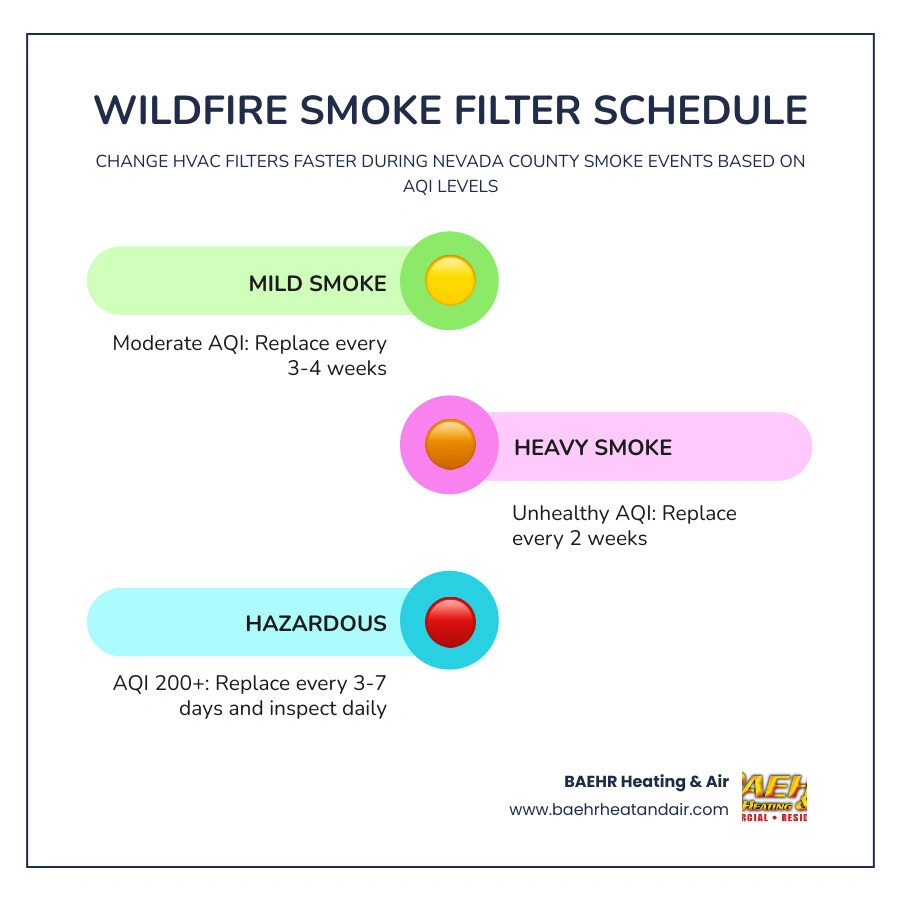
| Mild smoke / moderate AQI | Every 3-4 weeks |
| Heavy smoke / unhealthy AQI | Every 2 weeks |
| Hazardous AQI (200+) | Every 3-7 days, inspect daily |
| Post-smoke event (smell lingers) | Monthly until odor is gone |
Nevada County sits squarely in one of California's most fire-prone regions. Every summer and fall, residents in Grass Valley, Nevada City, and the surrounding Sierra foothills watch smoke roll in — sometimes from fires burning just miles away, sometimes from blazes hundreds of miles off. Either way, that smoke finds its way inside your home.
The problem is that wildfire smoke isn't like ordinary household dust. It carries microscopic particles called PM2.5 — fine enough to slip deep into your lungs and even enter your bloodstream. These particles load up an HVAC filter much faster than normal debris, and a clogged filter doesn't just hurt your air quality. It strains your entire system.
According to researchers at CU Boulder, VOCs from wildfire smoke can also off-gas from surfaces inside your home for weeks to months after an event — which means the job isn't done when the skies clear.
How Often to Change Air Filters During Wildfire Season in Nevada County
If you ask five different people how often you should swap out your filter, you’ll probably get five different answers. During a typical Northern California spring or winter, a standard pleated filter can easily cruise along for 60 to 90 days without a second thought. But when wildfire season kicks into high gear, those rules no longer apply.
Wildfire smoke is a complex, nasty cocktail of carbon monoxide, volcanic-like ash, volatile organic compounds (VOCs), and fine particulate matter (PM2.5). These tiny PM2.5 particles are roughly 30 times thinner than a single strand of human hair. Because they are so incredibly microscopic and often coated in sticky, oily wood resins, they don't just sit loosely on your filter fibers. Instead, they create an oily glaze that seals the filter shut, choking off your system's breathing supply much faster than dry household dust ever could.
During heavy smoke events, you may need to change your filter every 2 weeks to keep your indoor air breathable and your system from choking. If you live in high-exposure pockets of the county or have a busy household with pets, checking that filter weekly becomes an absolute necessity. Regularly replacing your filter is one of the easiest ways to Enhance Indoor Air Quality and ensure your home remains a safe sanctuary when the outdoors look like a scene from an apocalyptic movie.
Why You Must Know How Often to Change Air Filters During Wildfire Season in Nevada County
Neglecting your air filter when the skies turn orange does more than just make your living room smell like a campfire. It places an immense mechanical strain on your heating and cooling equipment.
Your HVAC system is designed to move a very specific volume of air through your home to maintain comfortable temperatures. When a filter becomes caked with fine ash and sticky smoke residue, it acts like a wall. Your blower motor has to work twice as hard to pull air through this barrier, leading to immediate system strain and restricted airflow.
Over time, this restriction can cause your air conditioner's evaporator coils to freeze up in the dead of summer, or cause your furnace to overheat and short-cycle during chilly foothill nights. Beyond protecting your expensive equipment, understanding this maintenance cycle is vital for health protection. Your filter is your home's primary shield against airborne hazards; keeping it clean directly impacts the Indoor Air Quality Importance for everyone living under your roof, especially children, seniors, and those with respiratory conditions.
Guidelines on How Often to Change Air Filters During Wildfire Season in Nevada County Based on AQI
Because air quality can change overnight in the Sierra foothills, a calendar-based schedule isn't always enough. A far more reliable method is to align your filter maintenance with the local Air Quality Index (AQI).
- AQI 0–50 (Good): Stick to your standard schedule. Check the filter monthly, and plan to change it every 60 to 90 days.
- AQI 51–100 (Moderate): If regional fires are active and a light haze hangs over the hills, check your filter every 3 weeks. If you have pets or suffer from seasonal allergies, go ahead and swap it out.
- AQI 101–150 (Unhealthy for Sensitive Groups): Check your filter weekly. Expect to replace it every 2 to 3 weeks, as those fine particles are actively making their way indoors.
- AQI 151–200 (Unhealthy): Check the filter every 5 to 7 days. Change it at the first sign of gray discoloration or if you notice a faint woodsmoke odor indoors.
- AQI 201+ (Very Unhealthy/Hazardous): Under these extreme conditions, check your filter daily. You may need to change it every 3 to 7 days.
By staying proactive and using our Indoor Air Quality Solutions Guide, you can keep your home's air clean and prevent fine ash from settling permanently into your ductwork and carpets.
Environmental Factors Accelerating Filter Clogging in the Sierra Foothills
Living in Nevada County means dealing with a unique set of geographic and environmental challenges that you won't find in coastal cities or flat valley suburbs. The Sierra foothills are beautiful, but they are also incredibly dusty, windy, and prone to rapid seasonal shifts.
First, consider our local soil. Foothill dust is rich in crystalline silica, aluminum, and iron oxides. In the dry summer months, this fine, abrasive dust becomes suspended in the air. Strong canyon winds, like the diurnal breezes that sweep up and down our local ridges, carry these heavy dust loads straight toward your home's exterior vents and window seals.
Second, we are surrounded by agricultural and natural cycles. From local orchard harvests to peak pollen seasons, our air is constantly filled with natural particulates. When you combine this heavy natural dust load with wildfire smoke, you get a compounding effect. The larger dust particles and agricultural debris act as a base layer on your filter, while the microscopic, oily smoke particles fill in the remaining gaps. This mixture creates an airtight brick of debris that ruins airflow.
Whether you are down in the lower elevations of the Grass Valley CA Service Area or nestled among the pines in the Nevada City CA Service Area, these combined local factors mean your filters will always clog much faster than manufacturer guidelines suggest.
Choosing the Best Filter Type and MERV Rating for Wildfire Smoke
Not all air filters are created equal. If you wander down the aisle of a local hardware store, you'll see options ranging from cheap, see-through fiberglass panels to thick, heavy-duty pleated filters. To protect your home from wildfire smoke, you need to understand MERV (Minimum Efficiency Reporting Value) ratings.
| Filter Type / MERV Rating | Particle Capture Capability | Best Used For | Wildfire Smoke Performance |
|---|---|---|---|
| MERV 1–4 (Fiberglass) | Captures large particles >10 microns (lint, carpet fibers) | Basic system protection only | Poor. Allows virtually all smoke and PM2.5 to pass through. |
| MERV 8 (Standard Pleated) | Captures particles 3.0 to 10.0 microns (dust, pollen, mold spores) | Typical residential homes under normal conditions | Inadequate. Does not capture fine PM2.5 smoke particles. |
| MERV 11 (Superior Pleated) | Captures particles 1.0 to 3.0 microns (pet dander, auto emissions, some smoke) | Homes with mild allergies or pets | Moderate. Offers decent protection but will clog quickly during heavy smoke. |
| MERV 13 (High-Efficiency) | Captures particles 0.3 to 1.0 microns (smoke, bacteria, microscopic allergens) | Best residential protection for wildfire smoke and viruses | Excellent. Recommended minimum by the EPA and ASHRAE for wildfire events. |
While a MERV 13 filter is the undisputed champion for residential smoke defense, you must ensure your HVAC system can handle it. Because these filters are woven tightly to catch tiny particles, they also restrict airflow more than lower-rated filters. If your system has an older or weaker blower motor, upgrading to a MERV 13 without checking compatibility can cause your system to work too hard, leading to higher utility bills or motor failure.
If you are looking for ways to bolster your home's defense without overtaxing your central system, Choosing the Right Air Purifier to run alongside your HVAC can provide excellent localized relief. Combining a high-quality central filter with targeted room air cleaners is a stellar strategy for Enhancing Air Quality with Advanced Filtration throughout the entire fire season.
Risks of Neglecting Filter Replacements During Smoke Events
What happens if you decide to ignore your filter during a heavy smoke event? The consequences range from uncomfortable to incredibly expensive.
First, there is the immediate impact on your HVAC system's physical components. When airflow is severely restricted by a dirty filter, the cold air produced by your air conditioner cannot escape into your home. This cold air stays trapped inside the indoor unit, causing the temperature of the evaporator coils to drop below freezing. Before you know it, your system is encased in a solid block of ice, leaving you without cooling on a hot, smoky afternoon.
Second, a clogged filter causes your system to "short-cycle." This means the system turns on, quickly overheats or freezes, triggers a safety switch, and shuts down after just a few minutes of operation. This constant starting and stopping places immense wear and tear on your compressor and blower motor, drastically shortening your system's overall lifespan.
Finally, there is the financial toll. A restricted system has to run much longer to cool or heat your home, which shows up as a massive spike on your monthly energy bill. And because the air isn't being filtered properly, those dangerous Indoor Air Pollutants will simply bypass the filter and settle into your furniture, rugs, and lungs. Remembering that Regular HVAC Maintenance is Important—especially filter care—can save you from costly emergency repairs when local technicians are already stretched thin during fire season.
Frequently Asked Questions About Wildfire Air Filtration
Navigating home comfort during California's fire season can feel overwhelming. To help you stay prepared, we’ve gathered some of the most common questions we hear from local homeowners, along with practical, everyday answers and Essential HVAC Maintenance Tips.
How can I tell if my air filter is clogged?
The easiest and most reliable way to check your filter is the "Hold It Up to the Light" test.
Take your filter out of its slot and hold it up toward the sun or a bright indoor light fixture. If the light passes through the filter easily, it still has some life left in it. If the light is completely blocked, or if the filter media has turned a dark, fuzzy gray or black, it is completely choked with debris and needs to be replaced immediately.
Other telltale signs of a clogged filter include a noticeable drop in the strength of the air coming out of your vents, longer run times for your AC unit, and an increase in dust settling on flat surfaces around your home. Keeping an eye on these signs is a key part of any Homeowners Guide Preventative AC Maintenance plan.
Should I run my HVAC system during an active wildfire?
Yes, but you must run it correctly to avoid pulling smoky air inside.
First, make sure your thermostat is set to Recirculate mode rather than drawing in fresh outdoor air. This keeps the smoky air outside while continuously running your indoor air through your system's filter.
Second, switch your thermostat's fan setting from "Auto" to "On." While "Auto" only filters the air when the system is actively cooling or heating, keeping the fan set to "On" ensures continuous, 24/7 filtration. This continuous movement of air helps capture those stubborn PM2.5 particles and allows you to enjoy the Top Benefits Using Air Purifiers and high-efficiency filtration systems.
Do standard fiberglass filters protect against smoke?
The short answer is no. Standard, inexpensive fiberglass filters are designed solely to capture large debris like pet hair, lint, and large dust bunnies to keep them from damaging your blower motor. They have incredibly loose weaves, which means microscopic smoke particulates and PM2.5 will pass straight through them without any resistance. During wildfire season, using a basic fiberglass filter is essentially the same as running your system with no filter at all when it comes to protecting your lungs.
Conclusion
Staying on top of your air filters during wildfire season is one of the most important things you can do to protect your family's health and keep your heating and cooling system running smoothly. By understanding how local factors like foothill dust and smoke interact with your HVAC, you can make smart, proactive decisions all summer and fall.
At BAEHR Heating & Air, we are proud to serve our neighbors throughout Lake Wildwood, Rocklin, Penn Valley, Nevada City, Grass Valley, Loomis, Auburn, Lincoln, and Truckee. We know how stressful wildfire season can be, and we are here to help you breathe easier. Whether you need help finding the right filter size, upgrading your home's air filtration system, or scheduling a seasonal tune-up, our customer-first team is ready to assist.
To make home maintenance completely stress-free, consider joining our annual maintenance membership, which covers two comprehensive system visits per year to ensure your HVAC is always ready for whatever the California climate throws its way.
Ready to secure your home's comfort and air quality? Explore our Comprehensive Filtration Services or schedule your next check-up directly through our AC Maintenance Services page today!
Ready to breathe easy?
Schedule service or request a free estimate. Honest assessments and upfront pricing on every visit across Nevada County.