

In-Depth Guide to How Rapidly Changing Sierra Nevada Seasons Stress Both AC and Heating Systems
Why Rapidly Changing Sierra Nevada Seasons Are Hard on Your Heating and Cooling System. How rapidly changing sierra nevada seasons stress both ac and heating…
Why Rapidly Changing Sierra Nevada Seasons Are Hard on Your Heating and Cooling System
How rapidly changing sierra nevada seasons stress both ac and heating systems is one of the most important things to understand as a homeowner in this region. The Sierra Nevada experiences some of the most dramatic temperature swings in the country — from freezing winters to scorching summers, sometimes within the same week. Mean annual temperatures have already risen 1 to 2.5°F over the past century, and projections point to an additional 6 to 9°F of warming by 2100. That kind of climate volatility puts enormous wear on both your air conditioner and your heating system, shortening their lifespan and driving up energy bills.
Here is a quick summary of how Sierra Nevada seasonal shifts stress your HVAC systems:
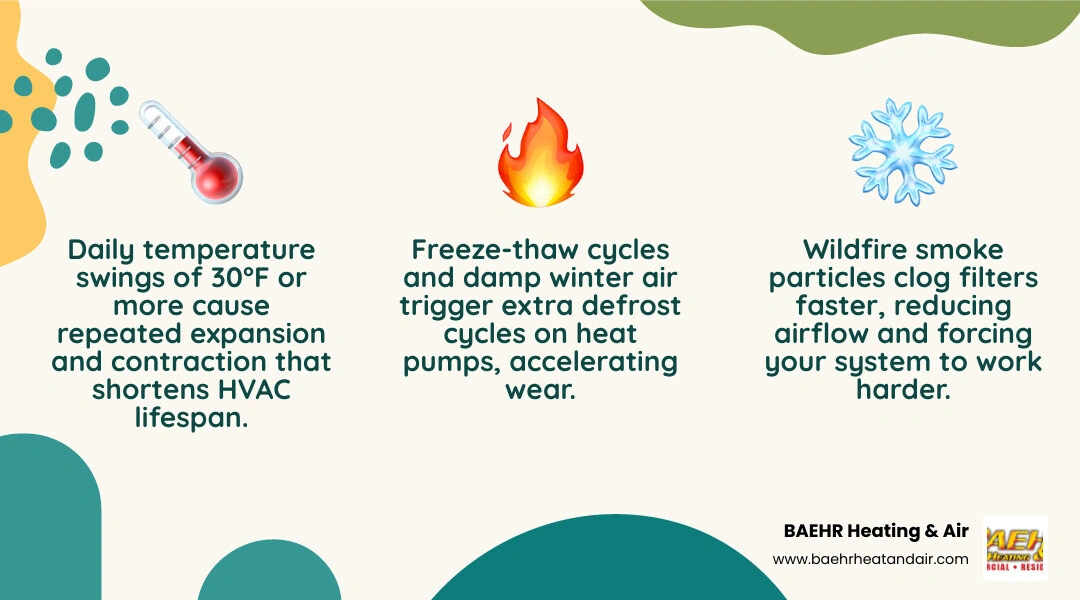
- Thermal cycling stress - Daily swings of 30°F or more cause repeated expansion and contraction in refrigerant lines, seals, and components, leading to early failure
- Extended run times - Hotter summers and longer cooling seasons force AC units to run longer and harder than they were designed to
- Rapid shoulder-season transitions - Abrupt shifts from cold to hot (and back) mean your system must switch between heating and cooling modes with little warning
- Wildfire smoke infiltration - Smoke particles clog filters faster, reducing airflow and straining components
- Damp winter air and freeze-thaw cycles - Moisture-heavy cold spells trigger excessive defrost cycles on heat pumps and accelerate corrosion
- Snowpack loss and soil drying - Changing moisture conditions affect building envelopes, altering the thermal load your HVAC must compensate for
- Altitude effects - At elevations between 2,500 and 6,000+ feet, thinner air reduces system efficiency, especially for cooling equipment
Whether you live in South Lake Tahoe, Truckee, Nevada City, or Grass Valley, your HVAC system is working harder than the manufacturer likely intended — and the climate is only getting more unpredictable. This guide walks you through exactly what is happening, why it matters, and what you can do to protect your home comfort systems.
Climate Shifts: The Science Behind Sierra Nevada Environmental Changes

To truly understand the physical toll on your home's heating and cooling equipment, we have to look at the shifting meteorological baseline of the Sierra Nevada. According to data from California’s Fourth Climate Change Assessment, our region is at the forefront of rapid climate transition.
By the end of the 21st century, temperatures in the Sierra Nevada are projected to warm by 6 to 9°F on average. While a few degrees might not sound like a lot on paper, in a mountain environment, it fundamentally alters how water and air behave. This warming is projected to raise the transition elevation from rain to snow during a storm by approximately 1,500 to 3,000 feet.
As a result, Sierra Nevada snowpacks will very likely be completely eradicated below about 6,000 feet elevation and will be reduced by more than 60% across nearly the entire mountain range. For communities like Truckee, South Lake Tahoe, and foothill areas like Nevada City and Grass Valley, this shift from snow to rain is a game-changer.
Without a sustained winter snowpack acting as a slow-release natural reservoir, several environmental feedback loops are triggered:
- Soil Drying: The loss of snowpack combines to dry soils 15% to 40% below historical norms, depending on elevation.
- Runoff Extremes: Earlier snowmelt leads to increased winter streamflows and high-volume winter floods, followed by dramatic reductions in spring and summer moisture.
- Precipitation Volatility: Deluges and prolonged droughts are both expected to increase markedly, creating massive swings in local relative humidity and ambient temperatures.
For your home, this means the air surrounding your outdoor HVAC units is drier, dustier, and hotter in the summer, yet swings toward highly saturated, heavy moisture during intense winter rain events. Your equipment must be prepared to handle both extremes with very little transition time.
How Rapidly Changing Sierra Nevada Seasons Stress Both AC and Heating Systems
When we look at how rapidly changing sierra nevada seasons stress both ac and heating systems, we have to examine the physical mechanics of thermal cycling.
In our high-desert and foothill microclimates—spanning from the lower elevations of Rocklin and Lincoln up to Loomis, Auburn, Penn Valley, and Lake Wildwood—daily temperature swings of 30°F to 40°F are incredibly common. It is not unusual to wake up to a crisp 45°F morning that requires heating, only for the afternoon sun to push temperatures past 85°F, triggering the need for air conditioning.
This rapid, repetitive switching back and forth is known as thermal cycling. When metal components in your compressor, evaporator coils, and refrigerant lines are subjected to these fast temperature fluctuations, they expand and contract constantly. Over time, this creates a "paperclip effect"—bending the metal microscopically until micro-leaks develop in your refrigerant lines, electrical connections loosen, and rubber seals dry out and crack.
Furthermore, altitude plays a significant role. At higher elevations, the air is thinner. This means there are fewer air molecules available to pass over your outdoor condenser coils to carry heat away from your home. Because the heat transfer process is less efficient at altitude, your air conditioner must run longer cycles to achieve the same cooling effect as a system installed at sea level. This increases the "sensible load" (the actual temperature drop required) on your system, accelerating wear and tear and driving up your monthly utility bills.
If you are trying to navigate these extreme demands, Choosing Between an AC and Heat Pump is one of the most critical decisions you can make to ensure your home remains efficient year-round.
How Rapidly Changing Sierra Nevada Seasons Stress Both AC and Heating Systems During Summer Heatwaves
Summer in the Sierra Nevada has changed. Historically, many mountain homeowners did not even install air conditioning, relying instead on cool overnight mountain breezes to naturally ventilate their homes. However, rising overnight lows mean that homes no longer cool down naturally after hot days.
This trend is compounded by a major modern challenge: wildfire season. When heavy smoke and ash blanket areas like Grass Valley, Nevada City, and Truckee, opening windows is no longer a safe option. Homeowners must keep their homes sealed tight, forcing their air conditioning systems to run continuously to maintain indoor air quality and temperature control.
During these smoky periods, your HVAC filter is your first line of defense. Wildfire smoke is packed with microscopic PM2.5 particles and heavy ash. If you do not upgrade to a high-efficiency pleated filter (such as a MERV 13) and change it frequently, the filter will clog within days.
A clogged filter chokes your system's airflow, causing the blower motor to work twice as hard and overheat. It can even cause the indoor evaporator coil to freeze solid, turning your AC into a block of ice on a 100°F day. This is why understanding Why Regular AC Service is Essential is so important, and why following a Homeowners Guide Preventative AC Maintenance can save you from catastrophic mid-summer breakdowns.
How Rapidly Changing Sierra Nevada Seasons Stress Both AC and Heating Systems During Winter Freezes
While summers are getting hotter, winters in the Sierra Nevada still bring severe, freezing temperatures. The combination of cold air and high moisture levels creates a unique challenge for heat pumps: frost accumulation.
When damp winter air hits the cold outdoor coils of a heat pump, moisture instantly freezes into ice. To keep running, the heat pump must periodically enter "defrost mode." In defrost mode, the system temporarily reverses its cycle, acting as an air conditioner to send warm refrigerant back to the outdoor unit to melt the ice.
Because we experience rapid freeze-thaw cycles in places like Auburn, Penn Valley, and Lake Wildwood, your system may cycle in and out of defrost mode far more often than normal. This frequent cycling reduces heating efficiency, increases energy consumption, and subjects the reversing valve and compressor to intense mechanical stress.
To keep your system running smoothly through these freezing transitions, keeping up with Comprehensive Heating Maintenance and scheduling professional Heating Maintenance Services before the first freeze is essential.
Building Envelope Vulnerabilities: Precipitation Extremes and Soil Drying
Your heating and cooling systems do not operate in a vacuum; they rely entirely on your home's building envelope (the walls, roof, windows, and foundation) to keep treated air inside. However, the environmental shifts of the Sierra Nevada are actively degrading these structural barriers.
With soil drying projected to drop 15% to 40% below historical norms, the ground beneath our homes is shifting. Clay-heavy soils in foothill areas like Grass Valley and Nevada City shrink dramatically when dry and swell when wet. This continuous shifting can cause foundation settling, which in turn cracks plaster, misaligns window frames, and—most importantly—pulls apart ductwork running through crawlspaces or attics.
Leaky ductwork is one of the quietest energy killers in a home. When joints pull apart, your heating and cooling system ends up conditioning your crawlspace or attic instead of your living room, forcing your HVAC equipment to run much longer to satisfy the thermostat.
Additionally, increased precipitation extremes—such as atmospheric rivers delivering sudden, heavy downpours—can overwhelm home moisture barriers. When crawlspaces become saturated, humidity rises throughout the home. High indoor humidity increases the "latent load" on your air conditioner in the summer, meaning the system has to spend more energy pulling moisture out of the air before it can effectively lower the temperature.
In the winter, this dampness makes the air feel much colder, tempting you to turn up the thermostat and put extra strain on your furnace or heat pump. If your system is already struggling with these shifting loads, you might begin to notice Common Heat Pump Problems or find your Heating System Broken right when you need it most.
Practical Adaptation and Resilience Measures for Sierra Nevada Homeowners
While we cannot control the weather in the Sierra Nevada, we can change how we prepare our homes for it. Mitigating seasonal HVAC stress requires a combination of smart home upgrades, passive design elements, and modern equipment choices.
Here are some of the most effective strategies to protect your home and your budget:
- Install Smart Controls: A smart thermostat can be programmed to gradually adjust temperatures, preventing your system from short-cycling during rapid 30°F daily temperature swings.
- Upgrade Insulation & Seal Air Leaks: Adding insulation to your attic and sealing gaps around windows and doors keeps conditioned air inside, lowering the overall load on your HVAC system.
- Transition to Modern Heat Pumps: Modern variable-speed heat pumps are uniquely suited for our climate. Unlike traditional single-stage systems that are either 100% "on" or "off," variable-speed systems run continuously at lower, highly efficient speeds, adjusting dynamically to changing outdoor temperatures.
- Utilize Zoned Systems or Mini-Splits: Zoned systems allow you to heat or cool only the rooms you are currently using, significantly reducing the overall demand on your equipment.
To help you decide on the best path forward, review our helpful guide on the Home Heat Pump Ultimate Guide and learn about Maximizing Efficiency Mini Split Heat Pump systems. And remember, no matter what system you have, practicing Essential HVAC Maintenance Tips is key to long-term reliability.
HVAC System Comparison Table
| Feature | Traditional Central AC & Furnace | Modern Variable-Speed Heat Pump | Ductless Mini-Split Heat Pump |
|---|---|---|---|
| Energy Efficiency | Standard (Single or Two-Stage) | High (Variable-Speed) | Extremely High (No duct loss) |
| Adaptability to Temperature Swings | Moderate (Prone to short-cycling) | Excellent (Adjusts output dynamically) | Outstanding (Zoned room control) |
| Performance at Altitude | Decreased capacity in high heat | Highly efficient year-round | Excellent for targeted zone cooling |
| Wildfire Smoke Protection | Dependent on central duct filtration | Advanced filtration options | Individual room filtration |
| Lifespan in Harsh Climates | 10–12 Years (Without maintenance) | 12–15 Years (With maintenance) | 15+ Years (With maintenance) |
Frequently Asked Questions about Managing Sierra Nevada HVAC Stress
Why is my heat pump entering defrost mode so often during Sierra Nevada winters?
During our wet, cold winters in areas like Truckee and Grass Valley, high relative humidity causes moisture to condense and freeze on your heat pump's outdoor coils. To prevent ice buildup from blocking airflow, the system automatically enters defrost mode.
While this is a normal safety feature, running excessive defrost cycles can indicate a problem like low refrigerant, a faulty sensor, or a failing reversing valve. If your system seems to be stuck in a constant defrost loop, it is best to check for Common Heater Repair Problems to avoid long-term damage.
How does wildfire smoke affect my heating and cooling system's efficiency?
Wildfire smoke is loaded with fine particulate matter (PM2.5) and sticky ash. When your system draws in air, these particles quickly coat your air filter. Once the filter is clogged, air cannot flow freely through your system.
This forces your blower motor to consume more electricity and run hotter, which can lead to premature motor failure. Additionally, ash can settle on your outdoor condenser coils, acting as an insulating blanket that prevents heat from escaping, drastically reducing cooling efficiency. This is why Regular HVAC Maintenance is Important—especially during and after our active summer fire seasons.
Is air conditioning now a necessity in high-elevation areas like Lake Tahoe?
Historically, Lake Tahoe residents could rely on cool night temperatures and open windows to keep their homes comfortable. However, with record-shattering summer temperatures and rising overnight lows, natural ventilation is becoming less effective.
Furthermore, keeping windows open at night is often impractical due to local wildlife concerns (such as active bears) and heavy seasonal wildfire smoke. For many homeowners, installing a highly efficient cooling system or heat pump has transitioned from a luxury to an absolute necessity. If you are wondering how to best prepare your home, understanding Is HVAC Service Really Necessary can help you make an informed decision.
Conclusion
Living in the beautiful Sierra Nevada means enjoying stunning landscapes, but it also means dealing with a climate that is uniquely demanding on your home's heating and cooling systems. From the rapid thermal cycling caused by daily temperature swings to the added stress of wildfire smoke and freezing winter moisture, your HVAC equipment works incredibly hard to keep you comfortable.
At BAEHR Heating & Air, our customer-first team is dedicated to keeping your home safe and comfortable no matter what the weather brings. We proudly serve homeowners across Lake Wildwood, Rocklin, Penn Valley, Nevada City, Grass Valley, Loomis, Auburn, Lincoln, and Truckee.
To help you stay ahead of seasonal stress, we offer an annual maintenance membership that covers two comprehensive system visits per year—ensuring your heating and cooling systems are fully prepared for both the summer heat and winter freezes.
Don't wait for the next extreme weather event to test your system. Contact us today to learn more about our services or to schedule your next seasonal tune-up!
Ready to breathe easy?
Schedule service or request a free estimate. Honest assessments and upfront pricing on every visit across Nevada County.